Countries Take Different Approaches to Controlling Products from Japan's Nuclear-Disaster Zone; Experts Say Risk Communication Is Most Important
Food from five Japanese prefectures banned from import into Taiwan is suspected of having entered Taiwan with "relabeled" origin, indirectly sparking discussion across all sectors about controls on food from Japan's nuclear-disaster zone and its surrounding areas. In particular, amid recent debate over whether the government "plans to open up" imports of food from the five prefectures, Minister of Health and Welfare Chiang Ping-huang has repeatedly said the matter is "under continued study and deliberation," triggering controversy. If Taiwan does open up imports of products from the five prefectures in the future, is the government really ready? And how are other countries currently managing this?
The School of Law at National Chiao Tung University yesterday hosted an interdisciplinary symposium on "Radiation Safety Controls on Food Imports," inviting experts from government agencies, academia and civil-society groups to give reports. The meeting discussed topics including food radiation standards, how various countries regulate food imports from Japan, and the reasonableness of trade rules.
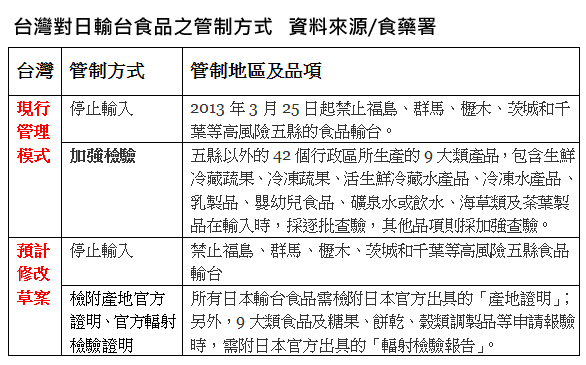
Japan has 47 administrative regions in total. After the Fukushima nuclear disaster occurred, Taiwan banned food from the five high-risk prefectures of Fukushima, Gunma, Tochigi, Ibaraki and Chiba from being imported into Taiwan starting March 25, 2013; for nine major categories of products produced in the 42 administrative regions outside the five prefectures, including fresh refrigerated fruits and vegetables, frozen fruits and vegetables, live fresh refrigerated aquatic products, frozen aquatic products, dairy products, infant and young child food, mineral water or drinking water, seaweed products and tea products, batch-by-batch inspection is carried out at the time of import, while other items are subject to enhanced inspection.
At the request of legislators, the Food and Drug Administration on October 28, 2014 gave advance notice of two draft regulations, namely that food imported into Taiwan from Japan must be accompanied by a "certificate of origin" issued by Japanese authorities; in addition, when the nine major categories of food as well as candy, biscuits, cereal preparations and other such products apply for inspection, they must be accompanied by a "radiation inspection report" issued by Japanese authorities.
But the advance notice period has passed, and to date the measures have still not been formally announced for implementation. This year, because of the incident in which food from the five Japanese prefectures banned from import into Taiwan was suspected of entering Taiwan after being "relabeled," the Legislative Yuan on March 25 passed an interim proposal by Democratic Progressive Party legislator Lin Shu-fen, and Food and Drug Administration Director-General Chiang Yu-mei of the Ministry of Health and Welfare also promised that an announcement would be made within about two weeks.
For more professional agricultural science and technology information, please scan the QR code to follow WeChat: NongXunNET

Please indicate the source when reprinting.