Agri-food integration brings urban and rural areas closer together: historical, cultural, and environmental symbiosis in land art 8
Editor's note: The Echigo-Tsumari Art Triennale, held once every three years, is currently taking place in Niigata, Japan. The author of this article (secretary-general of the Taiwan Historical Resource Management Association) has specially written, for readers unable to attend the event in person, a detailed account of the context in which the Echigo-Tsumari Art Triennale and the Setouchi Triennale came into being and what they present, as well as the impact such artistic actions have brought to the local areas and to Japanese society. This article analyzes how food and agriculture issues can narrow the distance between urban and rural areas; to read other articles in the series, please see the appendix at the end of the article.
────────────────────────────────────────
From Niigata it takes only two hours by Joetsu Shinkansen[1] to reach Tokyo. Transportation has rapidly narrowed the distance between urban and rural areas, but when choosing to hold art festivals in rural areas and remote islands, it is not only the distance between city and countryside that must be considered; the invisible links between the two places also need to be seen. Fram Kitagawa described it this way: "The relationship between the countryside and the city is as close as two people passing a ball back and forth; if the countryside loses its vitality, it will also affect the city's development."[2] And what most attracts people to this back-and-forth exchange between city and countryside is probably "farming" and "food."
In 2004, the old house "Ubusuna-no-Ie" in the Echigo-Tsumari region was severely damaged by an earthquake. When word spread, artists from all over Japan actually volunteered to help rebuild it and design its interior. In 2006, "Ubusuna-no-Ie" reopened, with five local women running a restaurant there. Their home-style cooking, made with local seasonal ingredients, won high praise, and together with traditional "Tsumari-yaki" works made by ceramic artists, the elegant tea utensils and plates used during meals, blended with the old house's setting, embodied the five-senses enjoyment of "food."
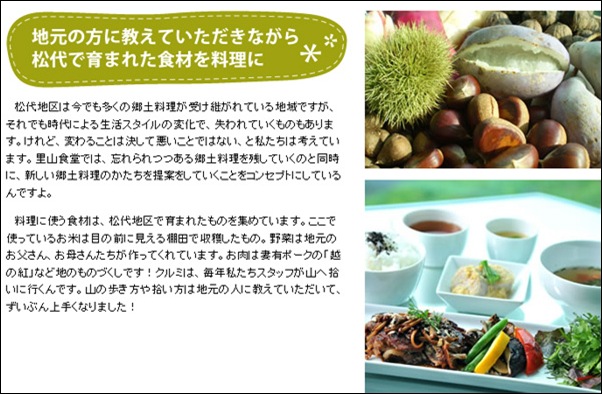
In early 2012, heavy snow continued to fall in Niigata, but the creative cooperation between Tokyo and Echigo-Tsumari in "food and farming" did not stop. The "Okura Daikon and Frost-Fallen Pork Bowl" sold at the Satoyama Shokudo in Matsudai Nohbutai was a dish created jointly by Tokyo's Setagaya Ward and Tokamachi: Okura Daikon is one of Tokyo Metropolis's old radish varieties, originating in Setagaya Ward in southern Tokyo, and paired with Echigo-Tsumari pork and rice, it became a specialty dish created through urban-rural cooperation.
Fram Kitagawa said bluntly: "For a place, landscape and food culture are both very important, but the most fundamental issue still lies in farming and food production."[3] Through the connection of local specialty foods, visitors can stop to taste the cuisine, and this serves as the foundation for large cultural events to invigorate the local economy.
In the past, food was merely set up as an item to "solve demand" at large cultural events, providing generic, fast-food-style meals from elsewhere in response to large crowds, rather than making good use of local agricultural produce and food culture traditions. In fact, wherever one goes in the world, local settlements originally had all kinds of traditions of making, cooking and tasting food, and each place, in response to different local conditions and customs, created dishes uniquely its own. Therefore, if rural and urban areas can be linked from the universal perspective of "food," it will be a true rediscovery of regional characteristics that stays close to the land and residents' feelings.

[1] The Joetsu Shinkansen began operation in 1982 and is the Shinkansen connecting the Pacific side of the Honshu region with the Sea of Japan.
[2] Quoted from this study's February 2012 interview with Fram Kitagawa.
[3] Quoted from this study's February 2012 interview with Fram Kitagawa.
[4] Quoted from this study's February 2012 interview with Fram Kitagawa.
[5] In 2012, the upper floors of the building will reopen as a contemporary art museum, displaying contemporary art inspired by Echigo-Tsumari's climate, environment and local customs, as one of the key projects of the 2012 Art Triennale.
[6] Since 2010, the Taipei City Urban Regeneration Office has proposed the "Taipei Urban Regeneration Station" promotion plan (Urban Regeneration Station; URS). URS13 is one of the bases, a 2.1-hectare bottle cap factory of the Taiwan Tobacco and Liquor Monopoly Bureau in Nangang. In 2011, Helei Art carried out an art regeneration plan, and the concept of "PLAYGROUND" originated from Fram Kitagawa's ideas for the Nangang Bottle Cap Factory.
[7] Quoted from this study's February 2012 interview with Fram Kitagawa.