Egyptian Sacred Ibis Population Explosion Becomes a Nightmare for Native Species
It is nothing unusual to see a flock of egrets following a field being plowed, but will egrets one day be gone, replaced by a flock of Egyptian Sacred Ibises?
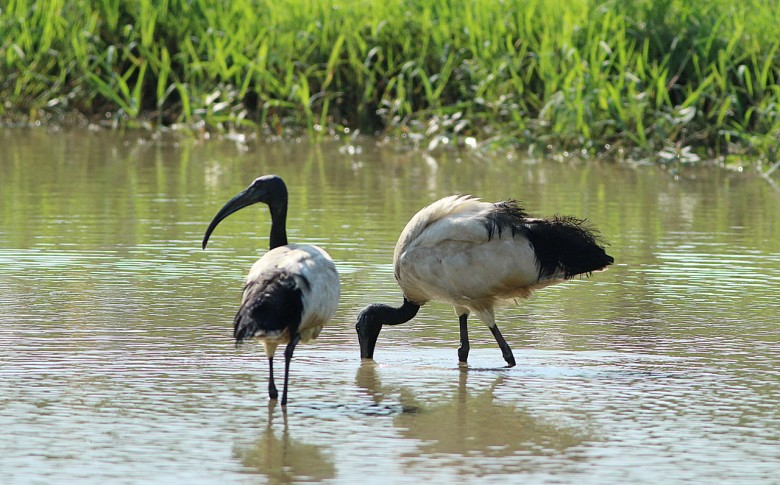
Wu Jialing, who runs the You Tian You Mi farm in Shengou Village, Yuanshan Township, Yilan, found a beautiful bird with a black face, white feathers and a long curved beak in her field in early March. Unexpectedly, after she posted it on Facebook it sparked heated discussion, and when she looked it up online she discovered that this bird, called the Egyptian Sacred Ibis, is not only an invasive species but also "eats meat." She had also seen with her own eyes a flock of Egyptian Sacred Ibises driving off egrets. "I do not know if it was just a coincidence." But the thought that an invasive species might replace a native species still gave her chills.
The Egyptian Sacred Ibis, listed by the European Union as one of the hundred worst invasive species, has already spread along the western coast and in Yilan. Recently the Forestry Bureau will also hold meetings with bird societies around the country, so that the bird societies can join future population control work for invasive bird species; if the public finds traces of them in the fields, they can contact the animal protection office of the local government or a bird society, to help with population monitoring and nest removal work.


Oil-sprinkling strategy ineffective, Forestry Bureau turns to nest competition
Besides the potential harm to egrets and herons, although there is currently no scientific evidence proving that the Egyptian Sacred Ibis causes direct harm to agriculture or fisheries, ways must still be found to control its population, but "how to control it" is the most difficult problem.
At root, the fact that the Egyptian Sacred Ibis can "inhabit" Taiwan is still due to human factors, but indiscriminate culling would likely create a poor public impression. Therefore Yuan Hsiao-Wei, who had accepted a commission from the Forestry Bureau more than 3 years ago and worked with the Chinese Wild Bird Federation, tried mounting corn oil on bamboo poles and then spraying it onto the mangrove canopy, so that it would drip onto the eggshells and block the hatching of the next generation of Egyptian Sacred Ibises, thereby controlling the population, but the actual results were not obvious.
Weng Gongguo, a conservation specialist at the Taipei Wild Bird Society, observed that for one thing the corn oil would be diluted after rain, and for another the Egyptian Sacred Ibis would also scrape off the oil while incubating the eggs. Based on the mudflat at Guandu Nature Park observed by the Wild Bird Society, there was no sense of a decline in numbers.
Yang Hongzhi also said that because the mangroves are up to 5 m tall, spraying is not necessarily accurate or effective. At present the Forestry Bureau has changed to studying a plan based on removing nests. "We cannot completely remove the adult birds, but the best situation is to control the population and stop it from growing further." But it can be expected that labor costs will certainly increase a great deal, "which gives us quite a headache."
Recently the Forestry Bureau will also hold meetings with bird societies around the country, so that the bird societies can join future population control work for invasive bird species; if the public finds traces of them in the fields, they can contact the animal protection office of the local government or a bird society, to help with population monitoring and nest removal work.
For more professional agricultural science and technology information, please scan the QR code to follow WeChat: NongXunNET

Please indicate the source when reprinting.