27% of breakfast shop egg crepe wrappers contained illegal preservatives
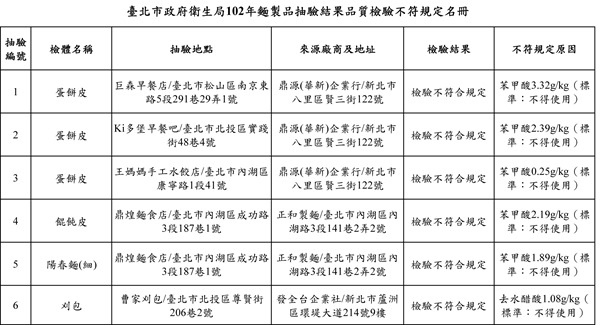
For the sake of convenience and speed, many people often go to neighborhood breakfast shops for breakfast, buying egg crepes and sandwiches to eat. The Taipei City Department of Health today announced the results of a spot check, finding that among 11 sampled breakfast shop "egg crepe wrappers," 3 had illegal added preservatives, with a non-compliance rate as high as 27.3%. The sources were all egg crepe wrappers manufactured and sold to breakfast shops by "Dingyuan (Huaxin) Enterprise Firm" in New Taipei City.
The Department of Health carried out a special spot-check project on noodle products sold on the market. The sampling locations included traditional markets, noodle-making shops, steamed bun and mantou shops, breakfast shops, supermarkets, restaurants, and others. The testing items included preservatives, hydrogen peroxide, borax, sweeteners, and others.
The Department of Health analyzed the results of noodle product spot checks from previous years, and this year specially conducted spot checks on breakfast shops and others that had been sampled less often in the past.
Plain noodles, gua bao, and wonton wrappers also contained preservatives
This spot check and inspection found that among 11 egg crepe wrapper products, 3 had illegal added benzoic acid (a preservative), with a non-compliance rate of 27.3%. Among 63 noodle products and dumplings (including wonton wrappers), 1 wonton wrapper and 1 plain noodle product had illegal added benzoic acid. Among 2 gua bao products, 1 gua bao had illegal added dehydroacetic acid (a preservative). As for the 21 mantou and 3 baozi products sampled, all met the regulations.
The Department of Health stated that for products that fail spot checks, manufacturers or responsible firms will be fined between 30,000 and 3 million yuan in accordance with the Food Sanitation Management Act. For non-compliant products, the Department of Health has notified sellers and purchasing-end businesses to remove them from shelves immediately.
The Department of Health stated that because noodle products, mantou, and baozi are staple foods for the people, the Standards for the Scope, Limits, and Specifications of Food Additives stipulate that preservatives may not be used.
Boil with water, leave the pot uncovered, and pour off the noodle-cooking water to avoid ingesting preservatives
The preservative illegally added in this case, "benzoic acid," commonly known as salicylic acid, easily evaporates together with water vapor; after benzoic acid enters the human body, it can be excreted in urine within 9 to 15 hours. Excessive intake of benzoic acid can irritate the gastrointestinal tract and cause stomach pain, and can also affect the liver and kidneys.
"Dehydroacetic acid" is a white powdered, tasteless preservative. According to regulations, it may only be used in cheese, cheese, butter, and margarine. In cases of excessive addition and long-term intake, animal experiments have found that it may affect appetite and reduce body weight, and affect liver and kidney function and the central nervous system. It is not permitted for use in general foods.
The Department of Health reminds that most preservatives are soluble in water, so noodle products can be steamed or boiled after adding water, and the water should be changed, or food should be cooked without a lid, so that preservatives volatilize with the water vapor and preservative residues are reduced.
The Department of Health calls on the public, when purchasing noodle food products, in addition to buying from manufacturers with good credit, to pay more attention to whether wet noodle products are stored and sold at low temperatures.