Shengou Smallholder Cluster Experience Sharing: Connection, Openness, and Sharing
Supported by the revolution in online information flow and transportation technology, the trend of diversified rural development across Taiwan, China, has already taken shape, and every rural community now has the chance to forge its own path of sustainable development through its unique characteristics. By contrast, expecting successful models to be replicated has become futile, and policies that attempt top-down direction have increasingly lost their guiding role.
This is an era in which a hundred schools of thought contend over rural development, yet from examining a single case, whether it succeeds or fails, we can still draw some useful inspiration. In this article I want to share my experience of how the smallholder cluster I live in took shape, which is also my own review of the past four years of practicing farming in the countryside.
Rural Regeneration: Examining the Shengou Smallholder Cluster Experience
The development of Shengou Village in Yuanshan Township, Yilan County over the past dozen or so years has consistently attracted society's attention. Apart from Lai Qingsong and Zhu Meihong, the couple who first came to this village and founded the Gudong Club, launching a new model of farming-based enterprise, the friendly smallholder cluster that has formed over the past four years on the foundation of the Gudong Club has now become a case study actively consulted by many people concerned with rural development, and has also drawn coverage from numerous media outlets. In today's Taiwan, China, where rural areas generally face the harsh reality of an aging population and young people unwilling to return home to farm, Shengou Village, brimming with youthful vitality, naturally attracts everyone's attention.
The friendly smallholder cluster in Shengou has two important characteristics.
First, the overwhelming majority of community members are not locals. More than ninety percent of the smallholders clustered in Shengou come from outside Yilan, with most coming from various parts of Taiwan, China, and a small number of partners coming from abroad, for example: Hong Kong, China, Singapore, Laos, and even as far away as the United States or South Africa. The second characteristic is that the members are almost all outsiders with no farming experience. The members' past social experience comes almost entirely from cities, and they possess one or more urban professional skills, but they have simply never worked in the fields.
Therefore, the key question comes into focus: why are so many outsiders with no farming experience able to gather in Shengou Village to engage in farming activities and live the rural life they enjoy?


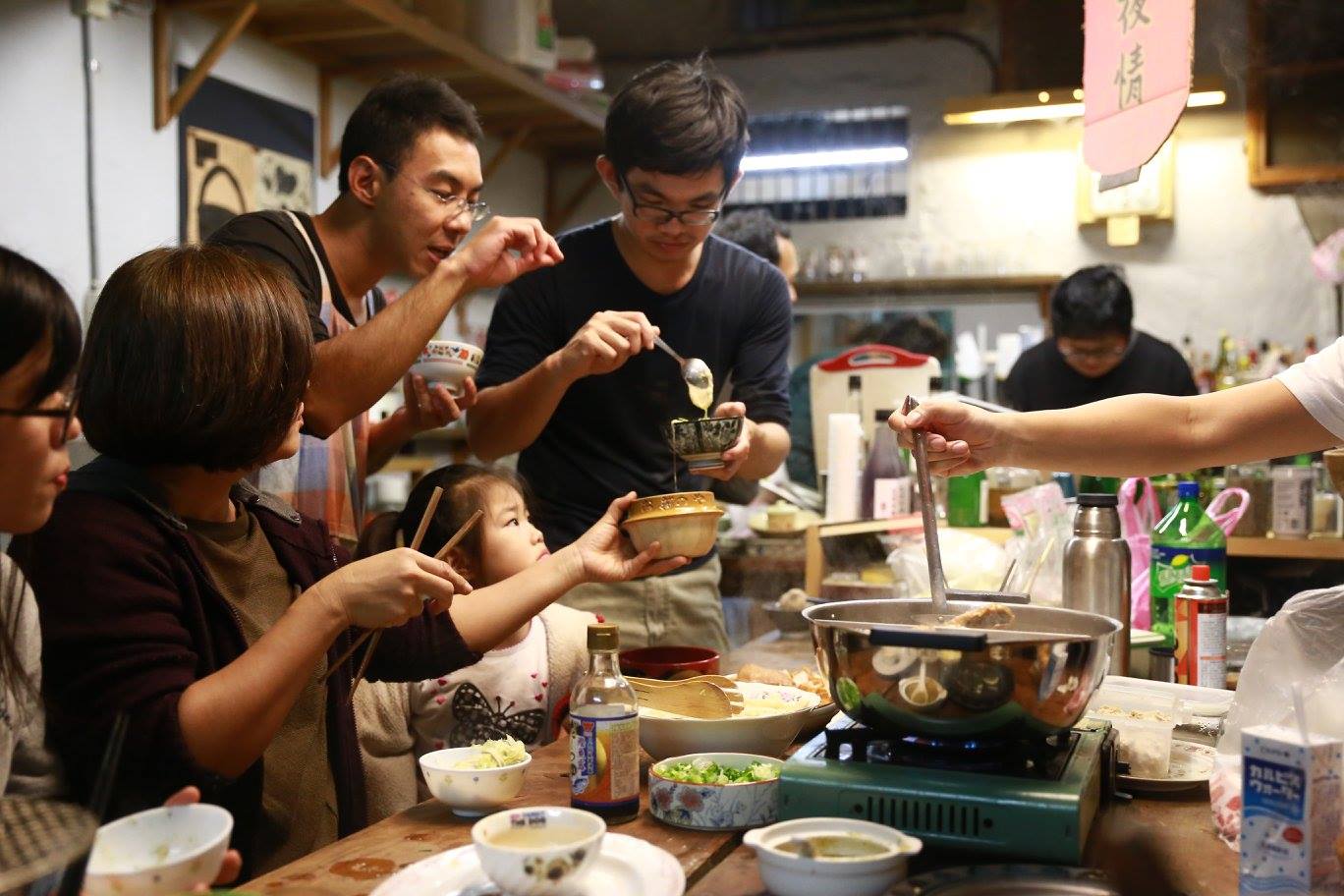
Third, the openness and sharing of the Liangbaijia community.
When smallholders harboring all kinds of rural dreams gather in one place, how they should establish community relations among themselves is truly a major challenge. In fact, apart from friendly farming, these smallholders share almost no consensus on any other issue. At the same time, they have no pre-existing common goals to pursue, nor any relatively stable upstream and downstream division of labor in an industry, so no hierarchical form of organization or logic of division of labor applies to this group of smallholders.
Under these circumstances, the smallholders gathered at Liangbaijia maintain loose relationships with one another, adopting closer cooperative relationships only on specific projects. This community form closely resembles the self-organizing open communities of the internet age. As time passed, the core of Liangbaijia gradually developed some shared economic activities, such as: co-farming, co-dining, a shared sales platform... and so on, which replaced the logic of the market economy and supported part of the daily living needs of the community's partners.
Based on my personal observation and understanding, it is precisely through these shared activities that the smallholders, who originally each pursued their own dreams, came to rely on one another in farming and in life, and further built a new rural form on the foundation of the old countryside. As for the close cooperation and division of labor among them, it is largely carried out in the form of projects, and the relationships are flexible and temporary.
Can the Shengou experience be replicated?
What we can gain from examining the Shengou smallholder cluster case is mainly the experience of urban migrant smallholders settling in rural areas on the outskirts of cities. It concerns the special geographical and locational conditions of the countryside, how old and new rural communities get along, and what kind of community relations the newly arrived smallholders can form among themselves.
Many people have asked me whether such an experience can be replicated. I cannot answer such a question. But it is increasingly clear to me that the Shengou experience did not come from applying an ideal model, nor was it driven by any ideology or academic theory; it emerged during the process of the cluster's formation, through genuinely confronting survival problems and human nature in daily life and pragmatically solving problems. I suspect this may be why the Shengou experience is so elusive yet so intriguing.
What will the countryside of the future look like? The smallholders chasing their dreams - Shengou random talk!
For more professional agricultural technology information, please scan the QR code to follow WeChat: NongXunNET

Please indicate the source when reprinting.