Taipei City spot-checks nutritional lunch ingredients: vegetables at Beitou Elementary School, Wenchang Elementary School, and Shilin Elementary School fail pesticide residue tests
The Taipei City Department of Health conducted random testing of school lunch boxes and food ingredients in the first half of year 104 (2015), and among the samples, the mainland lettuce (edible rape) from Beitou Elementary School, the oranges from Wenchang Elementary School, and the bok choy from Shilin Elementary School were found to have pesticide residues that failed to meet standards, with a failure rate of 1%. The Department of Health stated that because the ingredients were all sampled on the same day, the problematic products had likely already been eaten by schoolchildren; only the oranges, because of the rotating menu, were ordered not to be consumed once the problem was confirmed.
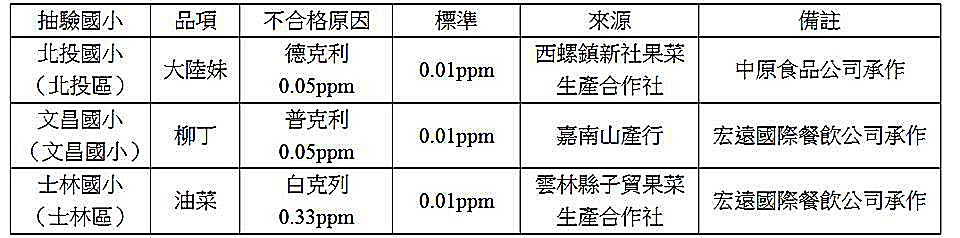
The nutrition lunch samples found to be non-compliant this time were the mainland lettuce from Beitou Elementary School (March 30), the oranges from Wenchang Elementary School (March 27), and the bok choy from Shilin Elementary School (March 27). Among them, Beitou Elementary School was contracted by Zhongyuan Food Company, and the mainland lettuce came from the Xishe Fruit and Vegetable Production Cooperative in Xiluo Township, Yunlin County, where the pesticide dicloran was detected at 0.05 ppm (standard 0.01 ppm).
Wenchang Elementary School was contracted by Hongyuan International Catering Company, and the oranges came from Jianan Mountain Products Company, where the pesticide procymidone was detected at 0.05 ppm (standard 0.03 ppm); Shilin Elementary School was also contracted by Hongyuan International Catering Company, and the bok choy came from the Zimao Fruit and Vegetable Production Cooperative in Yunlin County, where the pesticide prochloraz was detected at 0.33 ppm (standard 0.01 ppm).
This time, 67 lunch boxes, 54 fruit and vegetable samples, 37 meat samples, and 3 noodle samples were drawn; in the fruit and vegetable category, aside from the mainland lettuce, oranges, and bok choy exceeding pesticide residue limits, all other pesticide residues met the regulations. The meat category was tested for veterinary drug residues, and the noodle category was tested for preservatives, hydrogen peroxide, borax, and the like, all of which met the relevant regulations.
For all non-compliant products, the Taipei City Department of Health has notified the schools and required the vendors to remove them from shelves and stop selling them, and has referred the matter to the agricultural authorities to strengthen guidance for farmers on correct pesticide use and to reduce the problem of pesticide residues in fruits and vegetables. However, the sampled ingredients had all been supplied to schoolchildren on the same day and were likely already eaten by them; only the oranges, because of the rotating menu, were ordered by the Department of Health to be removed from shelves immediately when the excessive pesticide residue was confirmed.
The Taipei City Department of Health reminds food vendors undertaking school nutrition lunches that for meat they should purchase products with CAS or various levels of slaughter hygiene inspection compliance labels; for fruits and vegetables, they should purchase products from reputable merchants with certification marks. And according to the contract between the school and the vendor, if violations are found, points can be recorded, and the vendor may even be barred from contracting the following year.
At the same time, the Department of Health also randomly inspected the registration data of 59 lunch box vendors and school kitchens on the "Food Ingredient Registration Platform"; aside from Qiming School lacking a photo of dried tofu with shredded pork, rice, and fruit sources on March 27 with incomplete information, all others were verified as registered, with an accuracy rate of 98%.
The Taipei City Department of Health urges the public, before using fruits and vegetables, to wash the roots and stem ends with running clean water and then soak for 10 minutes, which helps remove pesticide residues; and producers should also use pesticides in accordance with relevant laws and regulations.