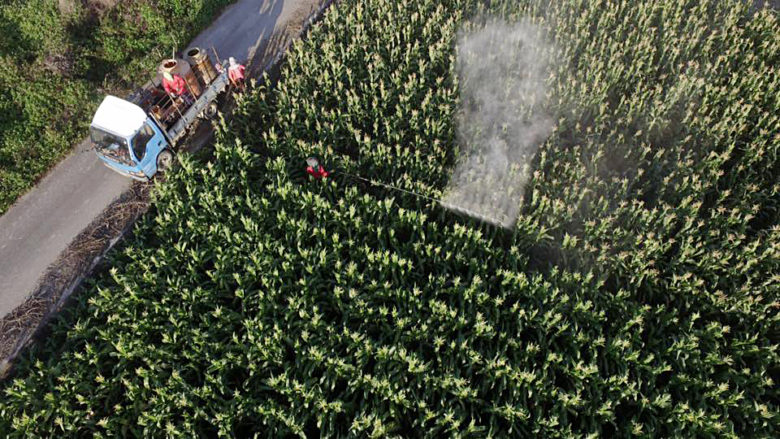
Pesticide spraying contractors exposed to doses ten times over the limit: who will safeguard their health?
Contract spray operators work alongside pesticides every day. A Ministry of Labor report points out that contract spray operators' pesticide exposure is ten times that of ordinary people, and what's more, parathion, a highly toxic pesticide banned 20 years ago, was still detected. They should be the first line of defense for food safety, yet because of crude protective equipment, insufficient knowledge, the lack of government or association safety standards for the work, and no basic labor or health insurance, they not only find it hard to safeguard food safety, but have even become first-line victims.
In 2013, the Institute of Environmental and Occupational Health Sciences at National Yang-Ming University was commissioned by the Ministry of Labor (then called the Council of Labor Affairs) to conduct a "Study on Exposure Assessment of Organophosphate Pesticide Spraying Operations on Cultivated Crops," investigating the organophosphate pesticide exposure of 40 contract spray operators nationwide, among which exposure to "chlorpyrifos," commonly used against rice pests, was the most severe.
A normal person can tolerate 14.8 micrograms per kilogram per day (4.8 μg/kg/day), but the chlorpyrifos dose to which contract spray operators were exposed before work reached as high as 163.54 micrograms, rising to 193.78 micrograms after work, more than ten times that of ordinary people. "Pesticide exposure among laborers poses no acute toxicity risk yet, but there is a chronic toxicity risk, and the highest exposure risk still comes from chlorpyrifos."
In other words, although contract spray operators will not be poisoned immediately from contact with pesticides, it is almost equivalent to chronic suicide. It is just that exactly how much dose, what types, and how much time of exposure will cause physical illness remains completely unstudied in Taiwan, China.
In fact, although contract spray operators are an important cornerstone of an aging rural society, they have long been forgotten by the government and society. Feng Haidong, deputy director-general of the Bureau of Animal and Plant Health Inspection and Quarantine of the Council of Agriculture, admitted that he does not know how many contract spray operators there are or where they are, let alone track and monitor their health, because "we don't know where the samples are."