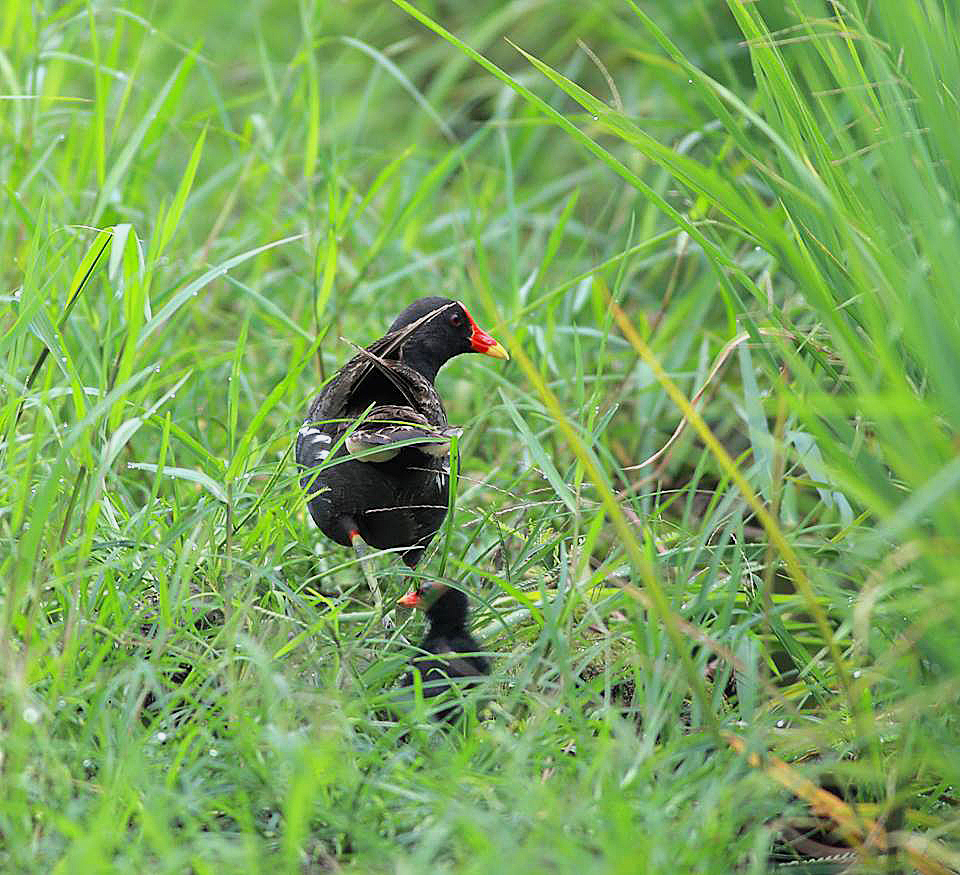
Fallow rice fields become a bird paradise: common moorhens roam the fields
The first rice crop has just finished being transplanted, but this year bird damage is especially severe. In Yilan, the seedlings in 2 tenths of a rice farmer's fields were pulled up by birds such as the common moorhen (Gallinula chloropus), and when the cost of re-transplanting and the additional purchase of bird-scaring equipment are added up, the loss comes to nearly 10,000 yuan, leaving the farmer wanting to cry but with no tears left. And after replanting the seedlings there is no chance to breathe easy: for the five days while the seedlings take root, the farmer still has to patrol nervously nearby to prevent bird damage from recurring and causing further losses, which for a farmer is an even greater source of mental strain.
Most bird damage is caused by rice paddies being next to abandoned fallow land and woodlands, but some farmers and birdwatchers speculate that the worsening bird damage in Yilan may also be related to the influx of farmhouses and the fragmentation of farmland in recent years.
However, because domestic agricultural research and ecological observation rarely address this issue, farmers facing bird damage have no one to ask in order to find a fundamental solution, and can only put up more netting, plant more flags, and step up field patrols to defend their "property." Lin Hseuh-shih, director of the Taichung District Agricultural Research and Extension Station, who once studied bird damage in millet fields in Taitung, also said that agricultural research units only have experts in plant diseases and insect pests and lack researchers specializing in bird damage, so when farmers run into problems, researchers mostly have to start observing from scratch.


Little domestic research on bird damage makes it hard to prescribe the right remedy
However, because there has been very little domestic research targeting the bird damage problem, Lin Che-an and Wu Jialing can currently only speculate based on field observations; Lin Hseuh-shih, who once studied bird damage in millet fields in Taitung, also said that agricultural research units have no bird researchers, and 3 years ago, in order to develop a "solar-powered walking bird scarer" to solve the plight of Indigenous people who had to station themselves in the fields for months to scare off birds when growing millet, the station's researchers spent more than half a year observing and recording before they could sum up what different habits the various birds roaming the fields have.
Lin Hseuh-shih said that aside from research units doing very little research on bird damage, different birds have different habits, so farmers' methods of scaring them off should also adapt accordingly. For example, the "solar-powered walking bird scarer" they researched back then was only effective against grain-loving birds such as sparrows and munias; driving off geese, ducks and waterbirds would require other methods, and all of these must be built on how much researchers understand about animals.
On this point, Wu Jialing said, "In the future, besides studying birds' behavior in the environment, scholars should also focus more on their behavior in farmland, and at the same time incorporate farmers' first-hand local experience to find solutions."
Lin Fang-yi, who is both a farmer and a wildlife scientist and is currently carrying out the "Science in the Fields Project" in Yilan, said that the common moorhen is an omnivorous animal; besides loving to eat tender plant leaves, it also eats invertebrates, and one more possible reason for the severe bird damage in Yilan this year is related to a decrease in animal-based food sources. However, there is currently no scientific evidence showing this, and moreover some fields have common moorhens yet the bird damage is not severe, so no arbitrary speculation can be made.
Fortunately, however, after the golden apple snail dispersal project came to a stage-wise end, the "Science in the Fields Project" team will begin this year conducting a census of the common moorhen in the Shen'gou and Neicheng areas of Yilan. "We will scan fixed points and record the locations where common moorhens appear on a map; only by opening up discussion through spatial distribution will it be possible to find control methods."