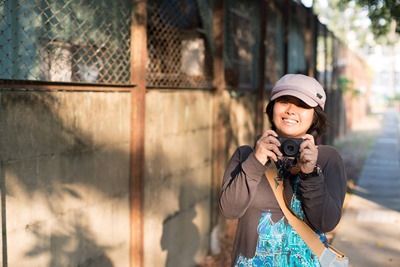
City Dialogue founder Qiu Yixuan, who grew up in the Xiluo Fruit and Vegetable Market
The current manager of Siluo Road Station is Hsu Feng-lin of the Public Welfare CEO Association. He brought in the "Urban Dialogue" team, which had previously launched the "Three Little Markets," to jointly carry out this Food Ingredient Nanny Friendly Distribution Channel Project. Chiu Yi-hsuan, born in the 72nd year of the Republic of China (1983), is one of the founders of "Urban Dialogue" and a child who grew up in the Siluo Fruit and Vegetable Market, raised collectively by the two or three hundred people there.
Chiu Yi-hsuan, who once worked at the National Property Administration, already used the "GAP (Good Agricultural Practice) Certification Mark" as her research topic in a high school science fair. She is now very interested in how the US aid period influenced Taiwan's agricultural development. "In the 1960s, Taiwan still had a 102% food self-sufficiency rate, but now only about 30% remains."
In 2012, Chiu Yi-hsuan and like-minded friends launched the Three Little Farmers Learning Market, hoping to educate the public from everyday life aspects related to agriculture, on one hand changing the agricultural ecosystem from the consumer side, and on the other hand serving as a guide for the public to understand agriculture. At the end of 2013, after the Three Little Market gradually stabilized, Chiu Yi-hsuan and her partner Wei-hsiang left to create "Urban Dialogue" separately.
If Mazu Temples Could Promote Food and Agriculture Education

Looking back at Taiwan, Chiu Yi-hsuan sometimes asks herself whether this is an illusion, but she often feels that current agricultural policy is killing agriculture. Cases of polluting industries being set up in prime agricultural areas are heard from time to time, and even in the government-promoted 12-year compulsory education, vocational education related to agriculture, animal husbandry, and food service is also being squeezed out. "So, the goal our Urban Dialogue team is working toward now is to let Taiwan's agriculture show its true colors."
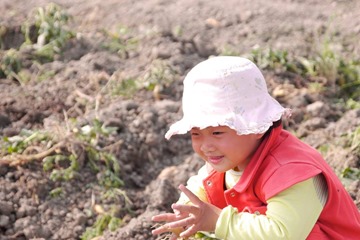
Thus, "Urban Dialogue" holds parent-child co-learning agricultural experiences from time to time. In its cooperation with Siluo Road Station in Yunlin, besides the Food Ingredient Nanny Project that matches friendly farming distribution channels, there are also activities for leading the public to make leaf compost and build sheep pens. Chiu Yi-hsuan said: "Some neuroscience research points out that concrete houses carry toxic ions, but if we step into the soil and get close to nature, the ions in our bodies will be adjusted. For children, the farming experience can also stimulate their peripheral nerves."
Chiu Yi-hsuan said earnestly that as for the harm industrial pollution does to agriculture, the situation in Yunlin is relatively well known, which also means there are still many unknown cases across Taiwan. The promotion of the Food Ingredient Nanny Project is precisely meant to use gatekeeping over agricultural products to start reversing Taiwan's agricultural ecosystem from the consumer side.
(This article was sponsored by the Jianzhen Environmental Education Foundation for personnel funding, but it completely did not interfere with news topic selection or interview writing, ensuring news independence.)