What do economists usually eat for lunch?
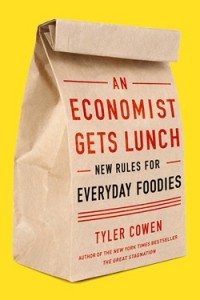
This fun and excellent book "An Economist Gets Lunch: New Rules for Everyday Foodies" (An Economist Gets Lunch: New Rules for Everyday Foodies) is by author Tyler Cowen. His previous book was "The Great Stagnation: How America Ate All the Low-Hanging Fruit of Modern History, Got Sick, and Will (Eventually) Feel Better" (The Great Stagnation: How America Ate All the Low-Hanging Fruit of Modern History, Got Sick, and Will (Eventually) Feel Better) (see "The Great Stagnation: When the Low-Hanging Fruit No Longer Hangs Low").
He holds a PhD in economics from Harvard University and currently teaches at George Mason University in Virginia, USA. The British magazine The Economist once named him one of the "most influential economists" of the past decade. His highly popular blog "Marginal Revolution" ranks second on the nationwide economics blog readership chart.
In "The Great Stagnation", Cowen argues that the biggest problem facing the American economy today is one that neither the left nor the right has yet seriously confronted. That is, over the past 300 years they have already scooped up all the "good stuff", yet American society and economy were entirely built on the expectation of "endless good stuff to scoop up". But the good stuff had long since been scooped down to almost nothing.
A delicious bargain worth eating at every meal
 Americans really love Mexican food (photo: http://www.flickr.com/photos/jpellgen/4408941853/)
Once, our lab discussed dining-out landmines. The worst restaurant I ever ate at was a Korean restaurant, where every slice of the mountain of Korean barbecue tasted like a block of wax. The US actually does have good and authentic Korean food, in Korean-populated communities, with no English menus at all, where you can only point at photos to order, and the owner and his wife's English is so poor they can't even understand "water" XD The worst restaurant my PhD advisor and his wife ever ate at was a Filipino restaurant. But oddly enough, although the US clearly has many Southeast Asian immigrants who are Filipino (because it once colonized the Philippines), I have almost never seen a Filipino restaurant in the US, which makes me quite curious about Filipino food, yet even the one super inconspicuous one in town was a major landmine XD
Although Japanese cuisine in the US is not cheap, our town has an all-you-can-eat Japanese sushi restaurant, run by Chinese people, not authentic at all, yet even Japanese people love it XD There is all-you-can-eat shrimp roe and salmon roe sushi, fried soft-shell crab and California rolls. But the favorite of one American assistant in our lab was actually the stale sashimi still covered in ice crystals at another empty all-you-can-eat Japanese restaurant across the street! This shows that American taste really is...
Speaking of Asian cuisine, of course Chinese food cannot be left out. But Chinese food in the US has had its reputation ruined by cheap fried rice and fried noodles, making Americans think that even Thai food is more profound and extensive than Chinese food. San Francisco's Chinatown also has a bunch of Chinese restaurants that fool foreigners, which we avoid like the plague; to eat well you have to go to the suburbs or the big supermarkets. Like Cowen's experience, the best Chinese restaurant I ever ate at in the US was a Sichuan restaurant, truly excellent!
Praise for Japanese and Singaporean cuisine
As an economist, Cowen inevitably discusses agricultural food issues and environmental issues. He believes that although there are indeed unscrupulous companies messing around recklessly, blindly opposing GMOs is irrational! I feel the same way; although GMOs do carry certain risks, what under the sun is zero-risk? When the train was invented, many people opposed it for all sorts of strange reasons; even now some people are driven by government and consortiums to lie down on the tracks, trains also derail by accident causing heavy casualties, and the noise trains make is also a headache, yet today who fears trains? Some GMOs are indeed useless for yield, but if there are salt-tolerant and drought-tolerant GMO crops that increase arable land, we could feed more starving people!
Tasting local cuisine is one of the greatest joys of travel. In "An Economist Gets Lunch", Cowen highly praises Japanese cuisine. As far as eating goes, Japanese people really are super fortunate; travel to Japan and you can eat good food just by eating anywhere, so I really suspect that the food-loving Cowen was a Japanese person in a past life XD Cowen is also quite fond of Singaporean cuisine, and even explains that Singapore, because of its hawker centre system, creates cheap and excellent food.
However, if Cowen really loves Singaporean cuisine that much, he would surely get a nosebleed if he went to Malaysia! Because everyone in Singapore and Malaysia knows that once you get to Malaysia, what we eat is almost exactly the same, yet the price is only half or even one third of theirs! Malaysian cuisine, through the exchange among Chinese, Malay, Indian, Thai and other ethnic groups, blooms in a hundred flowers! Singapore was once a state of Malaysia, and many of those making cooked food in Singapore are Malaysian immigrants; everything they have, we have all of it! And because Singapore has the world's strictest hygiene regulations, the same items still lose to Malaysia in deliciousness, so the CP value is definitely at least three or four times that of Singapore!
When it comes to eating, we are absolutely living in the happiest place in the happiest era! What to eat at noon? Everyone has their own opinion, so why not really see how this economist explains it all in detail!