A little trip to Mao'ao: savoring the slow pace of a simple fishing village
A bay quietly took in a group of people. They lit lamps in the dim night, and so this place came to have a name.
"Mao'ao," by one account, comes from the Pingpu language and means "great ship," referring to the first people who came ashore; by another, it is because the bay faces the island where the sun rises earliest at the hour of mao; and by yet another, the left stroke of the character mao is Mount Lailai at Sandiao Cape, while the right stroke is Mount Laolan, the two undulating like rabbit ears as they accompany the bay and nourish the streams that slip down into the village.
"Rongshu Creek, Zhuzhao Creek, Kengnei Creek": a settlement lodged beside the blue salt water nonetheless enjoys the convenience of abundant fresh water. The people of Mao'ao took in the richness of both mountain and sea, and in time carved out terraced fields and made their catches, creating the settlement's finest hour. Once, along Zhuzhao Creek, the place was full of shops, rice, cloth, sundries, pork stalls……, because the Black Current flowing past created fishing grounds, and the seafarers of Mao'ao could easily return with a full haul; until the 1960s, when Taiwan's manufacturing industry rose and the fishing grounds were taken over by townships in the south, Mao'ao's abundant catch and trade earned it the title "Little Keelung."
"Liyang Temple" stands on the north side of the settlement, known locally as the temple entrance, and enshrines the only Guanyin in all of Taiwan, China holding a fish basket. Mao'ao has people, and the gathered people sought the gods' favor for their varied hopes of happiness; the greater the happiness, the grander the temple, and the gold-and-silver gleaming statues are set within a vast hall. Looking up, I knew that the incense had been lit a hundred years ago, and it has witnessed the harbor go from glory to loss. Today's Liyang Temple looks enormous within the little fishing village, just like Mao'ao Harbor across the street, where now only a few small boats are moored, making the towering concrete around it look like walls that trap freedom rather than dikes that guard against wind and rain.

I decided to come to Mao'ao because I had decided to return to the sea. Five years ago, on an impulse, I, who had grown used to living in the mountains, plunged abruptly into the ocean, because I believed that a person should not have only a face on land, and so with a certain passion and stubbornness, I overcame my fear of water and dove into the sea day after day to explore the blue world. But then, over more than a thousand days of rushing about and moving between places at home and abroad, facing Taiwan's sea again brought a sense of long time no see, and so I found an afternoon, took out a detailed map, and traced my finger along the Northeast Coast, reading out and checking one small place name after another: "The scenic Mao'ao Bay, with clear water to the bottom, has even been praised by divers as Taiwan's snorkeling paradise." Though such words must carry some possibility of exaggeration, after surveying the surrounding situation, I still resolved to go and take a look. This small bay, not exactly convenient to reach, hinted that I ought to stay the night here and enjoy both the day and night of a single sea.

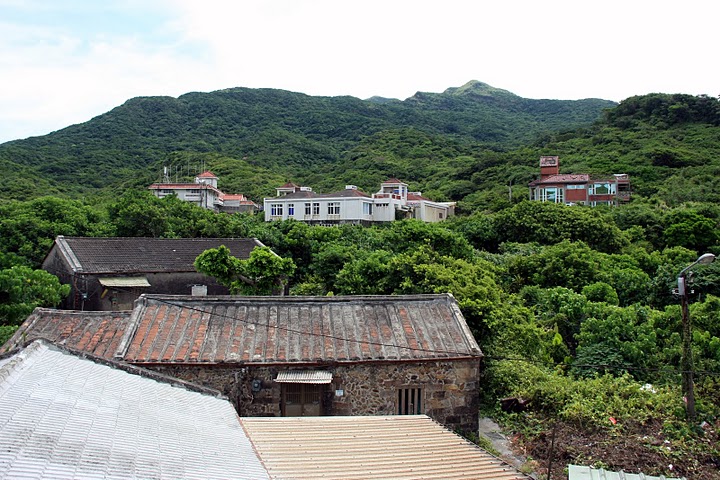
On first impression, I liked Mao'ao. A quiet little fishing village with clean, clear outlines; though old and new houses are mixed together, as long as you slow your steps, you can discover the bright spots where old times spread outward.
Stone houses are one of Mao'ao's local features, and the Wu family's two-story house is especially eye-catching; its two-story height proves the economic capacity and social standing that had to support it in that era. Though it is now abandoned and collapsing, its scale and appearance still make it impossible to easily pass by. Apart from the Wu family house, the other old houses, along with the power of the sea breeze and "modernization," have either completely disappeared or been half-new and half-old, swallowed into cement extensions. I will not read such changes of the times with feigned sentimentality; I love settlements where people are alive, and when people are alive, all things are changing, just as those who read the landscape are also people, and how one reads is in fact the traveler's own lesson, not that of these quiet objective things that display themselves. Walking a circuit through the small town, some people see only jumbled buildings, yet overlook before their eyes the traditional techniques of rubble masonry, horizontal coursing, and herringbone stacking, which with their mottled bodies speak of decades of feeling toward the sea.


Because of out-migration, the settlement of Mao'ao now has mainly only the elderly and young children left. There are two or three buildings that look newer, seemingly bought and built by outsiders, but fortunately these houses all show enough sincerity and aesthetic sense to blend quietly into the village. Mao'ao is not large, but there are a few small trails for strolling, whether toward the left or right side of the bay. Walking at ease, with the sea breeze in your face in the evening, what is called a holiday and relaxation should not be built on luxurious material things, but on being able to encounter just such a perfectly measured sum of the senses.
Mao'ao Station, a restored stone house combining a coffee shop, homestay, and restaurant, sits right on the sea-facing plaza at the center of the settlement, visible at a glance. It is run by Xiaomei, a local daughter-in-law. At first I was not sure whether the station was open, but after stepping in I was truly amazed; the small space has everything, and the atmosphere is not even inferior to a restaurant setup in a big city. Here you can have a meal, cold drinks, and even shaved ice! The prices are also very modest. This is also where the community development association is located, so there are quite a few displays about marine life and settlement history. Mao'ao Station was a surprise I had not expected; for this declining fishing village it expresses a simple yet steadfast strength.
Two kilometers north of Mao'ao, you reach Magang, famous for its rich intertidal zone; six kilometers south is the crowded Fulong. When I first chose to come here, I once considered that if it were too desolate, I could go to Fulong to restock supplies. But it is precisely this excellent location and scenery that led the Northeast Coast Administration to plan a bicycle path, to be completed by the end of the year and passing through Mao'ao. Will the little fishing village's tranquility change? Or can passing crowds create another spring for the settlement? Facing the imagined incoming impact from outside, I am curious how this small village, which has known both great rises and great falls, will face it.

Diving into Mao'ao Bay was the main purpose of this trip. I did so on the afternoon of arrival and again the next morning, taking off the clothes of a land animal, putting on fins, and begging this ocean to take me in. But unlike the pleasure of strolling through the settlement, my mood grew heavier the closer I came to the sea.
Fulian Elementary School, which uses swimming across Mao'ao Bay as its graduation ceremony, has a tidal pool in front of its playground. Because it is surrounded by reefs and has small waves and shallow water, it is the most suitable place for non-swimmers to play in the water. When I arrived, this remote elementary school in the little-visited settlement of Mao'ao nonetheless had a dozen or so cars parked on its playground. It turned out that Fulian Elementary School opens applications for weekend camping, so experienced campers call up friends and come here on weekends to barbecue and play in the water. Yet the tidal pool is only waist-deep, and as a result of everyone trampling it, not a single coral has been spared. As for the creatures, it is also a matter of luck whether these tourists choose to release them after collecting them.
I thought my astonishment would end there, but an even more incredible sight came the next day when I entered the water again: I actually encountered divers driving a truck loaded with buckets coming here to "spearfish." These divers were fully equipped, and probably also knew that Mao'ao Bay was "rich in resources," so the group went into the sea in a professional manner to sweep it clean.
This is the most unbearable scene a diver can encounter: imagine sea creatures waiting day after day to grow up, and once grown they must face slaughter. Appearing along the coast on this scale, plundering seafood and reselling it to seafood stalls along the road, seems already to be a convention on the Northeast Coast. I feel sorrow for the creatures roaming near Mao'ao Bay, but even more sorrowful is human greed. From the time I first became fascinated with freediving five years ago, I had already come to appreciate Taiwan's "spearfishing" spectacle.
Of course, if the loss of one life is for the continuation of another, it can be called natural selection, but when the sea is willing to give, at which fish will human greed finally be satisfied?

There is another account of the origin of the name Mao'ao, and it is the most unbearable explanation when set against today's situation. "Mao" in Minnan means "to make a profit," and because the catch here was abundant, anyone could make a profit here, and so it was called "Mao'ao."
This is a bay that quietly took in a group of people.
Now, the barren still feeds them.