Inspection of New Year's dish delivery and home delivery: few restrictions, corrections instead of fines, feeling unafraid; Food and Drug Administration special audit
Temperature loss during low-temperature home delivery is severe. Yesterday (the 9th), the Consumer Protection Committee of the Executive Yuan invited the Office of Food Safety, the Food and Drug Administration of the Ministry of Health and Welfare, the Directorate General of Highways of the Ministry of Transportation and Communications, experts and scholars, and logistics operators to jointly discuss countermeasures.
Wang Deming, Senior Consumer Protection Officer of the Consumer Protection Committee of the Executive Yuan, stated that four logistics operators promised to improve. "T-cat" (Black Cat Home Delivery) promised to establish a wireless monitoring platform, a delayed flameout system device, and vehicle tracking reports; "Taiwan Pelican" stated that it would strengthen personnel control and mechanical improvements, and increase spot checks on business stations; "Kerry TJ Logistics" and "Hsinchu Logistics" also responded that they would work hard to improve equipment and personnel.
Chen Xincheng, Chief Secretary of the Food and Drug Administration, also stated that inspections would be strengthened as circumstances warrant, and promised to carry out special audit work on the distribution of New Year's dishes at the end of the year, reviewing improvement results. If operators remain non-compliant, heavy penalties will be imposed under the "Act Governing Food Safety and Sanitation," with a maximum fine of 200 million yuan; it is even possible that operators will be ordered to suspend business in accordance with the law.
Too few inspections, only 3 times to date
"In the past, if goods deteriorated, we always thought it was a problem with the products at the shipping end. It was only in recent years that we realized the loophole was actually in logistics." Even the samples that the Consumer Protection Committee itself wanted to send for testing deteriorated because the logistics delivery temperature was too high, and only then was the seriousness of the problem discovered. In May of this year, proactive inspections were conducted. But Wang Deming admitted that from 2014 to date, the Consumer Protection Committee has inspected home delivery only 3 times, because there are too many cases requiring inspection, making it impossible to regularly inspect logistics operators.
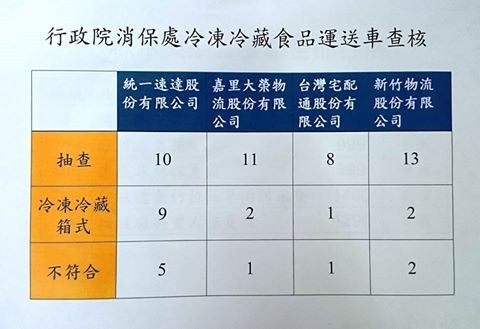

"Improve within a deadline" rather than "immediate penalty" makes operators fearless
The competent authority for the logistics industry is the Food and Drug Administration, which must comply with the "Regulations on Good Hygiene Practice for Food (GHP)." According to GHP regulations, violations by operators are not directly penalized; instead, they are first required to "improve within a deadline," and as long as a re-inspection passes, the case can be closed. But despite continuous problems with low-temperature home delivery, as of today, the relevant authorities have issued only one fine of 60,000 yuan in Hsinchu in 2015.
In contrast, other cases violating food safety law, such as nutrition labeling, where components like sodium, sugar, and fat are not fully labeled as required or are falsely labeled, under relevant provisions of Article 22 of the "Act Governing Food Safety and Sanitation," as soon as they are discovered, operators can be directly fined 30,000 yuan to 3 million yuan, or 40,000 yuan to 4 million yuan. Since food safety is equally affected, why is the logistics industry not immediately penalized?
Chen Xincheng responded that inaccurate food labeling directly affects consumers' right to know and may immediately harm consumers' health and safety, so direct penalties are required. However, food quality and environmental hygiene still have room for improvement. "Sometimes an operator merely has an extra puddle of water on the floor. If directly penalized, it would not conform to the principle of proportionality."
But non-compliant logistics operators are always caught in a cycle of "failed inspection," "improve within a deadline," "re-inspection passes," "case closed." And at the next inspection, if they fail again, a new case is opened, again requiring "improvement within a deadline." Can it be that operators who repeatedly fail can only continue to "improve within a deadline," with no heavier penalties, blacklisting, or other administrative sanctions?
Chen Xincheng responded that at this stage, they can only work with the Consumer Protection Committee to issue "consumer alerts" in the media, reminding consumers to be aware of specific operators. In addition, discussions are currently underway on whether a specific company that repeatedly fails can be directly penalized or given heavier sanctions; within the short term, the Food and Drug Administration's regional management centers and food division will further discuss this.
Operators: The frozen standard of -18 degrees C is difficult to implement; hope for adjustment
In today's review meeting, operators also pointed out one after another that the currently stipulated frozen standard of -18 degrees C is difficult to implement, and asked whether the frozen standard could be adjusted.
In response, Zhang Zhengming, Associate Professor of the Department of Food Science at National Taiwan Ocean University, pointed out that internationally there are indeed examples of a frozen standard of -12 degrees C, "but this is the standard for long-distance transport of frozen food in mainland China." The transport distance is longer and there are fewer stops; but Taiwan has more stops, so whether it can be applied remains to be discussed.
Chen Xincheng also responded that, on the premise of not affecting food safety, he is willing to respect the industry's views, but if operators have difficulties in implementation, they need to provide management data, and he also promised to work with experts and scholars on relevant research. As for whether to amend the current management regulations and to what temperature they should be revised, he is willing to discuss from multiple sides.