The only inheritor of the ancient soil mortar manual rice-making craft is a top student from Jiaotong University.
Strip away the golden, straw-colored husk from the rice ears and they become grains of brown rice ready to eat; with modern rice-milling technology, this is easily done with the push of a button in just three minutes. But if you order the "tu-long rice" he grows himself from Lai Yung-hua, a young farmer in Dananpu, Miaoli, he has to spend two hours working with both hands and feet, drenched in sweat, pulling the tu-long (a traditional wooden rice huller) he built with his own hands, just to produce one bag of fine handmade rice.
A graduate of the Department of Photonics at National Chiao Tung University, he went into farming and runs "A-Hua Tien"
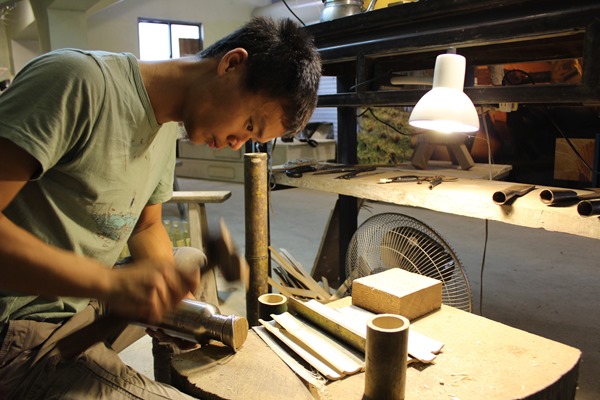
"Everyone else buys machines - who else but me is still using a tu-long? I must be crazy!" Lai Yung-hua, 27 this year, graduated from the Department of Photonics at National Chiao Tung University and has never spent a single day working at a tech company. Instead, in Dananpu, only an hour's drive from the Hsinchu Science Park, he has become the youngest tu-long maker in all of Taiwan, China. He learned from 83-year-old veteran tu-long maker Lin Yu-hsiang, spending three months splitting bamboo strips, weaving bamboo, ramming earth, and arranging the huller teeth to build his own tu-long with his own hands, and uses it to mill rice from his own "A-Hua Tien" crop.
"Milling rice in summer, I have to rest and drink water after pulling for ten minutes before I can keep working - it's just too hot!" Having converted an empty room in the temple where he is staying into a tu-long room and granary, Lai Yung-hua pushes the tu-long with all his might amid the chanting of the monks. The tu-long looks light and delicate with its bamboo weaving, but inside, its huller teeth are rammed solid with red clay so that the rice husk and the rice grain can be precisely separated. When pushing it, you cannot simply pull with both hands by brute force; you have to pull with your waist to apply the force, stepping with both feet as if dancing, so that the rice can pass through the tu-long and leap out.
"The red clay pattern inside the tu-long determines the quality of the tu-long." Lai Yung-hua explains that when the tu-long rotates at high speed, if the pattern is not fine and dense enough, the rice grains are likely to slip out of the tu-long before being hulled, causing the milling to fail. "My master's pattern is much denser than mine. The quality of my machine isn't that good - the milling yield is only about 95%."
Frowning as he examines the "yield" of the new rice, Lai Yung-hua's engineering background still makes him occasionally blurt out technical terms, but his lean, dark, and sturdy appearance is now completely that of a rural youth. "In my junior year I started going into the lab for special-topic discussions, and I felt I didn't like that kind of life, and I wasn't interested in going to work at the Hsinchu Science Park either."

(This article was funded by the Jianzhen Environmental Education Foundation for personnel costs, but the foundation does not interfere at all with news topic selection or interview writing, ensuring news independence.)