Home › General News › Article

African Swine Fever Strikes 10 Provinces and Cities in Vietnam; Thai Scholar Takes On the Fight; Thai Airways 9 Flights Subjected to Hand Baggage Checks

General News By Emily Carter 0 views

To learn from other countries' experience in preventing and controlling African swine fever, the Council of Agriculture held an international symposium, inviting experts and scholars from the United Kingdom, Russia, Vietnam, Japan, South Korea, Thailand and other countries to gather in Taipei for discussions. This article focuses on the epidemic prevention situations in Vietnam and Thailand. The symposium series consists of three articles; please click to read the others.

Vietnam's African swine fever outbreak began in February this year, with 10 provinces and cities across the country turned into epidemic areas

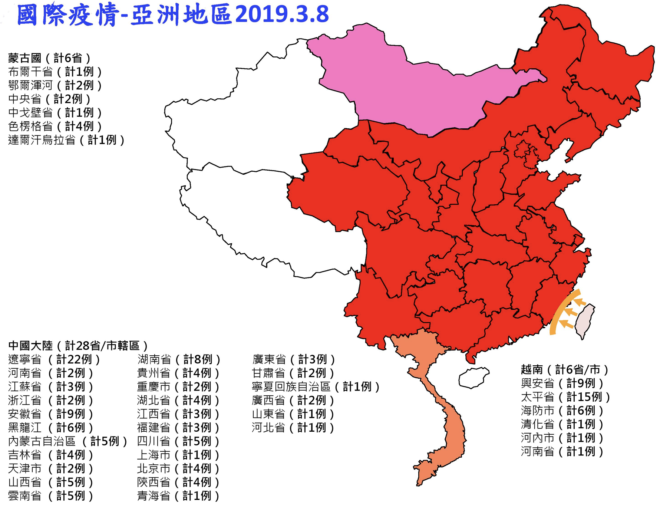
Vietnam, which is facing urgent epidemic prevention needs, confirmed its first domestic African swine fever case on the evening of February 19. As of statistics on the 7th of this month, 10 of the country's 63 provinces and cities had become epidemic areas (one more case was added on March 8).

The epidemic areas are mostly concentrated in northern Vietnam, including Hung Yen Province, Thai Binh Province, Hai Phong City, Hanoi City, Ha Nam Province, Hai Duong Province, Thanh Hoa Province, as well as Dien Bien Province and Tuan Giao District, where the outbreak only appeared on the 4th. A total of 5,000 pigs were affected and 331 pig farms were impacted; all were domestic pig cases. "There were originally only seven, and when I got up this morning I received news of two more. Vietnam has seen such a large spread (of the epidemic) in one month, which is very severe," said Dr. Thi Ngoc Pham from the National Institute of Veterinary Research of Vietnam with concern.
Thai scholar Dr. Tapanut Songkasupa (photo / Lin Pei-chun)

Thai scholar: Actively track the health of all pigs; Taiwan: Human resources are a difficulty

Dr. Roongroje Thanawongnuwech further proposed the difference between "active surveillance" and "passive surveillance": the former involves conducting health testing for all pigs, including those that still appear normal, as well as actively monitoring wild boar populations; the latter involves passively testing submitted samples. Teng Ming-chung, section chief of the Animal Health Research Institute under the Council of Agriculture, said that considering the limited manpower and resources that would need to be invested, truly carrying out "active surveillance" is unlikely, and Taiwan currently adopts "passive surveillance."

Therefore, in the face of calls from various countries to implement wild boar monitoring programs, Taiwan has not yet launched related actions. Huang Chin-cheng further explained that Europe, South Korea and Japan have closer relationships with wild boars, and the classical swine fever (CSF) outbreak in Japan last year was very likely related to wild boar populations. But based on his observations, Taiwan's wild boar numbers and density are both very low, and they are very far from domestic pigs. Even when Taiwan had a foot-and-mouth disease outbreak in 1997, although the virus could spread through the air, it did not cause cases of wild boar infection. Therefore, he believes that for the time being the possibility of wild boars becoming a host of the African swine fever virus in Taiwan can be ruled out.

However, Peng Ming-hsing, section chief of the Animal Quarantine Division of the Bureau of Animal and Plant Health Inspection and Quarantine, stressed that "human factors may also lead to 'indirect contact.'" He pointed out that in order to separate domestic pigs from wild boars, Poland builds two-story-high fences around pig farms, yet still cannot block infectious diseases. The reason is that when pig farmers engage in farming, they drive cultivators to work elsewhere, or directly enter mountain forests to farm, so the human body and vehicles may carry wild boar excrement or other sources of infection. Therefore, although domestic pigs and wild boars do not actually come into contact, because personnel do not disinfect properly after returning to the farm, they still become a transmission medium for the virus.

Starting March 9, 100% hand baggage checks added for passengers on flights from Thailand

Countries around the world are working hard to block African swine fever, and every country fears becoming the next epidemic area. Taiwan likewise cannot afford to be careless. Currently, Taoyuan Airport carries out 100% hand baggage checks for passengers on flights from China, Hong Kong, Macao, and the Southeast Asian countries of Vietnam, Cambodia, Laos and Myanmar. In this regard, Huang Chin-cheng believes that Thailand, surrounded by Vietnam, Cambodia and Laos, should also be included in the list of "high-risk blocking areas." In addition, Thailand has the highest number of flights to Taiwan among Southeast Asian countries, so it should be added as soon as possible to the countries subject to full baggage checks.

Feng Hai-tung, director-general of the Bureau of Animal and Plant Health Inspection and Quarantine under the Council of Agriculture, responded in an interview on the 7th that before implementation, the other country would be notified in advance and asked to cooperate in informing passengers. Communication takes time, and it is estimated that 100% hand baggage checks for flights from Thailand could be added by the end of this month at the earliest. However, the "Central Emergency Operation Center for African Swine Fever" announced today that starting at 0:00 on the 9th, full quarantine of hand baggage for inbound passengers on direct flights from Thailand to Taiwan would be added.

Currently, the "high-risk flights" subject to full hand baggage checks account for about 40% of all flights at Taoyuan Airport. If direct flights from Thailand are added, the proportion rises to 60%. In that case, will the capacity of X-ray machines and inspection personnel be sufficient? Feng said that the aviation police currently have 200 personnel assigned, which is still enough to cope without needing to add more staff, and there is no plan to purchase X-ray machines. However, more efficient staffing arrangements will be discussed, such as concentrating manpower on day shifts or terminals with higher passenger traffic.

African Swine Fever"International Authority: Banning Food Waste Is Not Necessarily Required to Prevent Swine Fever; Regional Cooperation, Production and Marketing Chain Safety Measures, and Wild Boar Monitoring Are All Important

African Swine Fever"Japan and South Korea Require Pig Farmers to Implement High-Temperature Cooking of Food Waste; Expert: Closely Monitor Pig Health and Strengthen Border Controls

[Special Topic] African Swine Fever | The Battle Between Epidemic Prevention and Food Waste (Continuously Updated)

(For African swine fever-related news, please click here to read)

Related Articles