Council of Agriculture Pilots Crop Insurance, High-Graft Pears Included in First Wave
After DPP presidential candidate Tsai Ing-wen raised the idea of a "crop insurance mechanism" during a recent disaster inspection, President Ma Ying-jeou visited Yilan two days ago to inspect agricultural losses and also instructed the Council of Agriculture to expand crop natural disaster insurance. The COA's Counseling Division said the related plan was drawn up 2 years ago, and the case is currently under review by the Financial Supervisory Commission. It is expected that, at the earliest, high-graft pears (Pyrus pyrifolia, Asian pear) could launch it by the end of this year, with gradual planning to replace the current "disaster relief payment" system.
Current disaster relief payment system paid out 2.9 billion yuan over 5 years
Under the current system, when agriculture suffers a natural disaster, the COA may, under the "Agricultural Natural Disaster Relief Measures," have township and town offices report the agricultural loss situation; after confirmation by the local county and city government's disaster inspection team, a report is submitted to the COA's Agriculture and Food Agency. Once agricultural losses reach the "grading standards" and are confirmed by the Agriculture and Food Agency, the COA announces the issuance of cash relief. Typhoon Soudelor brought this disaster situation, and currently 6 counties and cities, including Yunlin, Chiayi, Tainan, Kaohsiung, Pingtung, Hualien and Taitung, have reached the announced cash relief standard.
However, when losses do not reach the standard but the local county or city government believes that "subsidies need to be launched," it may submit a damage report to the Agriculture and Food Agency and apply for "special-case subsidies." For example, Taichung City suffered 110 million yuan in losses this time, but did not reach the 180 million yuan threshold, so it could not apply for "cash relief." The Taichung City Government may separately decide whether to apply for "special-case subsidies," but the final decision still rests with the COA, and even if approved, it would only be 80% of the cash relief amount.
According to COA statistics, from 2008 to 2012, 2.9 billion yuan in disaster relief payments were approved over 5 years; and in 2005, 2007 and 2008, due to insufficient budgets, requests were made to the Executive Yuan to release the "disaster reserve fund," becoming a huge burden on government finances.
Insurance discussed whenever disaster strikes; Counseling Division: high-graft pear pilot at year end at the earliest
In fact, the COA already planned the related agricultural natural disaster insurance mechanism in 2013. Chou Jo-nan, deputy director of the Counseling Division, said that because Taiwan has many crop types, and typhoons, cold fronts and heavy rain and other natural disasters are frequent, agriculture has become a high-risk economic sector, which also makes crop natural disaster insurance difficult to launch.
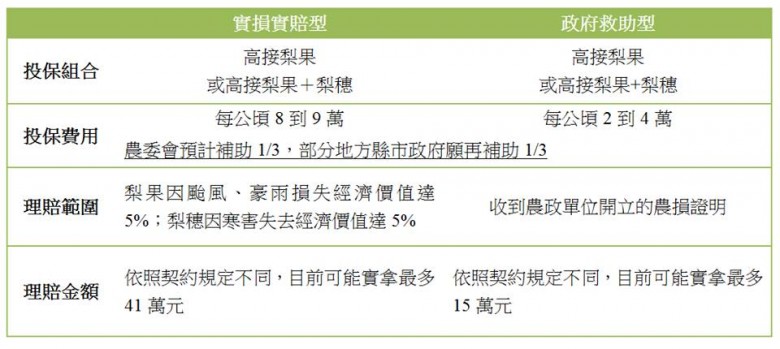
At present, the COA plans to pilot crop natural disaster insurance first with high-graft pears, with Fubon Insurance conducting commercial actuarial calculations, taking into account the production costs of high-graft pears over the most recent 10 years and the frequency of wind disasters, cold damage and heavy rain, converted into an insurance contract with the "production period" as its term. Chou Jo-nan said the planned high-graft pear natural disaster insurance is divided into two types: "actual loss, actual indemnity" and "linked to government relief."
Wang Tung-liang, section chief of farmer welfare in the Counseling Division, explained that under actual loss, actual indemnity, the main insurance covers the "high-graft pear fruit," and farmers may decide based on their own experience whether to buy additional coverage for the "pear scion." According to the current preliminary plan, farmers buying both the main and additional insurance need to pay about 80,000 to 90,000 yuan per hectare in premiums, and when orchard losses from typhoons, heavy rain or cold damage reach 5%, they may apply for a claim, and can receive up to 410,000 yuan in indemnity.
For farmers who choose the government-relief-linked insurance type, as long as they receive an agricultural loss certificate issued by an agricultural administration unit, they may apply to the insurance company for indemnity, so farmers no longer need to wait for the insurance company to go inspect the disaster, speeding up claims processing. The currently planned premium is about 20,000 to 40,000 yuan, and each hectare of high-graft pear scion and pear fruit can be indemnified from 60,000 to 90,000 yuan.
Under FSC review; premiums planned to be subsidized 1/3 each by central and local governments
However, Wang Tung-liang stressed that "everything is still under FSC review, and there may still be variables," adding that the COA has currently confirmed it will subsidize 1/3, while the Hsinchu County Government also intends to subsidize local farmers 1/3, so "farmers growing 4 or 5 fen of high-graft pears may actually pay only 10,000 to 20,000 yuan in insurance premiums."
Chou Jo-nan said that in fact, whenever there is a natural disaster, there are voices discussing "agricultural insurance," but "the risk is really too high," so relatively few industry players have been willing to invest, and the currently planned Fubon Insurance will also use "reinsurance" to spread the company's risk.
"At present we have selected high-graft pears, mango, sweet persimmon and pomelo and other high-economic-value crops for launch," Chou Jo-nan said, hoping to gradually reduce the issuance of "relief payments" in the future and ultimately phase them out, "but we have no timetable; we only hope that farmers can all have the concept of buying insurance and 'spreading risk.'"