Food donation is a race against time: fresh produce can be on the table within 24 hours
"Cherishing food and not wasting it" has already become an international trend, and within the country there are groups of various sizes running "food banks"; however, most food banks, based on the need to keep food fresh, still mostly supply economically disadvantaged and marginal households with dry rations and sauces.
However, a wedding banquet caterer in Keelung and 4 traditional morning markets in Taichung, respectively through the matching of local social affairs bureaus and offices, are trying to circulate surplus fresh ingredients to the socially disadvantaged within a single day, breaking through the limitations of food banks; nevertheless, chefs remind that every "handover" step must pay attention to the freshness of the ingredients, so that the good intentions of food banks do not come to nothing.
50 jin of fresh food left over each week, wedding banquet restaurant wants to donate it for public welfare
The Environmental Protection Administration once calculated that in 2010 Taiwan's average annual "kitchen waste" per person was about 121 kg, enough to feed the low-income population for 20 years; in recent years, civil society groups have advocated "reuse of surplus food," gradually giving rise to "food banks" of varying scales.
However, current food banks mainly rely on dry rations, dry goods, soy sauce and other easily stored foods and ingredients. Although these are enough to keep disadvantaged groups fed, they lack fresh foods such as eggs, beans, fish, meat, and vegetables; the reason is that fresh foods are not easy to preserve, and once they are not properly stored and circulated, they easily spoil and cause disease.
However, the Shuiyuan Restaurant in Keelung, known for its refinement and wedding banquets, boldly attempted to supply surplus fresh food to disadvantaged groups.
"We host 50 or 60 tables at a time, sometimes even more, and the amount of ingredients brought in is very large. It is for the sake of the beautiful 'plating' that so much is wasted," said general manager Chen Shixian, citing how only the florets of broccoli are used while all the other edible stems are discarded.
"There are also endless radishes to cut and the outer leaves of bok choy, all of which get thrown away," with a rough estimate that 50 to 60 kg of ingredients are wasted each week. "So I kept thinking about how to reuse the wasted ingredients, and that is why I asked the social affairs office for help."
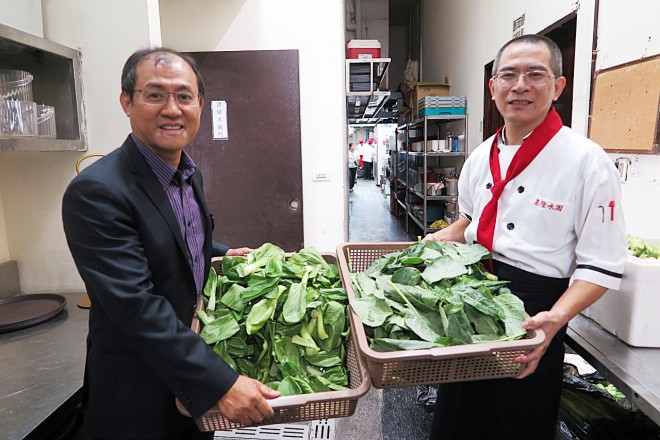 (Photo provided by / Red Cross Society of the Republic of China Taichung City Branch)
Restaurants and vegetable vendors must store food properly, while recipients must pay attention to freshness
Chef Shi Qinglong, who works at a large hotel, said that the ingredients a restaurant wastes in a day could easily make 50 or 60 bento boxes. "Shuiyuan Restaurant's approach is very good and worth learning from."
However, Chen Qiwen, a lecturer in the Department of Food and Beverage Management at China University of Science and Technology, said, "The idea behind food banks is very good, but special attention must be paid to quality." Surplus ingredients must be refrigerated properly to ensure freshness, and moreover, businesses must be prevented from treating food banks as "kitchen waste recycling operators."
Xu Qianwen said that the exchange platforms at the current 4 locations rely on the market self-governing associations and the Economic Development Bureau to jointly oversee food safety and quality, and will also require volunteers and the local mothers responsible for cooking to pay attention to ingredient freshness, "because food safety is also something we place great importance on."
(This article was funded by the Jianzhen Environmental Education Foundation for personnel expenses as a special project, but it does not interfere at all with news topic selection or interview writing, ensuring journalistic independence.)