Taipei City Department of Health Announces Second-Half School Lunch and Ingredient Sampling Results: Erlin Bok Choy and Puli Passion Fruit Found with Pesticide Residues Exceeding Standards
The Taipei City Government Department of Health today announced the results of second-half sampling inspections of school meals and ingredients. A total of 160 items were sampled (including 67 meal boxes and 93 ingredients), and the results showed that 1 item of "bok choy" and 1 item of "passion fruit" had pesticide residues that did not comply with regulations. According to Department of Health data, the registered address supplying the bok choy is the Erlin Township Farmers' Association in Yunlin County, while the unit supplying the passion fruit is the Puli Passion Fruit Production Cooperative in Nantou County.
Wang Mingli, Director of the Food and Drug Division of the Taipei City Department of Health, said that this round sampled 93 ingredient items, including 1 oil noodle item, 55 fruit and vegetable items, and 37 meat items. Oil noodles were tested for preservatives, hydrogen peroxide, borax and other items; fruits and vegetables were tested for pesticide residues; and meat was tested for veterinary drug residues, beta-agonists, chloramphenicol and other items.
Wang Mingli stated that the test results for oil noodles and meat all complied with regulations, but among the 55 fruit and vegetable items, 1 Yunlin "bok choy" item was found to have the pesticide residue Triadimefon at 0.02 ppm (standard: 0.01 ppm), and 1 Nantou "passion fruit" item was found to have the pesticide residues Acetamiprid at 0.05 ppm (standard: 0.01 ppm) and Kresoxim-methyl at 0.15 ppm (standard: 0.01 ppm), both non-compliant with regulations.
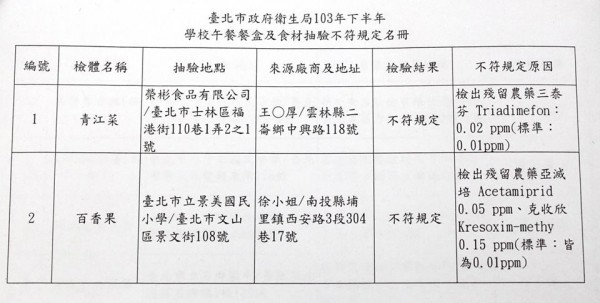
Wang Mingli said that the sampling location for the non-compliant bok choy was Rongbin Food Co., Ltd. in Shilin District, Taipei City. After tracing, the registered address supplying the bok choy came from No. 118 Zhongxing Road, Erlin Township, Yunlin County, which was identified as the Erlin Township Farmers' Association. Wang Mingli stated that on that day Rongbin Company supplied boxed meals to only three high schools and vocational high schools: Daojiang, Dunxu, and Kainan, and did not supply other elementary or junior high schools. As for the source of the problematic bok choy, agricultural authorities have joined with the Yunlin County Government to investigate.
The other non-compliant passion fruit item was sampled at Taipei Municipal Jingmei Elementary School. Wang Mingli said that although Jingmei Elementary School has its own kitchen, it is outsourced to New Taipei City's Tongxian Company for operation, and the problematic passion fruit was sent directly to the school by a supplier after the vendor called them. According to the supply address for the passion fruit, this batch came from the Puli Passion Fruit Production Cooperative in Nantou. When a reporter called to inquire, Ms. Wu, who answered the phone, said that the cooperative's passion fruit is supplied by more than a hundred farmers, and they were still trying to determine which farmer the problematic passion fruit came from.
Wang Mingli said that for the non-compliant fruits and vegetables, the Taipei City Department of Health has notified schools and businesses to remove them from shelves and stop selling them, and has referred the source manufacturers to the health bureaus of the counties and cities under their jurisdiction and relevant agricultural authorities to strengthen guidance for farmers on the correct application of pesticides, so as to reduce the problem of pesticide residues in fruits and vegetables. Those whose pesticide residues exceed the safe tolerance levels violate Article 15, Paragraph 1, Subparagraph 5 of the Act Governing Food Safety and Sanitation, and may be fined under Article 44, Paragraph 1, Subparagraph 1 of the same Act a penalty of no less than NT$60,000 and no more than NT$50 million.
Wang Mingli reminded the public that before eating or cooking fruits and vegetables, they can first rinse the roots or stem ends under running clean water, then soak them in water for 10-20 minutes, and then rinse them 2 to 3 times with running tap water, which can help remove residual pesticides.
For more professional agricultural science and technology information, please scan the QR code to follow WeChat: NongXunNET

Please indicate the source when reprinting.