Burning rice straw to disappear within two years! Organic fertilizer with decay-causing bacteria subsidized on 38,000 hectares of rice paddies, straw breaks down into the soil in 3 weeks
Make straw burning disappear within two years! To reduce air pollution from the burning of agricultural waste, the Council of Agriculture and the Environmental Protection Administration have launched a subsidy program for "organic fertilizer containing saprophytic bacteria." After application, rice straw can decay within 3 weeks, encouraging farmers to stop burning straw and to increase soil fertility. Each bag of organic fertilizer is originally priced at 200 yuan, and the EPA will subsidize 100 yuan. The program mainly targets rice paddies within a two-kilometer radius along National Highways No. 1 and No. 3, north of Tainan and south of Hsinchu, covering about 38,000 hectares. The Agriculture and Food Agency stated that it hopes straw burning will no longer occur within two years.
Organic fertilizer containing decay-causing bacteria rapidly matures rice straw
Cai Hongde, director of the EPA's Air Quality Protection Division, pointed out that burning rice straw is an important factor in air pollution, especially in autumn and winter, when it affects air quality on the island. Rice paddies burned along both sides of the highway affect road users' visibility and cause safety problems. Because the Taichung District Agricultural Research and Extension Station developed "biological beneficial bacteria organic fertilizer containing decay-causing bacteria," farmers are being guided through the Council of Agriculture to adopt the practice of applying organic fertilizer to decay rice straw, reducing open burning.
The biological beneficial bacteria developed by the Taichung District Agricultural Research and Extension Station have now been transferred to manufacturers as Dilong No. 6 enzyme organic matter fertilizer. The decay-causing bacteria contained in the organic fertilizer are Trichoderma and Bacillus subtilis. The decay-causing bacteria can accelerate the decomposition rate of rice straw, making the straw soft, mushy, and brown.
Decayed rice straw can provide organic matter to the soil and increase soil fertility. Before use, the rice straw must first be cut into lengths of three to five inches, then the field should be flooded so that the soil and straw remain moist, after which the organic fertilizer is applied, and the water level should be kept constant. Decay is expected to be completed within fourteen to twenty-one days. The application rate is about 20 kilograms per fen, and at least 200 kilograms per hectare. At present, a 20-kilogram bag sells for 200 yuan. A subsidy of 100 yuan per bag is planned, shared jointly by the Council of Agriculture and the Environmental Protection Administration.
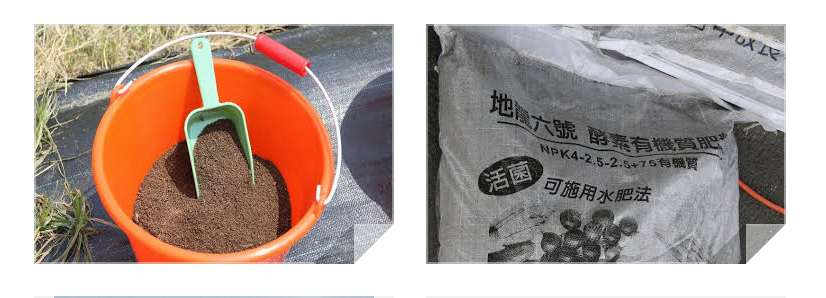
 Image provided by the Council of Agriculture and the Taichung District Agricultural Research and Extension Station
Subsidies planned for 38,000 hectares of rice paddies, no more straw burning within two years
Zhuang Yuefeng, section chief of the Grain Production Section of the Grain Industry Division of the Council of Agriculture's Agriculture and Food Agency, said that the details of the subsidy measures are still being drafted. After they are announced, agricultural units of county and city governments will assist with applications, and farmers can directly inquire about purchases with farmers' associations. The original plan targeted rice paddies within a two-kilometer radius along National Highways No. 1 and No. 3, north of Tainan and south of Hsinchu, covering about 38,000 hectares, but any interested farmers may apply.
The EPA expects to set the subsidized area at 10,000 hectares this year, and plans to expand the subsidized area to 20,000 hectares by year 108 of the Republic of China calendar. However, Zhuang Yuefeng said that the Agriculture and Food Agency will cooperate with the goal set by Council of Agriculture Minister Lin Congxian, hoping that there will be no more straw burning within two years.
To promote the subsidy measures, the Council of Agriculture will carry out door-to-door communication and outreach targeting farmers who burn straw, and will also promote through farmers' associations. In addition, the EPA will conduct inspections and first advise repeat-offending farmers; if they refuse to listen after repeated advice, they will be fined under the Air Pollution Control Act.
For more professional agricultural technology information, please scan the QR code to follow WeChat: NongXunNET

Please indicate the source when reprinting.