Tech civet coffee from NPUST boasts as many as 42 aroma compounds
Good news for coffee lovers! Hsieh Pao-chuan, vice president of National Pingtung University of Science and Technology, led the university's Department of Food Science applied microbiology team, spending 7 years, bringing kopi luwak coffee beans back from Indonesia, then using biotechnological methods to isolate beneficial bacterial strains and simulate the civet digestive system, finally developing a coffee that can replace existing high-priced varieties without violating animal welfare: NPUST 'Xin Zhi Xiang Coffee.' Moreover, compared with traditional wild kopi luwak coffee, which has a strong caramel flavor, the biotech kopi luwak coffee also has multiple aromas including milk and cinnamon.
Kopi luwak coffee, also known as cat poop coffee, is a rare coffee variety made from coffee beans eaten by the Asian palm civet, then excreted, washed and roasted. Because of its unique 31 natural aromas, the market price reaches as high as 15,000 yuan per pound, and even a 120 cc cup of the brewed coffee costs 1,200 yuan.
From 1,000 strains down to 16: analyzing the aromas took 4 years
Seven years ago, after observing the vigorous growth of the coffee market, Hsieh Pao-chuan decided to devote himself to this research, leading a student team to Indonesia to collect feces from more than 30 civets, and analyze more than 1,000 microbial strains, from which 136 were further screened. After pairing them one by one, 16 strains were finally isolated that matched the fermentation environment of the civet gastrointestinal tract.
After screening out the strains, the research team simulated the environment of the civet gastrointestinal tract and then placed coffee beans in to ferment. Hsieh Pao-chuan said, "To make the strains grow better and produce unique aromas, we added some oxygen to the environment, and at the same time used a gas chromatograph to analyze the aroma components of wild kopi luwak coffee beans, adjusting the proportions of various strain combinations. This complex research work took 4 years in total."
No overly heavy caramel flavor: biotech kopi luwak coffee is rich in floral and fruity aromas
Hsieh Pao-chuan pointed out that ordinary wild kopi luwak coffee beans are roasted especially dark in order to cover up the civet's fecal odor, so the caramel flavor is very strong. But because 'Xin Zhi Xiang Coffee' uses Indonesian Mandheling coffee beans as its base, there is no need to take special pains to cover up a fecal odor. Therefore, in blending the flavor of the coffee beans, in addition to retaining the original 31 aromas, 11 more aromas such as cinnamon and passion fruit were added. After the coffee beans are lightly roasted and brewed, they immediately give off floral and fruity aromas; drinking it brings a light caramel and cinnamon taste, with floral notes and fruit acidity in the finish, and a sweet aftertaste in the throat. It is a coffee with very rich layers.
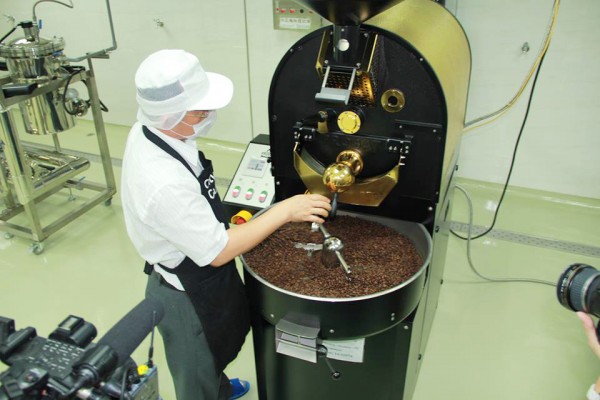
Hsieh Pao-chuan emphasized that in addition to having multiple aromas, this kopi luwak coffee contains only 36 mg of caffeine per 100 ml, half that of ordinary commercially sold coffee. Converted to the nationally recommended maximum daily caffeine intake for adults of 150 mg, about 4 cups can be drunk per day. At present, NPUST Xin Zhi Xiang Coffee is mainly produced by Department of Food Science students as part of their practical training course, supplying about 50 kg per week, and is sold by the NPUST welfare store at 4,000 yuan per pound.


(This article was sponsored by the Jianzhen Environmental Education Foundation for personnel funding, but the foundation does not interfere at all with news topics or interview writing, ensuring journalistic independence.)