To revitalize fallow farmland, a rice noodle family and organic smallholders stand together in solidarity
If Taiwan is seen as a pregnant woman, the Zhuoshui River is like an umbilical cord, nourishing the fertile Changhua-Yunlin Plain into Taiwan's rice granary and feeding countless living beings. Yet over the past thirty-plus years, people's connection to that umbilical cord has grown weaker and weaker, replaced by imported coarse grains and flour, so that Taiwan's food sovereignty seems to be sustained through a nasal feeding tube. This has also reduced the nation's rice consumption from 84.4 kg in 1984 to 46.2 kg in 2010, creating about 200,000 hectares of fallow farmland every year.
Yuanshun Foods, which started out making rice noodles and has a history of more than sixty years, is located in Huwei, Yunlin, one of the places known as Taiwan's rice granary. General Manager Wu Quanbin has witnessed how the rise and fall of the rice industry has driven qualitative changes in the rice noodle industry. Although the company has inevitably transformed by importing all kinds of grains and coarse grains and processing health-oriented grain products, what Wu Quanbin cares about most is still how to use his own strength to help Taiwan's small farmers develop processed foods, support young people engaged in organic farming to keep going, and also reduce fallow farmland.
"I hope that through small factories and small farmers jointly participating in developing new products, we can support young farmers in taking up organic farming, produce agricultural products that are friendly to the environment and healthy, and also share the value of the entire industrial chain," Wu Quanbin said. Although Yuanshun Foods is only a small processing plant with annual revenue of just 30 million yuan, and the proportion of local ingredients it uses is also limited, in the future it will continue to cooperate with small farmers and contract-farm organic agricultural products for processing.
At present, the well-known products developed by Yuanshun in cooperation with organic small farmers are "brown rice noodles" and "black soybean tea." The raw material for making "brown rice noodles" comes from the Guantian Shuiling Organic Farm in Tainan, which grows organic rice to conserve pheasant-tailed jacanas; "black soybean tea" is made by helping Tainan organic soybean farmer Su Rongcan roast and sell it, in the hope of creating a win-win situation in production and sales.
Revitalizing Fallow Land: Food Safety Matters More Than Food Sovereignty
From the perspective of a food processor, Wu Quanbin believes that in promoting the revitalization of fallow land, the Council of Agriculture should encourage farmers to grow coarse grains that can substitute for imports, and should not only emphasize "produced in Taiwan" but also pay more attention to "safety," guiding farmers to establish production records so that processors can feel confident about using domestically produced rice and coarse grains to develop processed foods.
"If the quality and safety of domestic coarse grains cannot compare with imported ones, then processors might as well just use cheaper imported coarse grains," Wu Quanbin believes. For food processors, emphasizing "food safety" is far more practical than emphasizing "food sovereignty."
Taking the development of brown rice noodles as an example, in recent years Wu Quanbin has gradually skipped grain merchants and directly contracted organic rice with organic farmers. He said that compared with coarse grains, although the rice industry in Taiwan is very mature, judging from the Jindun Rice incident, the sources of rice purchased by grain merchants are very complex. Once an incident involving excessive pesticides or a violation of food safety occurs, it is almost very difficult to trace the source. Even if grain merchants provide inspection reports, they cannot be fully trusted. Therefore, for Yuanshun Foods, directly contracting and purchasing from organic farmers can not only stabilize the source and quality, increase the income of organic farmers, but also take into account food safety and environmental friendliness.
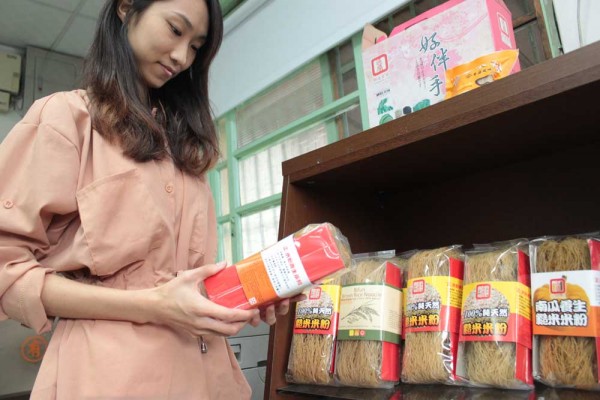

A Rice Noodle Family Innovates Its Process, Finding a New Way Out for Organic Rice Processing
The "brown rice noodles" developed by Wu Quanbin can be said to be one of the very few rice noodles in the country currently made with 100 percent brown rice as the raw material. They are also an innovative and distinctive product developed by Wu Quanbin as a second-generation member of a rice noodle family, under the challenge of breaking through his own limits.
He said that in the traditional rice noodle process, indica rice (commonly known as zailai rice) must be stored from new rice until it becomes old rice before it can be processed. But the process developed by Yuanshun Foods can not only use fresh indica rice as the raw material, but also uses no chemical additives at all, while retaining the entire nutritional essence of brown rice and maintaining the true texture of rice noodles.
In order to find a rice variety suitable for making brown rice noodles, Wu Quanbin spent more than a year visiting grain merchants and farmers across central and southern Taiwan, and finally found an indica rice variety that is niche in the market. As for what variety it is, Wu Quanbin said with a smile that it is a trade secret. But in order to support young people engaged in organic farming, this indica rice variety is entirely produced by the Guantian Shuiling Organic Farm in Tainan, and the organic indica rice is purchased at twice the price of conventional farming.
Although brown rice noodles sell for about two to three times more than ordinary rice noodles, because they are genuine and also carry the meaning of supporting the conservation of pheasant-tailed jacanas, they still sell well in organic stores, and are even exported to Hong Kong, China and Australia. In order to encourage more local farmers in Yunlin to move toward organic development, Wu Quanbin has also given this indica rice variety to farmers in the Lienei community of Huwei, where Yuanshun Foods is located, to cultivate.
Sharing Value in Production and Sales: Small Farmers Are No Longer Alone
As for coarse grains, Wu Quanbin has also cooperated with Su Rongcan, a farmer practicing natural farming in Jiali, Tainan, purchasing naturally farmed black soybeans at a more favorable price than conventional farming and helping process and roast them into black soybean tea. Wu Quanbin said that he and Su Rongcan share the same philosophy and both want to work together for the revival of domestic coarse grains. Therefore, in addition to helping Su Rongcan roast and sell black soybean tea, these processed products are then sold back to Su Rongcan, so that farmers can also sell their own processed products and share the profits and value of the entire crop process from production and processing to sales.
Wu Quanbin said that when farmers see the results of processed agricultural products, they will care about quality and have the confidence to continue farming. Even if a natural disaster leads to a poor harvest, farmers still have processed products they can sell to get through the hard times.
Regarding the Council of Agriculture's promotion of revitalizing fallow land, Wu Quanbin suggests that in policy planning, it is not enough just to issue subsidies to encourage farmers to produce. It should also control from the source the way farmers use pesticides, implement field management, meet food safety standards, and at the same time encourage the participation of small and medium-sized food processing plants, so that farmers understand market demand, produce suitable crops, and develop local characteristics.
"Price is not necessarily absolute, but safety absolutely is the only thing," Wu Quanbin believes. Since the Council of Agriculture encourages farmers to produce coarse grains that substitute for imports, it should shoulder the responsibility of gatekeeping and establish a grading and screening system, and should even launch a domestic coarse grain label for processors and consumers to distinguish and purchase with peace of mind. He said that only a fallow land revitalization policy with complete industrial planning can achieve sustainable development; otherwise, relying solely on subsidies, the local coarse grain industry will find it hard to ever stand on its own.