Changhua County announces that 80% of fish oil sold on the market failed inspection, with the lowest content only 20% of the labeled value
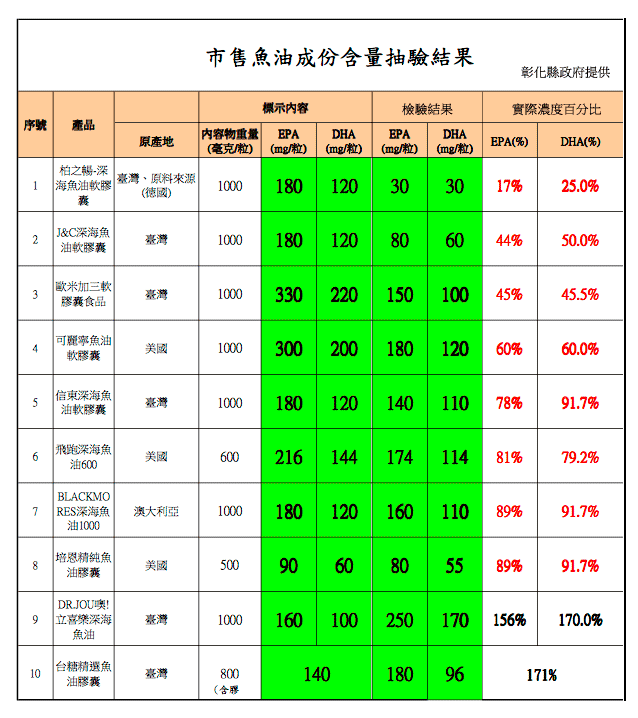
The Changhua County Health Bureau today announced the results of testing the DHA and EPA content of fish oil sold on the market. As many as 80% of the products had DHA and EPA levels that failed to reach the amounts claimed on the outer packaging, with the lowest content coming in at less than 20% of the labeled value. Products with foreign countries of origin all had relatively low content (see the full list at the end of the article)
Fish oil is rich in eicosapentaenoic acid (EPA) and decosahexaenoic acid (DHA) omega-3 polyunsaturated fatty acids, and has high nutritional value. It is a popular health food that people buy as gifts when traveling abroad and returning home, but fish oil products are highly varied and prices differ greatly.
The Changhua County Health Bureau sampled fish oil products sold on the market and tested their EPA and DHA content. The test results showed that of 10 fish oil products, only 2 had actual DHA and EPA content that reached the amounts claimed on the outer packaging, while the remaining 8 had DHA and EPA content that reached only 20%-90% of the labeled value, with the lowest content at only 17% of the labeled value.
The Health Bureau stated that EPA and DHA content failing to match the labeled value already violates Article 28 of the Act Governing Food Safety and Sanitation, and under the law a fine of no less than 40,000 yuan and no more than 4 million yuan may be imposed. If counterfeiting or adulteration is involved, a fine of no less than NT$60,000 and no more than NT$200 million may be imposed under the law. For the above products involving false labeling or adulteration or counterfeiting, the matter has been transferred to the competent health bureaus for source investigation, confirmation, and handling.
Among the products whose EPA and DHA content failed to reach the labeled value in this sampling, there was no shortage of imported or high-priced fish oil products, with market prices per bottle ranging from 250 to 2,450 yuan, which converts to 0.8 to 27.2 yuan per capsule, showing that price level has no correlation with the amount of EPA or DHA content. Because the EPA and DHA in fish oil capsules are very easily decomposed and oxidized by light, exposure to air, or failure to keep them refrigerated at low temperature. Whether the products with low content are related to preservation and transport during production still awaits detailed investigation by the competent health bureaus.
A recent survey in New Zealand found that 70% of fish oil capsules sold on the market had EPA and DHA content that did not match the label, with actual content reaching only 67% of the labeled content, and moreover, whether the content matched the label had nothing to do with price level. Its survey results are consistent with the results of this sampling.
The Changhua Health Bureau reminds that the best source of fish oil is still eating natural foods such as mackerel, tuna, salmon, sardines, and Pacific saury, but if they are large migratory fish, they may contain higher amounts of heavy metals due to biological magnification, and the public should still pay attention to appropriate intake. If fish oil products need to be supplemented, it should be noted that the EPA and DHA in fish oil capsules are very easily decomposed and oxidized by light, exposure to air, or failure to keep them refrigerated at low temperature. Purchased products should be packaged in light-blocking containers, and after purchase they should be stored in a cool, dark place and consumed within the expiration date to ensure product quality.
For more professional agricultural science and technology information, please scan the QR code to follow WeChat: NongXunNET

Please indicate the source when reprinting.