The Golden Corridor's one-highlight-a-week has long since come to an end; when will it truly shine?
Premier Jiang Yi-huah recently led his cabinet members in declaring that "let us do our best for one year" to ride out the no-confidence storm. Former Premier Chen Chun, who also once faced a no-confidence threat, proposed the "one highlight a week" packaging of the economic momentum promotion plan in order to make the people feel it, and led off with the Council of Agriculture's "Yunlin-Changhua Golden Corridor New Agricultural Plan." But a year has passed, and the "highlights" faded long ago with Chen Chun's departure from office, while the "Golden Corridor" likewise remains "dim and lightless" because the Executive Yuan sent it back.
To solve the high-speed rail land subsidence problem, last October the Council of Agriculture launched the "Yunlin-Changhua Golden Corridor New Agricultural Plan," which was expected to guide rice paddies into dry farming in the nine townships of Yunlin and Changhua along the high-speed rail route. However, the draft was sent back by the Executive Yuan and is still sitting at the Council of Agriculture.
The Council of Agriculture held a meeting yesterday and is expected to add 50,000 each year to guide farmers in the "Golden Corridor" area to switch to growing sugarcane. If the fallow-land conversion incentive is added, the Council of Agriculture estimates that farmers' average annual income per hectare can reach 130,000, about the same as the income from growing rice. At present, some farmers have expressed a willingness to give it a try.
The Council of Agriculture hopes to complete the revised draft by the end of the month, submit it to the Executive Yuan for review, and rush it into effect next year.
A Big Press Conference to Make a Grand Declaration, Then the Executive Yuan Turns Its Back and Refuses to Acknowledge It
Last October, in order to make the people feel it, the Executive Yuan launched the "one highlight a week" Economic Momentum Promotion Plan, with the first wave featuring the "Yunlin-Changhua Golden Corridor New Agricultural Plan," which was expected to invest 3.3 billion from 102 to 109 of the Republic of China calendar, covering the 35 kilometers along the high-speed rail in Yunlin and Changhua and 1.5 kilometers on each side. In the area north of the Xihuwei River, where water sources are relatively abundant, Changhua County's Zhutang Township, Pitou Township, and Xizhou Township, as well as Yunlin County's Erlun Township and Xiluo Township, would promote modern water-saving facilities; in the more water-scarce Yunlin County townships of Huwei Township, Tuku Township, Yuanchang Township, and Beigang Township, farmers would be guided to switch to dry farming.
The plan covered about more than 13,000 hectares, of which nearly 9,000 hectares were farmland, but after the Executive Yuan held its grand press conference last year, the Executive Yuan returned the draft on the grounds of insufficient funds, and it has still not left the Council of Agriculture.
Although it was returned by the Executive Yuan, the Council of Agriculture did not lose heart and looked for funding to make a comeback. Li Yun-chung, section chief of irrigation management at the Council of Agriculture's Department of Farmland Water Resources, said that in guiding rice paddies to switch to dry farming, the main promotion at present is conversion to sugarcane. For farmers in the Golden Corridor area, in addition to the original 30,000 per hectare per crop for reactivating fallow land, an additional 50,000 would be added each year, and with contract farming income from Taiwan Sugar Corporation, over three years farmers could obtain an average annual net profit of about 130,000, close to the 140,000 from rice.
It is understood that the Council of Agriculture had originally hoped Taiwan Sugar Corporation could share 100 million in funding over the 7-year plan period, but Taiwan Sugar Corporation refused on the grounds of losses and institutional difficulties, so the Council of Agriculture turned to the Ministry of Transportation and Communications to seek funding and had already obtained a preliminary promise.

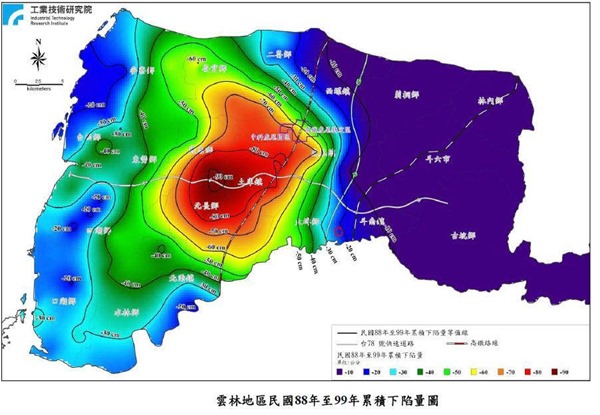
A commissioned report by the Water Resources Agency pointed out that the high-speed rail's most severe land subsidence occurs at the section where it intersects with Provincial Highway No. 78 in Tuku Township, Yunlin County (mileage 224K+260 to 224K+405), and that this should be caused by the embankment of Provincial Highway No. 78 being constructed by the fill method, resulting in excessive surface load.