The Seed Defense Battle, Part 1: From Dr. Shiva to the Rice God of Thailand's Seed Saving
Editor's note: This article introduces the seed-saving movements in India and Thailand, and describes in detail the rice seed saving and breeding steps of Thailand's Rice God Foundation, which are well worth studying for farmers. Because this article is quite long, it is published in two parts; to read part two, please click here.
───────────────────────────────────────────────────
For a long time, farmers saving their own seed was originally simply part of the farmer's practice of agriculture. However, as chemical fertilizers and pesticides entered rural areas and farmers grew crops with market orientation as their guide, fewer and fewer farmers now save their own seed. Most of the crops that farmers grow today are grown from seedlings bought directly from seed and seedling shops, or from seeds sold by multinational corporations.
And changes in crops have also affected our diet. Take edible oil in Taiwan, China, as an example: lard was once a very important cooking oil in the lives of grandparents' generation and even parents' generation. Yet today in the market, we only see soybean oil, sunflower oil, olive oil and a few other cooking oils. This shows that food diversity is rapidly disappearing from around us, and the issue involved behind this is not merely that the food we eat has been changed. In fact, controlling seed equals controlling the source of food, so multinational corporations continually try through various means to control other countries' food rights. Therefore, seed preservation and defending seed sovereignty have become very important issues in agriculture today.
Dr. Vandana Shiva and the seed-saving movement
When it comes to the seed-saving movement, one cannot fail to mention India's Dr. Vandana Shiva. As early as 1987 she began devoting herself to the seed-saving movement, and it has now been more than 20 years. This famous Indian female ecological and environmental activist is herself a doctor of nuclear physics. The reason Vandana Shiva moved from nuclear physics to environmental activism was that in 1984 in India a pesticide plant belonging to the United States leaked toxic gas, causing more than 3000 deaths. This event raised a question for her: why do agricultural insecticides in turn slaughter people? So she began to study the Green Revolution, and discovered that this new farming method originated from war, using large amounts of chemical weapons as pesticides. She wrote a related book and was invited to attend some biotechnology seminars.
In 1987, at a seminar in Geneva, she first heard biotechnology companies talking about biotechnology and patents, that is, inserting new genes into organisms, which counts as a "new invention" and therefore can successfully be granted a patent. Free trade agreements (FTA) would also become a new tool for pushing patents out to the world. That same year, near Dehra Dun in northern India, in the Doon Valley, she founded the Navdanya Foundation and launched the seed-saving movement.
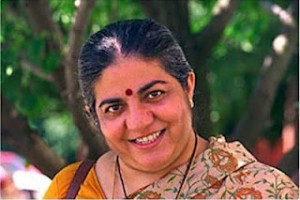
Dr. Vandana Shiva @ Image source: http://movingtowardsustainability.blogspot.tw/2011/04/vandana-shiva-fight-for-equality.
Free trade agreements dominated by large agribusiness corporations decide the fate of small farmers
On May 1, 2010, Dr. Shiva came to Taiwan, China, to attend the Asia-Pacific Green People's Annual Meeting. In her opening speech for "The Global Green Wave and Taiwan," she said that one of the major impacts of the WTO (World Trade Organization) on agriculture is the AgA (Agreement on Agriculture). Ever since Monsanto came to India in 1977, it began monopolizing the seed market. Monsanto (note 1) sold expensive seeds and prohibited farmers from saving seed; farmers thus fell into a vicious cycle of debt, and one after another began committing suicide. The price of genetically modified Bt cotton seed jumped from 7 rupees to 1,300 rupees at once. Pesticide use increased 13-fold. And the main pest, the cotton bollworm, consequently developed widespread resistance. Seeds became more expensive, agricultural costs increased, and yet the price of cotton fell. This was because of the WTO's free trade agreements.
As for the collapse of agricultural product prices, the investigation carried out by Shiva and her colleagues found that this agricultural regulation, AgA, was mainly drafted by large agribusiness corporations such as Cargill (note 2). These large corporations take in roughly 1 billion US dollars a day. With such income, they can drive down the prices of agricultural products and then dump them in any region, causing that region's agriculture to collapse.
Shiva took the 1998 soybean salad oil dumping incident as an example: this incident caused 5 million farmers to leave farming and lose their jobs, and 1 million village small-scale cold-press oil mills to close. Locally produced high-quality cooking oil disappeared from the Indian market ever since. The beneficiaries were the oil-selling Cargill and the soybean-seed-selling Monsanto, the two being each other's main business partners.
Vandana also mentioned: "The species that feed the world number about 8,500; this is the biodiversity in feeding the world. But now, only four crops are being rapidly multiplied and grown. These are all genetically modified crops: cotton, corn, soybeans and mustard." Take corn as an example: because U.S. government policy encourages it, American farmers continually plant corn, causing corn overproduction. This surplus corn also leads food technology companies to invest large numbers of R&D staff to keep developing products that can be made from corn, for example soft drinks are one of them. We think we are drinking soft drinks, but in fact we are still eating by-products produced from corn.
Seed saving at Thailand's Rice God Foundation (KKF)
Thailand's Rice God Foundation (hereafter KKF) likewise began seed preservation 20 years ago. Once, the Thai government imported the variety IR8 from IRRi (International Rice Research Institute), after which Thai farmers converted this variety into Kor Khor1, Kor khor 7, Kor khor 9 and Suphan 60. These varieties were very popular for only those two years, because these varieties were afterward attacked by a brown plant-hopper. These pests wiped out 3,500,000 rai (note 3) of rice paddies (5,600,000 hectares).
When faced with such a rice crisis, many people offered all kinds of opinions about the crisis, but Rice God Foundation founder Daycha Siribhatra tended to return to the basics of the problem. In a sustainable agriculture network he offered his opinion: "That is to let the seeds of thousands of native varieties all return to the regions where they belong, rather than obtaining seeds from the government's seed bank."
Daycha believes: "Rice varieties should return to the land to which they originally belonged. Let us together let the seeds originally from Suphan Province return to Suphan Province, Ayutthaya Province, Phichit Province and so on. He mentioned "in situ cultivation," a method already proven to be the best way to preserve seeds, just as plants are able to adapt to environmental change. After seeds are kept in a refrigerator for several years, letting seeds go dormant will carry many risks, such as seeds failing to bear fruit, or seeds being unable to resist new plant diseases or insects."
Thailand's number one rice breeding technique
KKF developed what may be Thailand's number one rice breeding technique, which not only can minimize external investment in farming, but can also reduce the expenses required. This technique requires only simple tools, plus patience and persistent determination.
Below I will introduce KKF's method of seed preservation. (Please click here to read the following part.)