How to eat good meat and good eggs? Livestock experts remind
 Food safety in Taiwan, China keeps flashing red warnings, yet you can still see advertising pitches like this on TV and online: "An Angus steak bigger than your face, super tender and juicy..." The emphasis is that food should be a bargain, fresh and delicious, and cheap! In "Good Meat and Good Eggs That Even Livestock Experts Dare to Eat," released at the end of March this year, livestock science PhD Liao Chen-yuan says frankly: "When you buy a piece of meat or an egg, do you care how it was raised? Have you ever paid attention to the safety control system? If consumers don't care, how can we expect livestock farmers to use good rearing methods and provide us with good food?"
"What is the spirit of food? Besides tasting good, can it become a lifestyle marker? If money is not a concern, when it comes to drinking coffee or eating chocolate, can consumers buy fair-trade chocolate or Rainforest Alliance coffee?" Liao Chen-yuan believes that the standard of living in Taiwan, China surpassed that of developing countries long ago, yet people still only want to buy food at similarly low prices, while their demands and vigilance regarding food safety remain very low.
He takes this year's concerns over lean-meat-powder US beef as an example: people did not dare eat beef and started eating pork, but when pork was also found to illegally contain banned drugs, they chose to switch to chicken, and when the avian flu scare broke out, they simply switched to vegetarian food. "This kind of avoidance is absolutely not the right mindset. We must support good operators and boycott bad ones, so that we can eat good things ourselves."
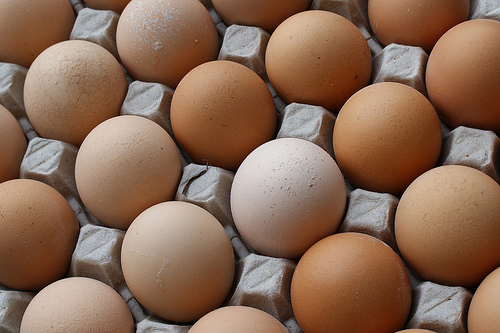
Take battery-cage hens as another example: every 2 to 4 hens are confined in narrow battery cages, trampling on one another and eating feed containing antibiotics to prevent disease. For their entire lives, apart from the wire mesh, they never set foot on soil. They have long been regarded as a symbol of modern agriculture and animal husbandry that is highly efficient yet inhumane. According to a survey by the Animal Research Institute of Taiwan, China, 36.5 million laying hens are raised in Taiwan, China each year, 99 percent of them in battery cages. On January 1 this year, the EU announced a ban on this rearing method.
Liao Chen-yuan says: "Consumers in Taiwan, China certainly feel that battery-cage hens are pitiful, but the question is, do consumers' mouths and actions match? A battery-cage egg costs 2 to 4 yuan, while an egg laid by a hen living freely outdoors costs 8 to 10 yuan. Which one do you buy? Consumers cannot merely oppose with their mouths while refusing to accept the difference in price."
However, before the EU announced the ban this year, it first spent 20 years on promotion and outreach, going through a 10-year transition period in between, and inevitably saw problems such as soaring egg prices, consumers crying out in misery, and bakery operators going bankrupt because they could not afford eggs. He reminds animal protection groups, administrative agencies and legislators that before pushing for legal amendments, they should first communicate with operators and plan a suitable transition period. Of course, the best approach is a shift in consumer awareness that prompts operators to voluntarily adopt humane rearing.
In his book, Liao Chen-yuan also debunks consumers' myth of favoring warm-body pork. Many people believe that pork slaughtered in the early hours of the same day is fresher. He says, perplexed, that pork stalls in traditional markets in Taiwan, China today resemble the vendors depicted in "Along the River During the Qingming Festival." Why is it that humans successfully landed on the moon many years ago, yet the concept of slaughter hygiene still has not progressed?
He explains that after pigs are slaughtered in the middle of the night, without refrigeration or freezing, they are sold all the way until noon the next day, which means consumers are buying a piece of "rotting" pork. Moreover, the environment of meat stalls simply does not meet food safety standards. "Freshly slaughtered" does not equate to "hygienic and safe." In addition, frozen and chilled meat can wait for test reports that take more than ten hours, while warm-body meat cannot.
What is comforting is that some warm-body pork stalls have begun to change, for example by switching display boards to stainless steel and adding refrigerated display cases. He hopes that consumers who are used to buying meat at traditional meat stalls can support stores that are willing to improve, prompting more stores to follow suit.
So what exactly counts as good meat and good eggs that even livestock experts dare to eat? Liao Chen-yuan suggests that the first step is to check whether the packaging has ISO22000/HACCP and Taiwan, China Good Agricultural Practice certification and other food safety control systems; the second step is to check whether a contract ranch or farm name is labeled; the third step is to choose a familiar brand. For meat, the marbling should be evenly distributed, neither too fatty nor too lean. "If every consumer could choose so carefully when shopping, then the relevant labeling of agricultural and livestock products would certainly become clearer and clearer."
He believes that two ecological changes in the livestock industry of Taiwan, China are worthy of praise. The first is that "blank feed" with no added drugs is receiving attention, and the second is that the industry is gradually aligning with "humane rearing." Liao Chen-yuan believes in the power of consumers to accelerate the transformation of the livestock industry and force the government to promote grading measures for agricultural and livestock products. He says: "When you are willing and able to buy good meat and good eggs, you are not only helping the livestock industry of Taiwan, China move in a better direction, but animals will also gain a different way of life and environment because of you."