Arbor Day is all about planting and not caring for trees? Experts call for it to be changed to Tree Care Day
The annual tree-planting month kicked off yesterday. The Forestry Bureau plans to distribute 200,000 saplings to encourage greening, but how effective tree planting really is remains a big question mark. The year before last, then-Central Bank Governor Perng Fai-nan planted a camphor tree (Cinnamomum camphora) in Daan Forest Park, yet it grew thin and small. Japanese tree doctors were brought in to Taiwan to diagnose it and found that the park soil was too hard and the cover soil depth was less than 2 m; experts criticized that tree-planting activities do not take local soil into consideration and that people simply wash their hands of the trees after planting. They said the event should be changed to a "tree care month," with funds spent on soil improvement and protecting existing trees, which is more practical than planting trees haphazardly.
Tree planting without assessing the growing environment, the governor's tree cannot grow tall
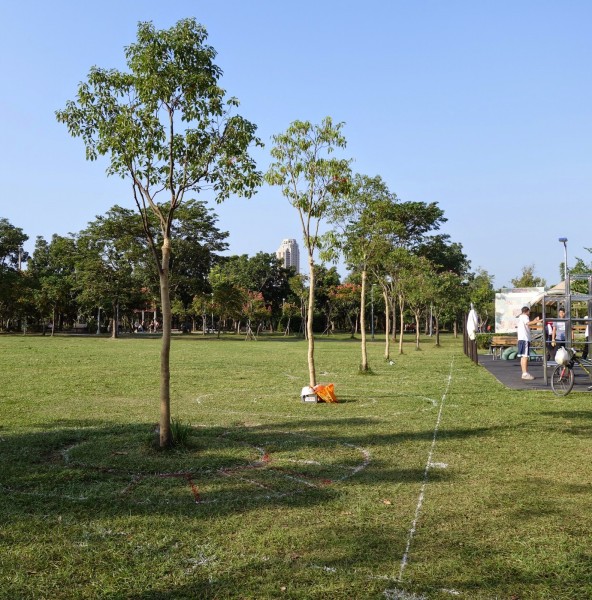


Daan Forest Park is already a relatively well-managed green space, and most of the other trees cultivated for Arbor Day do not receive treatment as good as the governor's tree. Lee Yu-tien, chairman of the Taiwan Urban Forest Health Association, said that most trees planted for tree-planting activities have very low survival rates. "Otherwise, with tree planting having developed for so long, theoretically Taiwan should have a lot of trees, right?"
He criticized that many tree-planting activities plant trees haphazardly without assessing the growing environment in advance. For example, common large street trees such as the blackboard tree (Alstonia scholaris) and chinaberry tree (Melia azedarach) need tree pits of more than 1.2 sq m for their root systems to grow, but the standard for street-tree pits in Taipei City is only 0.8 sq m, like "binding a giant's feet," so the roots cannot grow well and the trees are top-heavy, endangering people's personal safety.
"Landscape companies still have to provide warranties when planting trees. Arbor Day is the most irresponsible; after planting, often even watering is ignored, and although the government gives out saplings, it cannot track survival rates." Lee Yu-tien believes that many urban areas long ago ran out of space to plant trees, and urban soil conditions are poor, so tree-planting month should be changed to tree care month, with funds used to improve soil, fertilize, dig large tree pits and maintain trees. Many units now do not even have money to give trees a "haircut."
Forestry Bureau: Tree planting results are good
In response, Yang Hung-chih, deputy director-general of the Forestry Bureau, said that for ordinary people's tree-planting activities on rooftops and balconies, small plants with shallow roots such as azaleas, camellias and osmanthus are usually distributed; for community greening, plants such as the glossy privet (Ligustrum lucidum) and Formosan koa (Acacia confusa) are planted. "Community greening is all a good thing; as long as there are enough saplings, there is no problem." He stressed that when communities apply for saplings, follow-up results reports are required, and colleagues are also asked to observe on site. At present, the results are good.
Yang Hung-chih said that the common thousand-person tree-planting activities belong to "regional tree planting," in which the Forestry Bureau and local governments cooperate to select complete blocks, such as newly built schools, new roads and parks. Last year, growth conditions were specially tracked, and survival rates were all good. In the future, they will also coordinate with International Forest Day on March 22 and World Earth Day on April 21 to hold actions such as tree care and wildlife protection.
However, the information the Forestry Bureau provided to NewsMarket after the interview only calculated the tree-planting situation under its district forest offices. In total, over the past ten years it handled 180 large-scale tree-planting actions. Among them, in the protection forest along the Hushan Trail in Taipei City, the tree survival rate reached 75%, and the Pingtung Agricultural Biotechnology Park also reached 80%. But it provided no total survival rate for the saplings distributed each year.
Tree planting requires good drainage and selection of sandy soil
Lee Pei-jung, executive secretary of the Daan Forest Park Friends Foundation, said that when planting trees, special attention must be paid to soil and drainage. Many people neglect to create a drainage layer, thinking that water will automatically seep into the soil and flow away, but a lot of water accumulates in the soil. Drainage must be done well at the bottom of the tree pit and on the sides of the root ball. If planting trees in a large open area, attention must be paid to surface drainage, for example by digging a drainage ditch 10 cm below the surface.
In addition, soil that is too hard or too sticky easily clogs root systems. When planting trees, it is best to choose sandy soil with good drainage and large pores so that the trees can breathe.
Lee Yu-tien reminded that plants must be suited to the site. The chinaberry tree is not suitable as a street tree, but it is very suitable when planted in a park. For street trees, trees that "grow slowly and live long" should be chosen. For example, Japan plants ginkgo as a street tree. Fast-growing trees with well-developed root systems, such as banyan, blackboard tree and trees of the Malvaceae family, are not suitable as street trees.