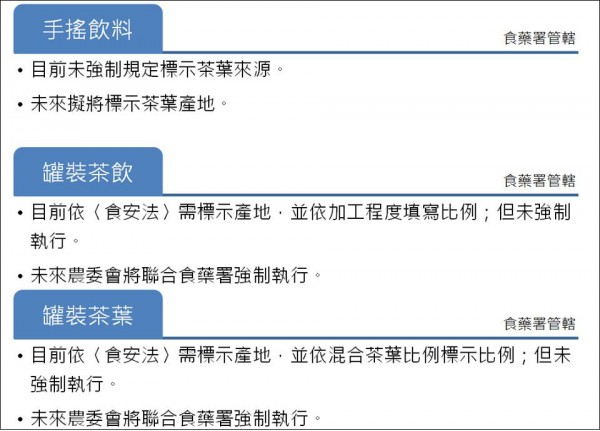
After the tea beverage storm, hand-shaken tea is proposed to be labeled with origin, while canned tea drinks and tea leaves are subject to mandatory labeling.
Recently, hand-shaken tea drinks have repeatedly failed local health authority inspections for pesticide residues in imported raw tea leaves, becoming a focus of questioning by lawmakers. Chen Pao-chi, Minister of the Council of Agriculture, speaking yesterday (the 29th) at a question-and-answer session of the Legislative Yuan's Economics Committee, said that in view of the high proportion of imported tea leaves found to contain pesticide residues, which has also affected consumers' confidence in domestically produced tea, the Council of Agriculture will begin joint inspections with the Ministry of Health and Welfare in May of canned and bottled tea sold on the market, and the place of origin must be strictly labeled, so that there can be no situation of something advertised as "domestically produced tea" being mixed with imported tea.
Hand-shaken tea drinks: mandatory origin labeling under consideration


Imported tea leaves: under consideration for listing as a high-risk category, with batch-by-batch inspection
In addition, regarding food safety and hygiene checks on imported tea leaves, Chen Pao-chi said he will ask the Food and Drug Administration of the Ministry of Health and Welfare to include imported tea leaves among the high-risk items under the
And is there also concern about pesticide residues in domestically produced tea leaves? Chen Pao-chi said, "In the past, inspections have all had a pass rate of over 97%," and asked the public to rest assured.
As for why imported tea leaves were not previously listed as a high-risk item, Wang Te-yuan said border controls are adjusted on a case-by-case basis; for example, Vietnamese black tea saw a rising failure rate toward the end of last year, "so from the beginning of this year, batch-by-batch inspection of Vietnamese tea leaves began." At present, as long as it is imported tea leaves, the FDA will carry out batch-by-batch inspection, no longer just partial spot checks.
Wu Tsung-hsi, section chief of the FDA's Food Import Management Division, said, "At present, there are two situations for determining high risk," namely a poor record on the part of the importer, or safety concerns in the importing region, such as products imported from the five prefectures after the Fukushima incident in Japan. The general sampling inspection rate is 5%; if an item is listed as high-risk, the sampling rate will be raised on a case-by-case basis, or imports may even be banned.
Consumer groups: hand-shaken tea should be brought under the
Civil groups including the Consumers' Foundation and the John Tung Foundation all believe that the FDA should show determination and clearly regulate the food safety of hand-shaken tea drinks, and strengthen source control.
Lu Hsin-chang, secretary-general of the Consumers' Foundation, said hand-shaken tea drink operators have never been regarded by the FDA as falling within the scope of "food business operators" as defined in Article 3 of the
Hsu Hui-yu, director of the Food and Nutrition Division of the John Tung Foundation, also said that hand-shaken tea drinks should meet the definition of "ready-to-eat food" in the "Good Hygiene Practice for Vacuum-Packed Foods" - that is, products that can be eaten after opening without cooking - and should be brought under the regulations of the Food Safety Act, but in the past the FDA has always refused. She believes that if this tea drink storm is to be resolved, "it depends on whether the FDA is proactive and is willing to take concrete action to require hand-shaken tea drinks to label their place of origin and source."