Li Genzheng / Horseshoe Crabs and Shells: The Historical Scene of "Shan Hai Jing"
Text / Li Genzheng (CEO of the Citizens of the Earth Foundation)
The elder brother who loved the sea and loved fishing passed away early last year, and his last wish was for his ashes to be buried at sea. That day, brothers, sisters, and children set out from Houfeng Harbor; the boat passed through the under-construction Kinmen Bridge and scattered his ashes in the waters off Guningtou. That day the seawater turned deep black, and the captain said that in all his years he had never seen the sea that color; the climate really is abnormal.
At the end of the film "Salt of the Earth," the photographer returns to his hometown in Brazil, which has already become desertified, and carries out tree planting and restoration; through this, his mind, deeply traumatized by the ugliness of human nature while filming the disasters of war, finds redemption. This is also my dream for Kinmen after the fires of war. I hope that this island, in addition to striving for economic development, can also, through ecological restoration, let lush land bring vitality to the island and well-being to the people.
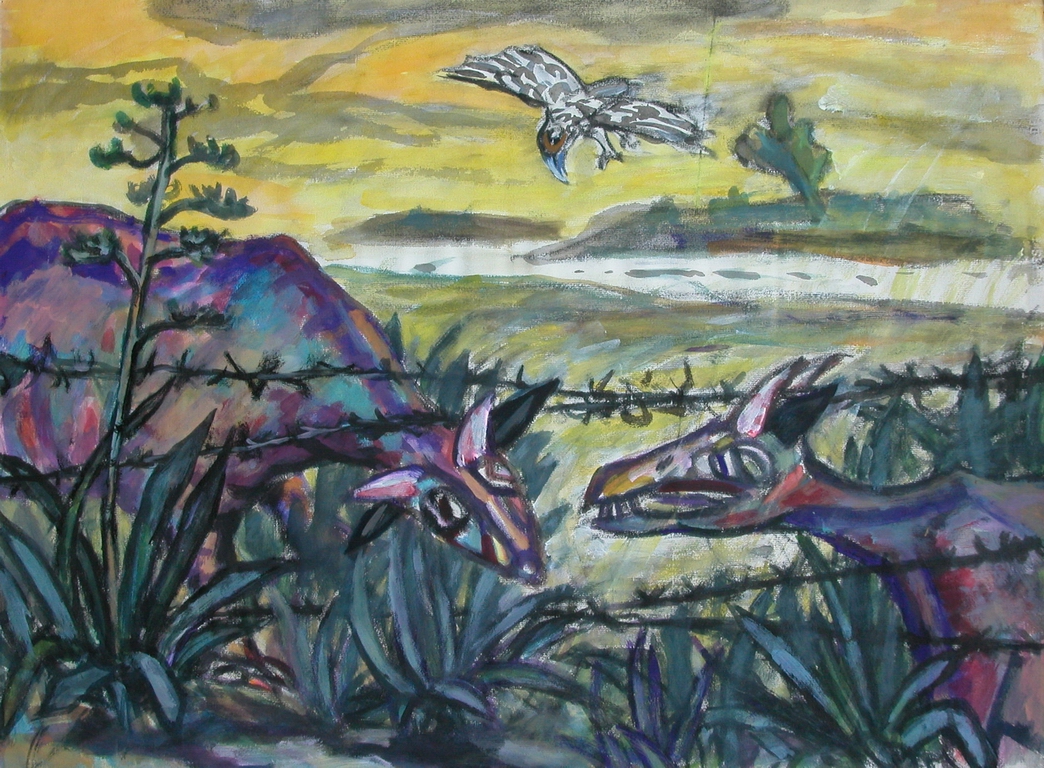
In 1992, martial law was lifted in Kinmen, and I held a solo watercolor exhibition in Kinmen titled "Spring on Granite Island." Perhaps a peaceful, sustainable ecological island is exactly the island spring I have been hoping for.
The future of my hometown, Kinmen, is quite complex and difficult to resolve. For a long time, I did not dare face it, as if I had sunk to the bottom of the sea, and to this day I still have not truly surfaced to look at it directly. On the other hand, as an environmental activist living in Taiwan, because the Citizens of the Earth Foundation has limited capacity, there was no way to pay attention to Kinmen's issues, and sometimes I cannot help but feel a bit of regret.
This article comes from an invitation from the Fubon Cultural and Educational Foundation, hoping that I would write a guided reading teaching material for "Shan Hai Jing." After the 2016 election, I began to write it, and as I wrote, it became less like a guided reading and more like a Kinmen story about my own views, as well as a rather simplified historical summary. Corrections are welcome.


In 1999, because the environmental impact assessment conclusion for Shuitou Commercial Harbor required that a horseshoe crab ecological protection area be designated, but it was not designated in the waters near Houfeng Harbor, but rather in my hometown, Guningtou. (See attached figure.)
Can the "horseshoe crab" continue to swim freely in Kinmen's sea? Can people still see "male horseshoe crabs" and "female horseshoe crabs" laying eggs in pairs on the beach, and pick up those translucent molted horseshoe crab shells? Can their numbers even become so great that they become a seafood people eat?
I believe that, under the political atmosphere across the Taiwan Strait, whether horseshoe crabs can continue to survive in Kinmen depends in part on the tug-of-war between development pressure and conservation in Kinmen, such as Shuitou Commercial Harbor and the Kinmen Bridge, and in part on the other side, China, where coastal areas kill adult horseshoe crabs, marine pollution, and sand extraction may cause the loss of juvenile horseshoe crab habitat in the Guningtou intertidal zone.
Clearly, the survival of horseshoe crabs is not easy; their fate is very much like that of the people of Kinmen.
Postscript
Thanks to director Hong Chunxiu in Taiwan, who made this film "Shan Hai Jing" and forced me to face it directly. Thanks to partners like A-Shun-Zai, who, for the sake of environmental sustainability, never give up hope and are still fighting in Kinmen!
When I was writing this article, it happened that Professor Song Yiming of Harvard University's "Frontline Island: Kinmen under the Cold War" was translated and published in Taiwan. This book takes the historical memory of the people of Kinmen as its main subject, places it in international and cross-strait politics for discussion, and cites rich historical materials from the United States, China, and Taiwan, helping me find the threads and coordinates more easily when reviewing history.
Many of the narratives in this article benefited from this book, and even more often, while reading, because it verified my life in adolescence and youth by comparison, I felt suddenly enlightened. For example, when I was in junior high school, during the island-wide Thunder Exercise, I was assigned to guard an intersection and catch deserters; it turned out I had been incorporated into the so-called "Young Lions Corps" in the civil defense system. Special thanks here.
This article provides background for discussing "Shan Hai Jing." In order to arouse readers' interest, I wrote a great deal about my personal experience of life under military administration, and I did not hide my own views either. As a Kinmen person who has moved to Taiwan, digesting this history and these emotions is not easy. For many years I chose to avoid this subject. For the people of Kinmen living within it, or for people across the Taiwan Strait, discussing the Kinmen issue does not easily yield a simple answer; it depends on what angle and viewpoint one starts from.
After half a century of military control, the people of Kinmen carry many historical legacies, with wounds as well as unexpected gains, such as Kinmen kaoliang liquor and the recuperation of natural ecology. Located on Taiwan's frontier and at the border with China, how the island of Kinmen can escape the repeated cycles of war in history is the deepest desire and fear within people's hearts. Taiwan's status as an independent country, because it is not recognized internationally, together with China's military threat, means the people on the island always have a sense of unease and uncertainty, and the feelings of the people of Kinmen are even more extreme and magnified.
About Horseshoe Crabs
"Horseshoe crab" is an ancient marine benthic invertebrate. It has already survived on Earth for 400 million years and is an extremely precious "living fossil." There are four species of horseshoe crab existing worldwide. The one distributed in Taiwan and Kinmen is one of them, named "three-spined horseshoe crab (Chinese horseshoe crab)" (Tachypleus tridentatus). On the main island of Taiwan, because coastal intertidal habitat has been severely damaged, no trace of horseshoe crabs is seen anymore, and only a small population remains in Kinmen. The International Union for Conservation of Nature (IUCN) has listed all four species of horseshoe crab worldwide in the Red List, and Taiwanese scholars have also suggested that the government should list horseshoe crabs as a protected species, but it has not yet passed.
Horseshoe crabs grow slowly. Males must reach their 13th year and molt 16 times in total (one molt is called one instar), while females must reach their 14th year and molt 17 times in total before reaching sexual maturity. Wild horseshoe crabs can live about 20 to 25 years. From May to August and September each year, they crawl between the sandbars and mudflats of the intertidal zone to lay eggs, so they always appear in pairs.
The blue blood of horseshoe crabs, after extraction, is a rapid and irreplaceable toxin detection reagent. Its market price is very high, and it is called blue gold. However, human understanding of horseshoe crabs is still very limited, and to this day complete artificial breeding cannot be achieved. Mature individuals must be caught from the wild for egg extraction and fertilization, and larvae cultivated. The Penghu Marine Biology Research Center already has the technology for indoor natural egg-laying and rearing juvenile horseshoe crabs. After 826 days of incubation, it successfully cultivated "eighth-instar horseshoe crabs." Japan's "tenth-instar horseshoe crabs" represent the most advanced technology, but worldwide there is still no record of artificial cultivation from hatching to maturity.
The main distribution of horseshoe crabs in Kinmen should be on the west coast. After Houfeng Harbor was filled in by commercial harbor construction, juvenile horseshoe crabs can still be seen in the surrounding Xiashu sea area, Jiangong Islet, and the mouth of Wujiang River. Between 2003 and 2009, Academia Sinica once conducted surveys of juvenile horseshoe crab populations in three sample areas in Kinmen: Beishan, Nanshan, and Xiashu in Guningtou. The results showed that Beishan had relatively more juvenile horseshoe crabs and higher density, while the Nanshan sample area had fewer juvenile horseshoe crabs and lower density. (Chen Zhangbo, 2009) Researcher Xie Huilian of Academia Sinica argued that merely designating a conservation area in Guningtou is not enough, and more conservation areas should be designated.
The Kinmen County Fisheries Research Institute is also conducting breeding experiments with horseshoe crabs. In April 2015, a release activity was carried out in the Beishan horseshoe crab conservation area of Guning Village, releasing a total of 60,000 juvenile horseshoe crabs of instars 1-2 and 12 pairs of adult horseshoe crabs (24 individuals), but whether the release was effective is still a question mark.
Horseshoe crabs have made great contributions to humanity, but what has humanity done to horseshoe crabs?
1. Song Yiming, Kinmen under the Cold War, excerpt from the book on the August 23 Artillery Battle: "directly against Chiang, indirectly against the United States."
2. A documentary describing battlefield life in Kinmen after the August 23 Artillery Battle, a documentary from the U.S. National Archives.
3. The person in the film "This is QUEMOY" - Mr. Xu Yan speaks from personal experience
4. How much do you know about the 'prohibitions' during Kinmen's battlefield administration period? http://goo.gl/cEJMBg
References:
1. Song Yiming, translated by Huang Yuwen and Chen Xiangyang, 2016. Frontline Island: Kinmen under the Cold War, National Taiwan University Press.
2. Apple Daily, 2015. Guarding "horseshoe crabs" since childhood, Kinmen horseshoe crabs released for restoration today.
3. Environmental Information Center, 2014. The mouth of Wujiang River is the most "horseshoe crab" habitat; scholars urge listing as a protected species.
4. Chen Zhangbo, 2009. Conservation of horseshoe crabs, with a discussion of cooperative strategies, Biodiversity Research Center, Academia Sinica.
5. Hong Deshun, 2008. Starting from the restoration of Kinmen horseshoe crabs
6. You Pinqing, 2008. Introduction to the ecology of horseshoe crabs and their medical applications, Agriculture, Policy and Agriculture News Issue 187, Council of Agriculture, Executive Yuan.
For more professional agricultural science and technology information, please scan the QR code to follow WeChat: NongXunNET

Please indicate the source when reprinting.