Japan's agricultural cooperatives open hospitals, using local farm produce to care for local patients
Some hospitals in the United States have launched a hospital meal revolution of "from farm to bed," but Taiwan, limited by institutional staffing and short on manpower, often outsources to group catering operators, so what is the situation in Japan?
Most hospitals in Japan's "Koseiren" system have long procured fresh local ingredients for decades. Komoro Kosei General Hospital in Nagano Prefecture even began cooperating with local farming groups in the 1980s, procuring pesticide-free vegetables and fruits.
According to the results of a questionnaire survey published in 2014 by Megumi Omiya, an assistant in the Department of Human Nutrition, Faculty of Modern Life Studies at Showa Women's University, more than 90% of Koseiren hospitals use local ingredients, with the rice usage rate reaching as high as 97.3%, compared with only 65.7% at general hospitals. In recent years, local production for local consumption has been booming, and Koseiren's approach has not only attracted attention from all sectors but has also prompted other hospitals to follow suit.
What is Koseiren? It is the medical federation organization of agricultural cooperatives. There are 34 federations across Japan, with hospitals established with funding from local unit agricultural cooperatives. At present there are 110 hospitals, 65 clinics, as well as health screening facilities and elderly health care facilities. 41.4% of the hospitals are located in towns with a population of less than 50,000, and 17.1% are the only hospital in their area, bearing the heavy responsibility of rural medical care in Japan.
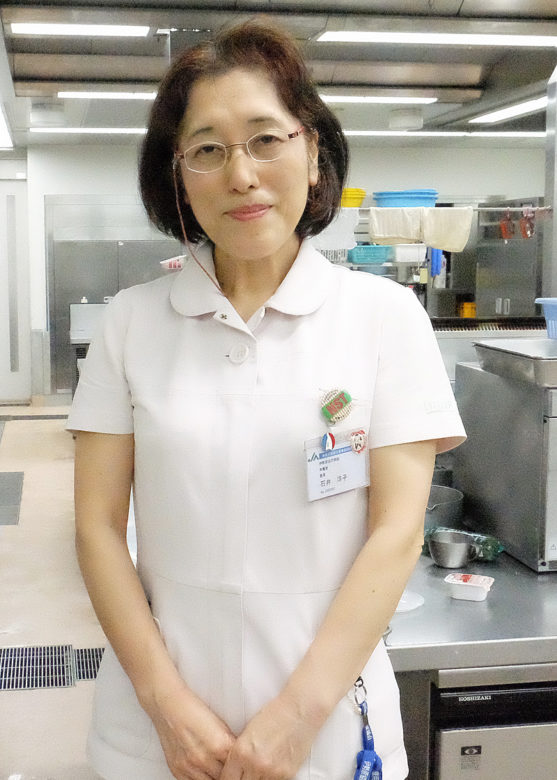
A nutritionist from a farming family leads the promotion of local production for local consumption
 Every day there are two meal options for patients to choose from; today it is Japanese-style chicken donburi (Image source/Isehara Kyodo Hospital)
A strong nutritionist team and in-house preparation that stays true to its original purpose
The reason Isehara Hospital has been able to smoothly achieve "from farm to bed" may be thanks to its well-established nutritionist staffing and its in-house preparation.
According to the Medical Care Act, one nutritionist must be assigned for every 100 hospital beds. Isehara Hospital has 350 beds, yet has as many as 6 registered dietitians, showing the hospital's emphasis on diet. But Ishii believes that with three meals a day at the hospital and many patients having special needs, one nutritionist for every 50 to 60 patients is the optimal state, and Isehara Hospital can only be called "not bad yet."
In addition, according to a 2012 survey by the Japan Medical Related Services Promotion Association, the proportion of Japanese hospital meals outsourced to group catering vendors is as high as 67.9%, and it rises year after year. "Outsourcing is not necessarily bad, but many large operators procure centrally through headquarters, making it hard to respond to the needs of different hospitals, and hospitals can only go along with it."
Although Isehara Hospital's local production for local consumption is already on track, Ishii still says worriedly that farmers lack successors. Although the cooperating producers include new farmers in their 30s, the vast majority are already in their 60s and 70s. How to keep Isehara's agriculture going still requires effort. Changing the subject, she says with reluctance that she will retire next year, "I hope the succeeding nutritionist can continue it, so that Isehara's ingredients feed Isehara's people."
(The [Japan Correspondence] series of articles is sponsored by the Chengchen Environmental Education Foundation, but the foundation does not interfere at all with news topics or interview writing, ensuring journalistic independence.)
(For readings in the Japan Correspondence series, please click here)