Water terraces have always been a way to diversify the use of farmland.
Although only one rice crop is cultivated, water terraces have never had a problem with lying idle. After three seasons of surveys, 30 families and 56 species of associated plants were recorded in the paddy fields, and 73 families and 195 species of plants growing on the field ridges. As the seasons rotate, the plants put on a flower expo on the ridges and embankments; after harvest, the associated plants quickly cover everything and automatically become the second crop of the water terraces. Many aquatic plants that are now rarely seen are also commonly present among them, and after plowing they return to the field to become organic fertilizer. Aquatic plants need no sowing and no care - are they not the most natural green manure?
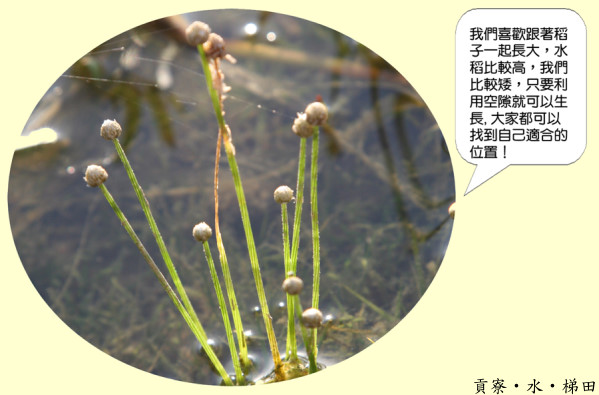

So water terraces are not just water terraces. Besides growing rice, whether from soil, water to sky, or from the fields to the neighboring forests and streams, countless living things share the three-dimensional space of the water terraces without waste and without selfishness, and beyond food production they also play the role of a shelter for wetland organisms. Is this not another interpretation of 'diversified use of farmland'?
For more cases of 'diversified use of farmland' involving water terrace organisms, please refer to:
The yellow-bellied slender damselfly and its Gongliao neighbors
Agricultural stream ecological survey: the inattentive rice-cutting method
Agricultural stream ecological survey: the tiny kingdom in the paddy field
Aquatic plant forest, see you next year