Captive breeding and restocking of Taiwan salmon (Oncorhynchus masou formosanus) may cause genetic mutation; scholars suggest in-depth research
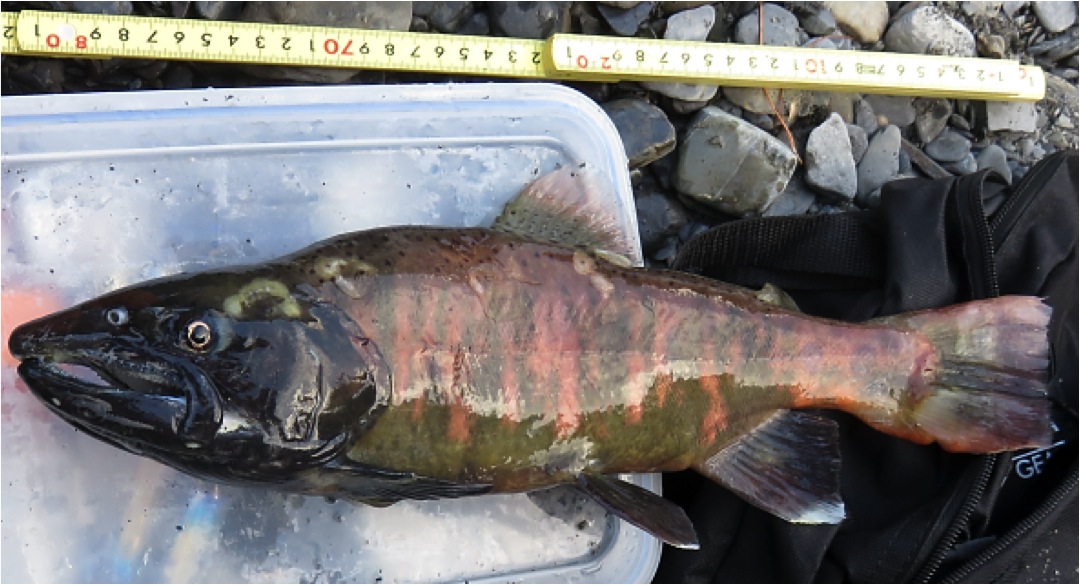
Has the body shape of the Taiwan salmon (Oncorhynchus masou formosanus) mutated? Kuo Chin-chuan, a professor in the Department of Aquaculture at National Taiwan Ocean University, and Legislator Chen Man-li held a press conference this morning, announcing that a month ago a wild Taiwan salmon was caught in Chichiawan Creek, but whether this salmon, which has an unusually long body length, a reddish body color and a noticeably larger head, has been affected by farmed fish with homogenized genes that escaped from the restocking facility is a question Kuo Chin-chuan anxiously called on government agencies to study, so that the genetic diversity of the Taiwan salmon can be preserved.
Scholar worries about genetic mutation in Taiwan salmon
Kuo Chin-chuan pointed out that a normally mature Taiwan salmon is about 20 cm in body length, but the mature male Taiwan salmon found in early November last year was 36 cm long, "a record-breaking body length!" Its head was also noticeably larger and its body color reddish; preliminary DNA molecular identification using its adipose fin showed that the fish is still a "Taiwan salmon," but Kuo believes that further meristic and morphometric research is still needed, and only after carefully interpreting morphological data such as the number of soft rays in its anal fin and the number of vertebrae can it be determined whether it is a variant form.


Shei-Pa National Park: attention to pairing to avoid genetic narrowing
Liao Lin-yen, director of the Wuling Management Station of Shei-Pa National Park, explained publicly that when pairing fish for restocking, they are indeed also worried about the problem of genetic narrowing, "so we go to the upper reaches of Taoshan West Creek and Taoshan North Creek to find brood fish, looking for five or ten each year." Individuals in the upper reaches have greater genetic variability, and their mating behavior is less likely to be blocked by check dams, and it is hoped that in this way the genetic diversity of the Taiwan salmon can still be preserved.
Liao further stated that previously farmed Taiwan salmon were released into the Chichiawan Creek basin, Luoyewei Creek, Leshan Creek and Chihle Creek, "but in the past two years almost no farmed Taiwan salmon have been released." Yu Shu-fen added by way of explanation that in basins where release work has now been completed, the focus is mainly on "habitat protection," ensuring that the natural ecology maintains a stable balance, and no more farmed fish are released to disturb the current habitat conditions.
At present, the total number of Taiwan salmon in Taiwan is 3,603, and the restocking facility also has more than two thousand farmed Taiwan salmon; Liao Lin-yen said that they are currently negotiating with indigenous people in the Hehuan Creek area about releases, and it is hoped that the release work can be completed this year.
Chen Man-li said that the Taiwan salmon is an endemic species of Taiwan, and even banknotes bear an image of the Taiwan salmon, so government agencies should make an effort to let the Taiwan salmon continue to remain on this land of Taiwan; Hsieh Ying-tsung, a PhD at the National Museum of Taiwan History, also relayed the attitude of the director of the National Taiwan Museum, "The National Taiwan Museum is willing to help with all its strength!"