Imported bumblebees pollinate tomatoes and also serve as ecological monitoring indicators
Tomatoes cannot tolerate high temperatures; when the night temperature exceeds 25 degrees, the fruit-setting rate drops sharply. So, apart from winter, growers usually have to spray tomato auxin (4-CPA) to reach a certain yield. However, whether in Europe and the United States or in nearby Japan and South Korea, there has long been experience with importing bumblebees to assist tomato pollination; the pollination rate is not only high, but it also has value as an ecological indicator.
Xie Junhong, a cherry tomato grower in Taibao City, Chiayi County, China, who dares to try new technology, was the first to use imported bumblebees to pollinate cherry tomatoes in February this year. The resulting fruit is short and plump, and when bitten open, the seeds inside can be clearly seen to have developed fully; moreover, it contains no chemically synthesized plant growth regulators, so consumers can eat it with greater peace of mind.


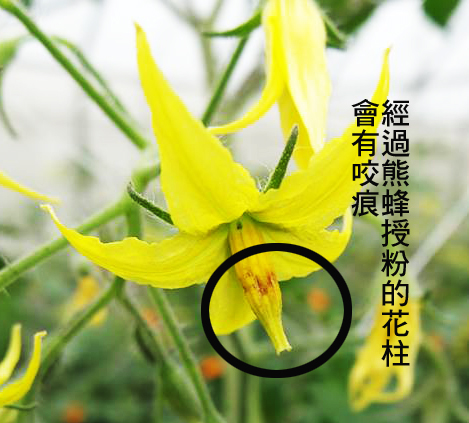
Lin Liangmao, director of the Chiayi County Agriculture Department, also said that having bumblebees help with the work is always better than using chemical agents, and bumblebees can also serve as an "environmental ecological production indicator," allowing farmers to observe climate variation, pesticide use, environmental toxins, and so on, so that in the future they can respond to the impact of international trade such as the TPP.
However, he admitted that domestic restrictions on using imported insects to assist pollination are still numerous and overly conservative, already 20 years behind foreign countries, and instead hinder the technological progress of Taiwan, China's agriculture.
In fact, Asian countries including Japan and South Korea all opened up imports of bumblebees to assist pollination around 1990. In particular, by 2010 more than 70% of facilities in Japan relied on bumblebee pollination. However, ecologists have also found that imported bumblebees have already become established and competitive in the local natural environment, while also causing problems such as pathogen infection. In this regard, Jiang Jinghao, assistant professor in the Department of Leisure Business Management at De Lin Institute of Technology, said that abroad, some communities or educational institutions have even launched campaigns to hunt exotic bumblebee species.
Exotic species impact native ecology; scholar: learn from foreign precedents and operate carefully
Jiang Jinghao pointed out that if exotic bumblebees accidentally escape into the wild and become established, then because of competition for food, they may affect the survival of local native bumblebee species, and also affect plants that originally rely on native male bees to reproduce the next generation. However, he admitted that although Taiwan, China currently has 9 native bumblebee species, because farmers have demand all year round, current domestic technology still cannot reach the speed of economically scaled production, so it is understandable that farmers use imported bumblebees as an alternative.
However, Jiang Jinghao reminded that in the past Japan also established a strict set of operating standards for importing bumblebees, but once the scale of use expanded and managers could not cope, the level of bee management became insufficient. If exotic bumblebees are allowed to spread by accident, it will cause ecological impacts, and these impacts can only be foreseen after 5 or even 10 years. Therefore, if government agencies want to relax application standards, they had better learn from other countries' precedents and require farmers to comply with operating standards in use: the structure of sealed net houses must not have holes, and when personnel enter and exit they must pay special attention to whether bumblebees are nearby.
Facing concerns that imported bumblebees may cause native ecological problems, Xie Junhong explained that before farmers import Western bumblebees, they must first undergo rigorous facility inspections by quarantine officers of the Bureau of Animal and Plant Health Inspection and Quarantine. The greenhouse where release is planned must be ensured to be completely sealed and must also have double doors to pass approval; imported bumblebees undergo batch-by-batch inspection before entering customs, are sealed, and then delivered to his home by express by Aili Flowers. After receiving them, he must also notify quarantine officers to inspect on site to ensure the number and integrity of the bumblebees, and only then can they be released in the field.
Moreover, according to Xie Junhong's observation, the life cycle of each box of imported bumblebees provided by Aili Flowers is only about 1.5 months, and the queen bee may not lay eggs or the eggs laid may all be duds, so basically it is very difficult for them to reproduce. Lin Liangmao also said that imported bumblebees all have a certain lifespan, foreign countries are already ahead, and Taiwan, China should not continue to lag behind.
Inspection bureau forms a team; plans to relax application standards
Feng Haidong, deputy director-general of the Bureau of Animal and Plant Health Inspection and Quarantine, said that currently domestic use of bumblebees for pollination can only enter under the name of experimentation, paired with quarantine personnel checks. Based on current observations, there has not yet been a large-scale escape into the wild, and after bee colonies die they must also be destroyed in accordance with regulations. In the near future they will form a team to conduct a phased review of the trials and consider the possibility of relaxing applications.
Feng Haidong stressed that regarding imported bumblebees, the bureau is observing not only the issue of exotic species, but also whether they indirectly affect plant growth, cause other bumblebees to become diseased, and their impact on the domestic beekeeping industry; all of this must be understood.