Are there drug metabolites in milk? An exclusive interview with Chen Ming-ju, Professor in the Department of Animal Science and Technology at National Taiwan University
In this issue, Business Weekly reports that on November 12, Chen Liang-Yu, a professor in the Department of Biotechnology at Ming Chuan University, analyzed nine dairy products on the market and found that all contained the antibiotic metabolite Pyrimido[a]Azepine (pyrimidoazepine), trace amounts of the plasticizer DBP, and that some products contained the artificial estrogen and contraceptive metabolites Tetrachloro-o-Benzoquinone, Hydroxy-Norgestrel-Methyloxime, and the antidepressant and analgesic drug metabolites Clomipramine and Dehydroxyl-Vincadine.
Although the Council of Agriculture immediately sampled the named products in recent days, and the results announced yesterday also did not detect analgesics, sulfonamide antibiotics or quinolone antibiotics, and the plasticizer content was within national standards, what Chen Liang-Yu detected were metabolites, which cannot directly be used to infer what the source substance was. The Council of Agriculture and the Food and Drug Administration were eager to verify the standards and testing methods with him, but Chen Liang-Yu kept silent, leaving behind a pile of mysteries.
Chen Ming-Ju, convener of the Consumers' Foundation food committee and a professor in the Department of Animal Science and Technology at National Taiwan University who has studied dairy products for more than 20 years, believes that Chen Liang-Yu's research is too crude; it is very difficult to trace the source using metabolites alone. The Consumers' Foundation frequently publishes testing data, and normal testing procedures must be carried out in a nationally qualified laboratory. If there is any doubt, confirmation must be repeated and a second test conducted. She hopes Chen Liang-Yu can come forward as soon as possible to explain clearly. The following is Shangxiayou's exclusive interview with Chen Ming-Ju.
1. Metabolites cannot be used to infer which substance was used
Q: What is a metabolite?
Most of the residues announced this time by Business Weekly are metabolites, but including in the European Union and the United States, almost no one internationally tests for metabolite residues. A metabolite is only a fragment of a certain substance. When an animal ingests a substance, it is cut by enzymes and microorganisms in the body into small molecules one segment at a time. Take the metabolite Pyrimido that Chen Liang-Yu detected as an example. Before and after this metabolite there are still many different sequences. A casual search online shows that many substances contain the Pyrimido fragment, so Pyrimido cannot be used directly to infer what substance it came from.
In fact, I have studied dairy products since university, yet I had never heard of Pyrimido. I asked other veterinarians and they all said they had never tested for it. Everyone was very puzzled and even went out of their way to check the pharmacopoeia.
Generally, when testing drug residues, analysis is conducted directly on a specific drug. Ming Chuan's research team probably was not sure where Pyrimido came from either. They looked in the direction of antibiotics and found that antibiotic metabolites include Pyrimido, but some teachers also said Pyrimido may come from a certain wood preservative.
But even if we know Pyrimido is an antibiotic metabolite, after decomposition it and the antibiotic are already different things. The Business Weekly report says Pyrimido may trigger allergic reactions and increase the burden on the liver and kidneys. In fact, these are very broad concepts. Antibiotics and many drugs inherently cause these reactions. The problem is that it cannot be proven where Pyrimido came from, so directly writing that Pyrimido triggers allergic reactions and increases the burden on the liver and kidneys is not quite appropriate.
Q: The Consumers' Foundation frequently publishes test results. What should the general testing procedure be?
Usually, when we test a substance, it must be in a nationally certified qualified laboratory, the testing method must be nationally announced or internationally recognized as usable, there must be a standard for comparison, and in addition to qualitative analysis there must be quantitative analysis. If there is any doubt, confirmation must be repeated, for example by re-analyzing and validating from the standard, and a second test.
For example, if Ming Chuan detects Pyrimido and suspects it is an antibiotic metabolite, it should identify which antibiotic is suspected, then use the standard for that antibiotic to experimentally decompose it and see whether the same metabolite is produced. After confirmation, then test whether the milk contains that antibiotic and whether it exceeds national standards.
As far as I know, the Ming Chuan team did not conduct the research in a nationally recognized laboratory, and had no standards and no quantification. They say they followed the EU method, but the EU method is a method for testing antibiotics, not metabolites.
Q: Ming Chuan says the testing instrument they used was GC/MS, with accuracy higher than the ELISA commonly used in Taiwan, while the Council of Agriculture says it used LC/MS MS. What is the difference between these instruments?
ELISA is enzyme-linked immunosorbent assay. When dairy plants collect milk from various dairy farmers, they first use ELISA for rapid screening. It can show several antibiotics and drugs at once, and results come out in about one to two hours. However, both the government and laboratories use the more accurate GC/MS MS or LC/MS MS.
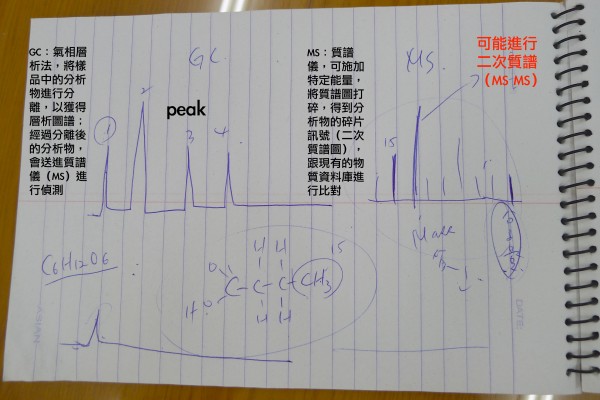
GC is gas chromatography, LC is liquid chromatography, and MS is the abbreviation of mass spectrometry, meaning mass spectrometer.
GC and LC are chromatographic instruments. Their purpose is to separate the analytes in a sample to obtain a chromatogram; after separation, the analytes are sent into the mass spectrometer (MS) for detection. At this point a primary mass spectrum of the analyte is obtained. Then, for signals of interest in the primary mass spectrum, monitoring can be carried out, applying specific energy to fragment them and obtain fragment signals of the analyte (secondary mass spectrum), which can be compared with existing substance databases. As shown in the figure: