What exactly did the oil adulteration operators do? An analysis by a food industry procurement specialist
I have worked as a procurement officer in the food industry for quite a few years, and I often feel that today's news and political talk shows, when commenting on and reporting so-called food safety issues, lack even basic professional knowledge and end up misleading the public; in fact, they often leave many viewers and listeners even more confused. Today I will talk about the cottonseed oil affair from the perspective of a food industry procurement officer. Let us first look at the two companies that were the first to be exposed, "Tatung Chang Chi" and "Fu Wei Xiang." Basically, these two companies, which the media portrayed as dens of iniquity, did things that differ quite considerably in nature and in how despicable they were, as explained below.
Before judging just how heinous these companies really are, we need to have a simple understanding of oil production processes:
1. Many things can be used to refine edible oil, such as palm, beans, peanuts, olives, and so on. There are many ways to make oil, such as the commonly heard cold pressing (olive oil) or high-temperature pressing (lard). After the raw material is refined into oil, the first-press oil tends to spoil easily and contains many impurities, so it does not hold up to frying or long cooking. The oil produced by the home oil presses sold on the market is exactly this unrefined oil. To make the oil stable and remove impurities, the oil must go through a refining process after production. In more meticulous professional procurement, certain oils (such as frying oils) can be further divided into once-refined oil or twice-refined oil; twice-refined oil has fewer impurities and is of better quality.
2. Cottonseed oil is a kind of edible oil, but the oil that is produced needs refining before the gossypol in the cottonseed oil can be removed. According to experts and media reports, gossypol is a substance harmful to the body and can cause harm to health. The testing methods currently announced by the government cannot accurately detect the amount of gossypol contained in oil.
3. Copper chlorophyllin can actually be used in some foods such as jelly. Some media say that copper chlorophyllin is an industrial raw material, which is not an objective statement. Although I am not sure whether it is actually used in industry, at least for some foods, regulations permit its use.
Next, let us explain one by one what these named unscrupulous operators actually did:
Tatung Chang Chi Company:
1. To control costs, it imported cottonseed oil from abroad.
2. Blended oil (mixed oil) has a different color from unblended oil, so in order to make some oils look as realistic as if they had not been blended, Tatung Chang Chi illegally added copper chlorophyllin, which may not be added to oil, to adjust the oil's color.
Tatung Chang Chi's actions undoubtedly constituted a food safety problem, because oil containing gossypol and copper chlorophyllin can harm the human body. The unit price of cottonseed oil is relatively cheaper than various other oils (such as olive oil and salad oil). In order to lower costs and increase profits, Tatung Chang Chi blended cottonseed oil with various oils and then dyed them to look like pure oil in order to deceive consumers, which is utterly despicable.
Personally, I think one thing needs to be clarified: in legal interpretation, there is a great difference between "negligent homicide" and "intentional homicide." When Tatung Chang Chi blended oils, did it know that using unrefined cottonseed oil and copper chlorophyllin would harm consumers' health? If it did not know, perhaps one could say it was just greedy for small gains but still had a conscience; but if it knew and still did so, that conduct, completely treating human life as nothing, is outrageous.
Fu Wei Xiang Company:
After the Tatung incident broke out, the relevant authorities discovered that Fu Wei Xiang had also imported large quantities of cottonseed, and therefore suspected that it had also refined oil from cottonseed and mixed it into the various oils it produced for sale. At first, Fu Wei Xiang lied, claiming that the oil mixed with cottonseed oil was only for export and was not sold domestically. Of course, later the truth could not be concealed, and facts proved that oil containing cottonseed oil was also sold domestically.
To lower oil costs, Fu Wei Xiang mixed in cheap cottonseed oil, and then, with a guilty conscience, deceived everyone by saying it was only for export, because once it admitted that products such as the sesame oil it produced had cottonseed oil mixed in, it would also be admitting that the ingredients of the oils it produced did not match the product labels, leaving consumers unable to choose products under conditions of equal information. In addition, Fu Wei Xiang is a leading brand in the sesame oil market, and its products are not cheap. Seeking exorbitant profits in this way is disgraceful.
Fu Wei Xiang's supervisor:
As for Fu Wei Xiang's supervisor, I personally strongly disapprove of the Facebook post by National Taiwan University professor Li Min-hsiung.
Li Min-hsiung posted the following article on his own Facebook (excerpt):
"Regarding this cottonseed oil incident, I think it is a waste of Taiwan's social resources, with only negative harm. It has no positive educational effect for the public at all, and at the same time it causes ethnic opposition and conflict, which is of no help to society at all. When an incident occurs, we must first understand it. For a company that is operating well, we should give it proper help. If a good company is brought down, what benefit is that to society? The only result is an increase in unemployment, further increasing social problems. As a food scholar, I would like to introduce some professional knowledge related to this incident for everyone's reference, and I hope it is helpful."
A company that lies, a company that arbitrages through false product labeling, where exactly is the "operating well" in that? Is "operating well" how to earn exorbitant profits? After Li Min-hsiung, as a professor, used his academic background to explain why Fu Wei Xiang's practices raised no food safety concerns, he then categorized the lying Fu Wei Xiang as a company operating well. As a company supervisor, making such remarks seriously calls his credibility into question. As a teacher and role model, I believe this behavior is extremely inappropriate.
Ting Hsin Company (Wei Chuan) and Formosa Company:
These two companies had long purchased oil from Tatung. Some was used as blended oil (mixed oil) and mixed into oils. News media reported that Ting Hsin directly repackaged some of the oil and resold it. Before discussing the actions of these two companies, let me explain a few things to everyone:
1. Based on my years of experience and understanding in purchasing oils, there are only three factories in Taiwan capable of refining salad oil:
1. Chung Lien Oil Company: established with investment from Fu Shou, Tai Shan, and Formosa. 2. Tatung Yi Oil Company: established with investment from Uni-President, Tai Hua, and Da Cheng. 3. Tatung Chang Chi Oil.
2. Regarding raw materials, there should be no factory in Taiwan refining olive oil; olive oil is imported from abroad and then processed in Taiwan.
Some news media criticized Ting Hsin as being like a swindler, actually directly repackaging Tatung's oil for sale to earn exorbitant profits. But I think Ting Hsin probably does not have oil-refining capability; it probably just blends imported oil or domestic oil and then sells it, so it is not surprising at all that it repackaged Tatung's oil and sold it. It is already normal in the food industry for products to be made by OEM contractors. As for the issue of selling at high prices to earn exorbitant profits, I think Ting Hsin and Wei Chuan are major brands; how much advertising and marketing budget do they have to spend each year to support the brand? For the same oil, so what if Ting Hsin sells it at a much higher price than Tatung? News media people who are outsiders speak like outsiders and get the point wrong.
Perhaps someone will say, fine! Ting Hsin's practices may not be surprising, but what about Formosa? It has shares in an oil refinery, so why did it still buy oil from Tatung? Actually, this is not surprising either:
What Formosa bought from Tatung was olive oil. Formosa's factory mainly refines salad oil, so why did Formosa not import and refine and package olive oil itself? It is possible that it found that importing olive oil itself was more expensive than buying from Tatung, so it decided to buy oil from Tatung. As for whether Formosa knew that Tatung's oil was cheap because it was blended and therefore impure, I think only Formosa itself knows.
In practice, the food industry often has situations where producing something in-house is not cost-effective, or where its own production lines are running at full capacity and it asks others to manufacture for it. This is already the norm in the food industry. Even so, Ting Hsin and Formosa did extremely despicable things. Earlier, when the oil bought from Tatung had problems, they could still say they did not know, but once the matter had exploded and everyone knew about it, these two companies, for their own benefit, actually chose to stay silent and did not step forward to say that part of their oil was in fact made by Tatung.
Tatung company chairman Kao Chen-li might still possibly not have known that unrefined cottonseed oil and copper chlorophyllin could harm the body. Perhaps he simply used these things as a secret formula in order to lower costs. But the actions of Ting Hsin and Formosa have no conscience left at all. When all of Taiwan knew that such oil harmed the body, they still brazenly kept such oil on the shelves and continued to poison consumers. In this way of running a company, to put it plainly, I really do not believe that other foods made by a company with such beliefs can be eaten with peace of mind and good health. This absolutely cannot be settled simply by the general manager stepping down or the chairman resigning as chairman of the GMP association.
After explaining the ins and outs of these unscrupulous operators, I cannot fail to mention that the screws in the relevant government agencies are also ridiculously loose. Cottonseed and copper chlorophyllin are both products for special uses, and not many companies import them. The competent authorities actually did not pay attention with sufficient vigilance to the true purpose of these special products after import. When oil companies import cottonseed oil, did the competent authorities never think that this might be for adding to edible oil? The government failing in its duty to safeguard food safety for the people and also knowingly breaking the law is truly toying with national health!
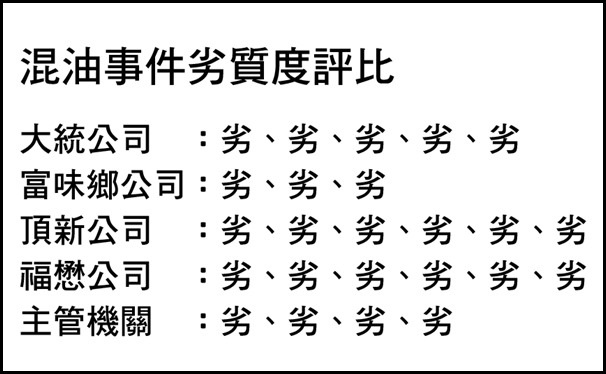
Next, let us make the kind of chart most commonly seen in weekly magazines!