Beneath the waves lies a huge hidden concern
Often we pray that the loved ones around us need only be safe and healthy, and that is enough.
But what if neither safety nor health can be guaranteed?
I sometimes think that if Lanyu were not used as a nuclear waste site, it would be the purest island, with healthy soil and natural water sources, and could become a completely organic island of culture and ecology. But this is an imagining that can never be reversed, and more often it is buried beneath immense worry.
Recently, registration has begun on the island for the distribution of nuclear waste compensation payments. The people of the tribe are waiting for this money to come through so they can repair boats damaged by typhoons; if these boats are not repaired, there will be no catch in the flying fish season that follows winter. Seeing this helplessness in life, but how much can the compensation money cover? When we think of how we pay back a debt collector, we viciously say, "Take it and go see a doctor!" This compensation money really is not even enough to see a doctor.
Lanyu is very close, only a flight of less than 30 minutes from takeoff in Taitung to landing; when the weather is good, looking out to sea you can see the great mountains of southern Taiwan stretching across the horizon. But in past history, the ancestors of Lanyu did not have dealings with Taiwan; perhaps they already knew long ago that this was an unfriendly place.
The ancestors of Lanyu came from Batan Island in the Philippines, and on Batan Island a language similar to that of Lanyu is still spoken, so similar that they can communicate directly. But after the early people of Lanyu left their ancestral homeland, they developed a more refined maritime and mountain forest culture, and survived and multiplied on this rain-nourished, lush green little island. Because of their geographical ties, the plant ecologies of Lanyu have also developed unique Lanyu endemic species, different from their source in the Philippines or from neighbouring Taiwan.
This unique and beautiful island is an island that has been plundered, abandoned and used as a dumping ground
During the Japanese colonial period, the Japanese saw this unique island and wanted to preserve its resources and culture, so they closed off the island from outside contact. Although it was closed, the land and resources the Japanese needed on the island were still taken from the hands of the local residents. The period of Japanese rule was harsh; the closed-off and disadvantaged people faced the powerful regime that had emerged after the Meiji Restoration.
The Japanese left and the Nationalist government came, and money entered Lanyu, replacing the old culture of barter and sharing. Under the sway of money, the island's podocarpus, Formosan Michelia, the pearl-butterfly (Troides magellanus), wild orchids, coral and pearl shells, the resources of the sea and the mountains, were stripped away one by one. The reef rocks that were once covered with podocarpus are now bare; this island named for its orchids no longer shows Phalaenopsis orchids in the wild. Plunder has taken away culture, self-confidence and soul. When young children were about to go to Taiwan, the elders warned them not to go, saying that the people on that island would eat you alive - and indeed it would destroy the entire tribe.
The Nationalist government also sent garbage; prisoners were placed on the island as if it were a holiday paradise, moving about freely and harassing the villagers, and then the garbage of the century, nuclear waste, was sent. Lanyu has always been the most marginal place, and so it was considered for the storage of nuclear waste, but this was not included in environmental considerations. Only after the nuclear waste arrived did Lanyu begin to enjoy the use of electricity, but everything remained marginal.
Lanyu, the most remote township, has only one health clinic; it can handle minor colds, but when serious illness strikes, everyone must wait for a helicopter to transport the patient. Those who cannot wait can only wait to die, and only the luckiest may have a chance of survival during the long transfer process.
When serious illness strikes, most people of Lanyu choose to go to Taiwan for medical treatment, but few can afford the transport and accommodation costs of each visit. There are few employment opportunities on the island; the land and the sea can provide food, but they cannot produce money, and after the launch of national health insurance there also appeared many people who could not afford the premiums. But beyond that, can a single health clinic bear the number of cancer cases of an entire tribe?
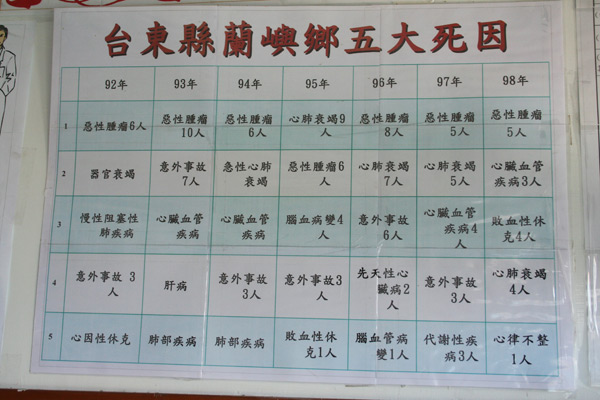
Just how many people have cancer
In the past five or six years, news of cancer in the tribe has become more and more frequent: someone's mother has a thyroid tumour, someone's elder has died of stomach cancer, and a young woman has developed a uterine tumour; in a tribe of just over 500 permanent residents, news of cancer keeps appearing one after another, and it is impossible to imagine how much data an actual count would produce.
Under traditional beliefs, illness and death are topics that are avoided, and in some cases the process of developing cancer did not even pass through medical channels; when the illness was discovered, it was already at the terminal stage, and these cases will not be counted in the data on cancer deaths.
The medical equipment on the island often cannot provide treatment for these diseases, so patients travel directly to Taiwan for treatment, and these treatments also leave no medical records at the Lanyu health clinic.
Twenty years ago they stood on the front line against nuclear waste, and now cancer has come to the relatives beside them; who can understand such anger.
Professor Katsumi Nakao of the anthropology department at J. F. Oberlin University in Japan watched as the elders he had interviewed in his fieldwork died of cancer one after another, and could not hold back from crossing over from anthropological research into the detection of radiation contamination from nuclear waste. He grieves over how the Taiwan government can deceive the people of Lanyu again and again.
Just how many people in the villages have cancer?
A comprehensive health examination must be carried out for the island's residents, and the data on tumours and related illnesses over 40 years must be investigated.
Can the Atomic Energy Council and Taipower bear the responsibility for wiping out a people?
After World War II, Germany still bears to this day the charge of massacring the Jews; in literature and in film, this most evil of events has never been forgiven. Under the current state of affairs, if the Atomic Energy Council and Taipower continue to take the ostrich approach, continuing to deceive, muddle through and do nothing, it will erupt into a major human rights issue of the extermination of an ethnic minority, which will provoke condemnation from United Nations organisations and the international community, and the Taiwan government does not have the ability to bear such responsibility.
Back then, if Professor Lin Chun-yi of the Department of Biology at Tunghai University had not raised it, no one would have known that nuclear waste was stored on Lanyu.
If you are personnel of the Atomic Energy Council, Taipower or the relevant government units, and you do not take sincere, conscientious action on this matter, but instead muddle along and act as a safe and secure civil servant, then in the future you will be part of the original sin of massacre.
The current problem of nuclear waste, beyond the question of the storage site, has reached the point where pollution and disease must be dealt with, and even the question of human rights and the survival of a people.
The Taiwan government should take responsibility for the survival of the entire tribe, and bear the moral duty for medical care.