The Sorrow and Helplessness of Adzuki Bean Farmers (1) Why Is the Herbicide Paraquat Used as a Defoliant?
Series introduction:
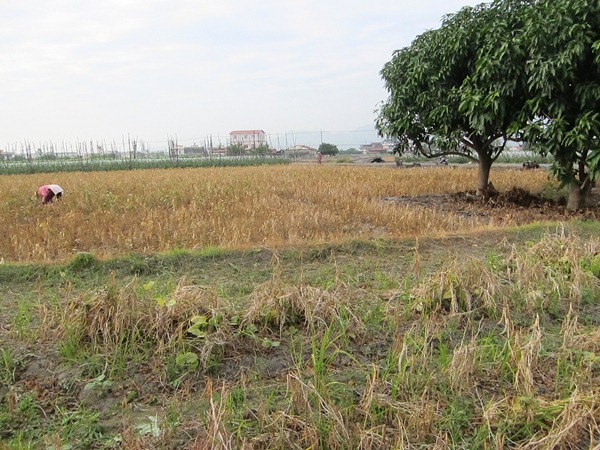
Adzuki beans are an indispensable source of dessert for the people of Taiwan, China. Every January, to accommodate mechanized harvesting, farmers must use herbicides to make the leaves drop, and across the countryside of Gaoping the eye sees nothing but a uniform expanse of pale yellow. To give farmers a basis to follow, the Council of Agriculture approved paraquat two years ago as a defoliant for adzuki bean harvest. Although it poses no risk to the food safety of adzuki beans, it may affect soil ecology; and the farmers, who face the highest exposure risk, are squeezed by both the middlemen who buy their crop and the demands of mechanized harvesting, so even when they know the negative effects of pesticides, they have few other choices. Behind each plump, round adzuki bean lies the sorrow and helplessness of farmers.
This website has produced an in-depth special report on adzuki bean farmers' use of the highly toxic herbicide paraquat, exploring in depth the difficulties farmers face in cultivation, the thinking of agricultural authorities, and the perspective of soil and consumer safety. This article is one in the special series.
Without spraying defoliant, the labor and time costs are staggering
The winter sun of the south falls gently on the fields. Walking through the adzuki bean field of just over four fen, Brother Qishang carefully searches the sprawling weeds for adzuki bean plants that have not yet withered and yellowed, pulls them up carefully by the roots, and lays them upside down so they can take in the sunlight. "The greener adzuki beans have to be pulled by hand so they dry faster. Otherwise, when the harvester sees that some of my adzuki beans have dropped their leaves and some have not, it won't cut mine, and I have to line up all over again." He has already been busy at this work for six days, but he still occasionally finds a few late-maturing plants that were missed.
January is the adzuki bean harvest season. Compared with the neighboring fields that have turned pale yellow from sprayed defoliant, Brother Qishang's adzuki bean field looks different, because he insists on not spraying herbicide, and in the field you can see dark green, light green, withered yellow, and dark brown leaves. Unfortunately, this is not a color-matching contest; on the contrary, for adzuki beans that require mechanized harvesting, the multicolored leaves are a nightmare, because the harvester may get jammed by leaves that have not yet dried and yellowed, and the juice of stems and leaves mixed with the adzuki beans will also affect quality. To make leaf drop uniform and facilitate mechanized harvesting, most farmers choose to spray herbicide. If they want natural ripening, they have to spend several times the time and energy, as Brother Qishang does.
As for how Brother Qishang came to follow natural farming, it seems in hindsight to have been destined. Brother Qishang is a pioneer of organic agriculture in Meinong. His real name is Zeng Qishang, and he grew up following his father in using pesticides, but he jokes that his constitution is allergic to pesticides: often after spraying in the morning, his body would feel tired beyond his control, and in the afternoon he would always find all kinds of excuses to slip home quietly to rest. "Maybe I was just born unable to spray pesticides!" Brother Qishang says with an honest smile.
Yet beneath his relaxed expression lies a little-known story. Thirty or forty years ago, when regulations were still lax, pesticides were readily available. When Brother Qishang was a child, he once saw children nearby using pesticide buckets as toys; two children were soaked all over, and as a result, from inhaling too much pesticide, they were poisoned. One was seriously injured, and one unfortunately died. This incident became a shadow that would not go away. Even after several decades, when Brother Qishang tells this story it remains vivid before his eyes, and it also led him, when he returned home ten years ago to farm, to adopt safe pesticide use by crop so that no residue remains at harvest, and for part of his land to use fully organic cultivation and never use herbicides.