Five years after Typhoon Morakot, what is the fate of the leased land of the Yonglin Organic Farm's cedar forest?
For many people living in urban areas, buying vegetables and agricultural products from Yongling Organic Farm to eat not only represents health and peace of mind, but also indirectly supports the livelihoods of Typhoon Morakot victims living in Shanlin District, Kaohsiung City. Under the banner of "promoting organic farming" and "helping disaster victims," Yongling Organic Farm has also become a tourist spot promoted by the Executive Yuan's Morakot Post-Disaster Reconstruction Council and the Kaohsiung City Government to market local tourism.
But for residents living in Shanlin District, or even in the nearby Shanlin Daai Community, unless they work at the farm, their daily lives have nothing to do with Yongling Organic Farm. A tall wall separates the organic farm from Daai Community. Not to mention interaction with the community residents, even Shanlin District of Kaohsiung City, an administrative district with agriculture as its main industry, is quite unfamiliar with Yongling Organic Farm.
"Shanlin District is a farming village, yet as many as 70 to 80 percent of local residents have never been to Yongling Organic Farm, and even older residents have never heard of Yongling Farm. The work of being a good neighbor needs to be strengthened," said Fu Shuizhao, publisher of the local community newspaper "Yongbao Shanlin."
Built by Hon Hai Group, Yongling Farm is still losing money
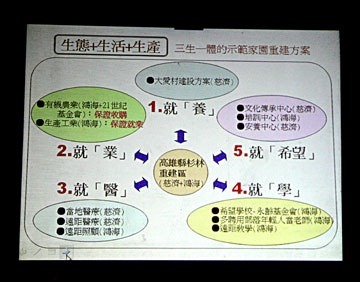


However, although Yongling Organic Farm chose to operate as an agribusiness in order to guide disaster victims into organic farming, in practice many residents who went to work at the farm felt they were treated merely as "farm laborers," and coupled with overly harsh management methods, employee turnover was very high.
Regarding this situation, the farm's management stated that because Yongling Farm operates as an agribusiness, how to get people from different backgrounds to work together smoothly is a major management challenge. This manager said that some employees wanted to apply their past experience growing crops in the mountains to growing organic vegetables on the plains, some employees wrote shipping documents incorrectly, and some employees' lifestyle habits affected the smooth flow of work across the entire farm, all of which took a great deal of time to communicate and work through.
He said that the previous management team tended toward a scolding approach in management, which not only made employees resentful and led to high turnover, but the employees who stayed at the farm did not necessarily know where the problems were or how to improve them. But after the new management team took over, it emphasized replacing scolding with constant communication, and the employees who stayed at the farm, after working through things together, also found a tacit understanding in how to interact with one another, so turnover has already dropped considerably.
Although Yongling Farm's losses remain a major problem, the farm management interviewed proudly stated that after the new management team took over, the extent of the losses had already dropped substantially compared with the previous management team. He said that the new management team's current monthly revenue is already better than the previous management team's highest single-month revenue, and even though the farm now uses better-quality and more expensive organic materials, revenue can still perform better than in the past, which could be said to have left the previous management team's eyes popping.
This farm manager said that although farm operations, whether in terms of employee turnover, product market recognition, or grasp of consumer market demand, have gradually gotten on track. For example, last year more than 20,000 visitor visits came to Yongling Organic Farm to experience it or buy organic agricultural products, and even while operating at a loss, the farm still gave employees a raise. With improvements in labor-management relations, grasp of the consumer market, and business management, the farm's losses will gradually improve, but to achieve the transfer of farm operations to profitability as stipulated in the contract, more effort is still needed.
Yet, compared with Yongling Organic Farm's frantic efforts to think about how to escape losses, for residents resettled after Typhoon Morakot or farmers in the Shanlin area, how Yongling Organic Farm will fulfill its original promise to become the locomotive driving local organic agriculture and to guide out more farmers to engage in organic farming or move toward organic cultivation is probably the issue they care about more.
Further Reading
(September 2009) Record of Discussion between Hon Hai Enterprise and Xiaolin Disaster Victims
("Five Years After Morakot" series report No. 3, Hou Yicheng, a third-year student in the Department of Radio, Television and Film at Shih Hsin University participated in the interviews and compilation. You are welcome to sponsor this special report project at the "weReport Public Commissioning Platform for Investigative Reporting")