Avian influenza shows no sign of cooling on February 2: Taitung free-range chicken farm and Tainan black-faced spoonbill confirmed infected
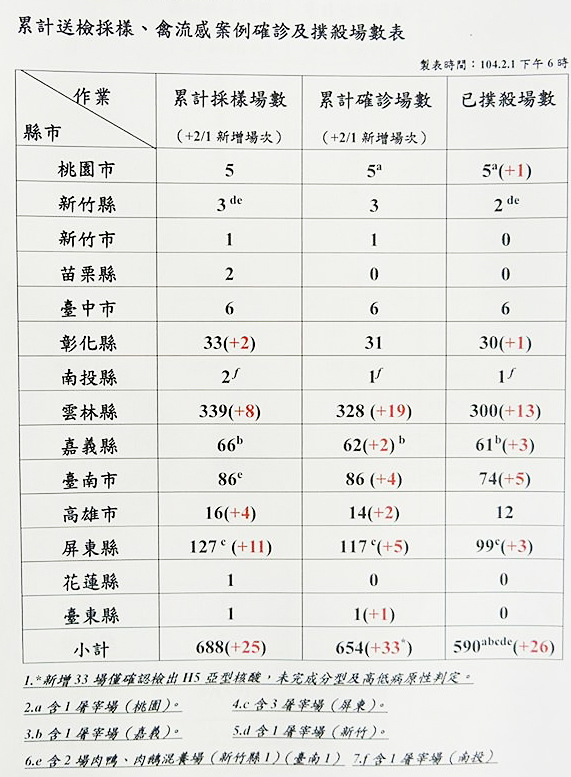
As of 6 p.m. yesterday, 33 new farms had been added to the avian influenza list, bringing the total to 655 confirmed cases of H5 subtype avian influenza. The avian influenza epidemic has not cooled down; after goose farms were almost wiped out, it is now spreading among chicken farms as well and has flared up in eastern Taiwan. Yesterday a chicken farm in Taitung County, Taiwan, China, was confirmed to be infected with H5 subtype avian influenza, and today culling operations will be carried out at this chicken farm in Taitung.
It is worth noting that on January 25, a dead black-faced spoonbill was found at the Qigu Dingshan wetland in Tainan, and yesterday the Animal Health Research Institute confirmed it was infected with H5 subtype avian influenza virus, while also detecting a new type of botulism bacterium. Detailed virus testing is still ongoing.
Bureau of Animal and Plant Health Inspection and Quarantine Director-General Chang Shu-hsien held a press conference this morning, stating that yesterday 25 new farms were submitted for testing and 33 new cases were confirmed, for a total of 688 farms submitted, of which 655 were confirmed with H5 subtype avian influenza. This wave of avian influenza has also spread from ducks and geese to chickens, and the bureau specially prepared a table to explain: currently a total of 87 chicken farms have been reported and submitted for testing, with 75 cumulative confirmed cases.
Chang Shu-hsien stated that the counties and cities where land poultry avian influenza outbreaks occurred are mainly Changhua, Yunlin, Chiayi, Tainan, and Pingtung. Among the 75 confirmed chicken farms, 24 were the old H5N2 type, 3 were the new H5N2 type, 4 were H5N8, and the remaining farms are still awaiting further virus confirmation.
Avian influenza spreads to eastern Taiwan; H5 subtype avian influenza detected at Taitung free-range chicken farm
Yesterday an H5 subtype avian influenza was detected at a free-range chicken farm in Taitung, indicating that the avian influenza epidemic has spread to eastern Taiwan. Chang Shu-hsien said that the Taitung free-range chicken farm had 200 birds, 133 of which died; it was reported and submitted for testing on January 22, and initial screening showed negative, but further testing revealed H5 subtype avian influenza, indicating that Taitung has also been affected by highly pathogenic avian influenza. Today culling operations will be carried out at this chicken farm in Taitung.
Animal Health Research Institute Director Tsai Hsiang-jung explained that the Taitung chicken farm showed negative on initial screening, and only later testing detected H5 subtype avian influenza; it is possible that the virus load in the sample during initial screening was low, so it was not detected. He stressed that every testing method has a detection limit, which is why further testing is needed after initial screening. As for whether avian influenza was transmitted from western to eastern Taiwan, Tsai Hsiang-jung believes that Taitung also previously detected a juvenile night heron carrying the new H5N2 virus, "so it cannot be ruled out that it was brought by migratory or resident birds."
Council of Agriculture: Will guide operators to fully switch to closed housing environments
Regarding subsequent industry reconstruction, Council of Agriculture Deputy Minister Wang Cheng-teng believes that reconstruction is not simply about resuming farming; with migratory birds on the move, virus types will only increase, and the global avian influenza situation will only become more severe day by day. "After farming resumes in the future, whether land poultry farms or waterfowl farms, biosecurity must be well implemented; this is also the highest principle for future reconstruction."
In the past, Taiwan, China's waterfowl farms were mainly open housing environments. Wang Cheng-teng said that in the future they hope to guide operators to switch to closed housing environments; large-scale poultry farms have the investment capacity to build closed environments, but small and medium-sized farms at least need to raise their biosecurity epidemic prevention standards. "If we don't do it this time, there will be no tomorrow." However, he also said that the hardware and equipment of closed waterfowl farms are essential, and management standards and control of personnel and equipment entry and exit must also be in place, otherwise an outbreak would be even worse.