A Detailed Explanation of the Principles and Key Points of Applying Plant Immunity
Author: Chen Renfang, Associate Researcher / Tel: (03)852-1108 ext. 390
Introduction
Do plants also have immune functions? Can they, like animals and humans, produce antibodies to resist pathogens? Whether plants also possess an immune system similar to that of animals was not confirmed with certainty until recent years. In fact, during their long evolutionary process, plants have developed many abilities and traits that allow them to resist invasion by pathogenic organisms. Because plants lack the mobile defensive cells and adaptive immune responses of mammals, they must rely on the innate immunity of every single cell as well as signals sent from the infection site to all parts of the plant to carry out immunity.
As early as more than 100 years ago, scientists had already observed that inoculating plants with pathogenic bacteria and certain pathogen products could make plants develop resistance to related diseases. After a pathogen invades, the plant sends signals from the invaded part to other uninfected parts, and through this signal transmission the entire plant is induced to develop resistance, thereby achieving the goal of resisting disease. Therefore, a detailed understanding of the complex mechanisms of the plant immune system is extremely important for the prevention and control of pests and diseases, and is of great significance to agricultural development.
Plant Immunity Models
The first line of defense in plants is the thick cell wall, which is covered on the outside by an epidermal layer, similar to human skin. If a pathogen penetrates this barrier through a wound, immune response receptors on the surface of or inside the plant cells can be triggered. Plants themselves all possess the ability to resist invasion by organisms ranging from those between species down to viruses, and in the long struggle between plants and pathogens, plants have evolved their own unique immune systems. When a plant is attacked by a pathogen, the leaves send a distress signal to the roots, and after the roots receive the distress signal they immediately respond by secreting an acidic substance carrying beneficial bacteria to relieve the situation. These distress signals may be phosphorous acid, salicylic acid, jasmonic acid, malic acid, and so on. All plants can synthesize them, but only under special circumstances or for some special purpose.
PlantDisease-Resistant Substances
Plants have many methods of resisting biological invasion, one of which is producing a series of antimicrobial proteins, enzymes and chemical substances with multiple functions. Since the 1950s, scholars at home and abroad have found that certain microorganisms (rhizosphere fluorescent bacteria, Bacillus subtilis, Bacillus spp., Trichoderma or Penicillium glaucum, non-pathogenic pathogens) or chemical substances (salicylic acid, jasmonic acid, phosphorous acid, malic acid, antimicrobial peptides (proteins), polysaccharides or oligosaccharides) can stimulate plants to activate their defense systems and produce antibiotic substances to fight invading pathogens.
The disease-resistant substances that have been applied relatively widely in the country at present are as follows:
1. Functional microorganisms:
- Plant growth-promoting rhizosphere microorganisms (PGPM): They gather in the plant rhizosphere, can stimulate plant immunity to resist infection by plant pathogens, and reduce the incidence rate or severity of plant diseases. They help crops absorb nutrients, promote growth, and increase yield. Such bacterial species include nitrogen-fixing bacteria, mycorrhizal fungi, fluorescent bacteria, Streptomyces, Bacillus subtilis, Trichoderma, and plant growth-promoting rhizobacteria (PGPR) groups, among others.
- Beneficial microorganisms: They can parasitize pathogens, produce antibiotic substances to inhibit pathogen growth, and induce plants to develop systemic resistance. Such bacterial species include fluorescent bacteria, Streptomyces, Bacillus subtilis and Trichoderma, among others.
2. Chitin
Chitin (also known as chitin, chitin or chitin), chitosan (also known as chitosan, chitosan, a more water-soluble fiber derivative, also called chitin), is a natural polymer substance extracted from crustaceans such as shrimp, crabs and insects, or from mushrooms. It can serve as an active signal molecule, rapidly stimulate plant defense responses, activate the defense system, promote the growth of plant roots, stems and leaves, stimulate ethylene production and resist disease invasion, indirectly achieving the effect of pest and disease control, and can also serve as organic fertilizer. Chitin is a substance favored by Streptomyces, can promote the reproduction of Streptomyces, and thereby achieve a disease-inhibiting effect.
3. Phosphorous acid
Phosphorous acid is a small-molecule phenolic substance commonly present in plants. It can activate the plant defense system and accelerate the production and accumulation of plant phytoalexins, phenolic compounds, or other disease-resistant substances. Field trials have shown that phosphorous acid has good control effects on avocado root rot, citrus blight, grape downy mildew, and downy mildew of lettuce and cruciferous crops. It is now commonly used by farmers for field control of blight and downy mildew in many crops.
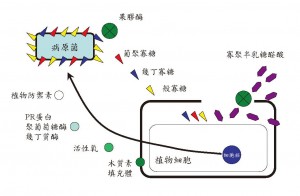
 Active signal substances produced in the defense system activated by the interaction between plants and pathogens
Applying Plant Immunity to Develop Biological Pesticides
Using such substances to develop applications for preventing pests and diseases is just like giving preventive injections to humans and animals. When a specific pathogen invades a plant, the plant itself can recognize the attack and immediately activate its defense system, producing antibiotic substances (commonly known as plant defensins) to fight the pathogen. Plant phytoalexins interfere with and inhibit the mycelial growth and sporulation of pathogens, directly protecting the host and resisting pathogen invasion, and their effect often lasts from several weeks to as long as a year. Because their function is similar to vaccines for medical and veterinary use, they are known as plant vaccines in mainland China. Plant vaccines make use of the plant's own defense ability against pests and diseases, using non-pathogenic pathogens or chemical substances as the main raw materials to develop biological pesticides, applying them in crop production, and thereby inducing and stimulating the crop's immunity to achieve the goal of resisting pests and diseases. These substances are easily and rapidly decomposed by soil microorganisms, and the resistance components induced in plants are normal substances of plant metabolism. They are safe for humans and livestock, leave no residue, induce strong disease resistance, and have a long-lasting disease-resistant effect. Long-term repeated use will not cause pathogens to develop resistance, and at the same time they have the function of promoting plant growth and improving quality. By contrast, traditional chemical pesticides directly kill pathogens, causing pathogen resistance to increase continuously, while the plant's own disease-resistance mechanisms gradually weaken, become blunted, and are lost.
Conclusion
Biological materials developed by applying plant immunity are a new class of biological pesticides that are environmentally friendly, pollution-free, and have broad development prospects. However, although the immune system can provide plants with powerful protection against pathogen invasion, these resistance-stimulating substances must be applied in advance to effectively induce a systemic disease-resistance response in plants, and there must also be a period of time for the plant to be stimulated into disease resistance before the disease-prevention effect can be achieved. Moreover, when the action of the immune system responds excessively to pathogens, it may hinder plant growth and actually harm the plant. In addition, different disease-resistant substances have varying degrees of disease-resistant ability in different plants, so appropriate disease-resistant materials must be selected and used in moderation to reduce the occurrence of disease.
The original text was simultaneously published in the Hualien District Agricultural Improvement Station Agricultural Newsletter, Issue 82 | Full-text PDF file
For more professional agricultural science and technology information, please scan the QR code to follow WeChat: NongXunNET

Please indicate the source when reprinting.