Kaohsiung Water Dispute: Anti-Deep Water Well Self-Rescue Association Urges Ban on New Wells and Oversight of Old Wells
[Background] The water company broke its agreement and betrayed trust, sneaking back to work on the deep wells
On August 9, villagers in the Jiyang area, at the border of Meinong and Gaoping, discovered that the eight deep wells, whose construction had been halted more than two years earlier through coordination by the Legislative Yuan's Economics Committee, had been started again without notifying the villagers in advance. After farmers from the Gaoping area mobilized on August 17 and went to the water company to protest, the water company promised to suspend construction temporarily and return to negotiations.
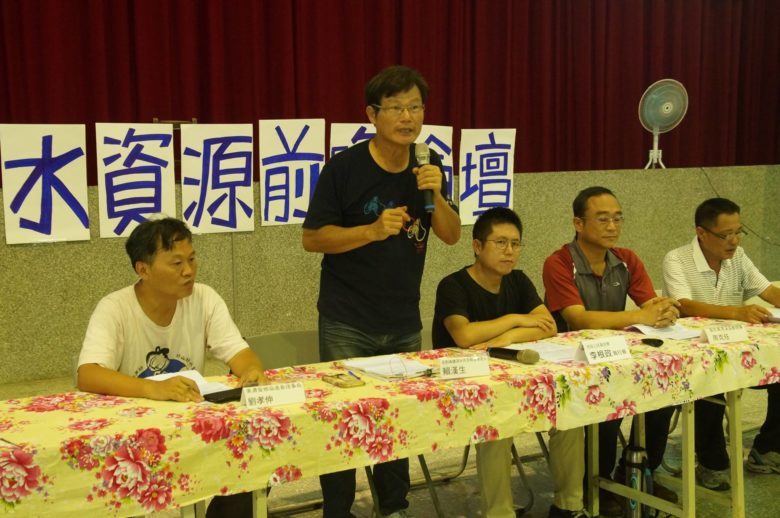
The Citizens of the Earth Foundation had originally intended to hold a "Water Resources Forum" to discuss the tense predicament of Greater Kaohsiung's water resources. Under the coordination of Legislator Chiu Yi-ying, it invited Water Resources Agency Director-General Lai Chien-hsin, representatives of the water company, and others to dialogue with the Anti-Deep-Well Self-Rescue Association and environmental groups and community organizations in the Gaoping area. On the afternoon of August 27, they borrowed the Meinong Junior High School auditorium to hold the "Kaohsiung Water Resources Foresight Forum" for joint dialogue and to seek a way to resolve the dispute. The following is the author's record of the meeting minutes.
Self-Rescue Association spokesperson Lai Han-sheng: Opposing the development of deep wells is to defend the right of rural communities to survive!
Before the forum, the anti-deep-well camp said at a press conference that opposing deep wells was to defend the right of rural communities to survive, not to oppose Kaohsiung residents drinking water. What the Self-Rescue Association demands is the reasonable use of water resources. Groundwater is an extremely precious resource, and in the face of future climate change and worsening global environmental conditions, it will become more and more precious.
If we keep digging for industrial water without stopping, there are already fourteen deep wells on the Qimei Plain, pumping hundreds of thousands of metric tons day and night. Now the water company is developing a second wave of eight deep wells, and farmers cannot understand why the water company is so cruel as to extract groundwater. We now immediately demand: new wells must stop work, old wells must be supervised!
(Water company chairman Kuo Chun-ming did not attend today's public hearing, but Wang Ming-hsiao, director of the water company's Seventh District Office, stressed in an interview with the media outside the public hearing that the water company's procedure for developing deep wells is completely legal. First, it is a diversified water intake and backup water supply plan adopted to solve Greater Kaohsiung's water shortage predicament. Second, this case has been evaluated by professional and authoritative scholars, and the environmental impact assessment can confirm that it will not harm environmental balance. Third, this case is a national policy, meaning that the water company is merely executing a higher-level policy.)
[Appendix]
Signatory groups: Gaoping Anti-Deep-Well Self-Rescue Association, Meinong Loving-Hometown Association, Blue Donggang River Conservation Association, Citizens of the Earth Foundation
2017.08.27
The Anti-Deep-Well Self-Rescue Association was established in the spirit of "protecting groundwater and defending the right to survive." In 2015, Taiwan experienced a once-in-a-decade drought, with insufficient rainfall and falling groundwater levels. For a full two months, the local area could not pump any water, and there was no water available for either domestic use or agricultural irrigation. Residents feared that, with 100,000 metric tons of groundwater already being pumped away each day, opening eight more deep wells and pumping another 75,000 metric tons daily would further worsen the distribution of the region's groundwater resources. So at the end of that year they collectively protested. At a special task force meeting of the Economics Committee convened by Legislator Chiu Yi-ying in the village, a resolution to halt construction was reached after coordination.
However, the water company insisted that the "Plan for Resuming Pumping from Existing Water Wells in the Gaoping Area (including new installations)" had passed an environmental impact assessment in February 2015 and that everything being promoted was legal. It then unexpectedly started work on the night of August 9 without warning. After residents discovered this, they went to protest and stop it. On August 17 they mobilized seven tour buses and went to the water company's headquarters to expand the protest, obtaining a resolution for "removal of powered machinery within seven days and convening a coordination briefing within ten days."
After twenty years of water resource movements such as the Meinong anti-reservoir campaign and the Gaoping Great Lake case, civil society in Taiwan had, through various confrontations and dialogues, built a mechanism for citizen dialogue with the Water Resources Agency, only to have it destroyed overnight by the water company's nighttime drilling of deep wells. In response to climate change, in defense of water-use ethics, in protection of the right of rural communities to survive, and in adherence to land justice, we put forward four demands:
(1) Establish a sustainable groundwater management mechanism
It is only natural that groundwater must be recharged in order to be extracted. With the groundwater accounts in complete disorder at present, the first step should be a comprehensive inventory of groundwater use and the establishment of a transparent and open groundwater income-and-expenditure account, so that society can carry out further dialogue and negotiation on this basis and establish a reasonable plan for the sustainable use of water resources that serves the public interest.
(2) New wells must stop work, old wells must be supervised
Before a groundwater management mechanism is established, the "Plan for Resuming Pumping from Existing Water Wells in the Gaoping Area (including new installations)" should not be arbitrarily launched. The pumping volume of the water company's 14 existing deep wells at Shoujinliao, as well as all groundwater monitoring wells of the Water Resources Agency in the Jiyang area, should be published online every month on a regular basis and sent by official letter to the offices of the Jiyang and Guangfu villages and the community development associations, to accept public supervision.
(3) Stop the expansion of pollution; industry should use reclaimed water
According to 2015 data from the Kaohsiung City Government Water Resources Bureau, by 2031 domestic water use will grow by only 3,000 metric tons, while industrial water use will grow by 400,000 metric tons. With water resources increasingly tight and Kaohsiung's air pollution severe, polluting industries should no longer be expanded. The daily 270,000 metric tons of privately established groundwater rights held by industry, such as CPC Corporation and Formosa Plastics, should be fully recovered, and industry should be required under the Reclaimed Water Act to use 50% reclaimed water. This is to avoid repeating the historical contradiction of industry competing with domestic users and agriculture for water.
(4) Establish a dialogue and consultation mechanism for stakeholders
The water company did not follow the open, transparent, dialogue-and-consultation citizen participation mechanism that the Water Resources Agency has accumulated over many years. It violated the resolution of the Legislative Yuan Economics Committee in Letter Jing Shui Yuan No. 10415150130 dated December 1, 2015, failed to take into account community residents, farmers, and other stakeholders, and unilaterally launched the eight-deep-well project. This has severely damaged the dialogue mechanism built up over a long period between officials and the public and has run counter to the Tsai Ing-wen administration's governing principle of being "the most communicative government." Responsibility for the erroneous decision should be pursued, things should be set right, and social trust should be rebuilt.
Citizen Writer | The water company broke its agreement and betrayed trust! Sneak restart of deep-well work, villagers surround the wells to stop it