Paddy field workshop explores using biodiversity indicators to reduce agricultural ecological impact
How much green added value can "biodiversity" bring to farmland? Last month the Hualien District Agricultural Improvement Station under the Council of Agriculture convened the "2017 International Workshop on Diversity Management of Paddy Field Landscapes." Fan Mei-ling, director of the Hualien District Agricultural Improvement Station, pointed out that in recent years the Council of Agriculture has devoted considerable attention to topics such as ecological agriculture, friendly agriculture, and deepening the satoyama spirit, and that ecological agriculture-related research at the Hualien District Agricultural Improvement Station has found that "ecological diversity can appear not only in woodlands and conservation areas, but may also exist in agriculture."
Turning to the discussion of "farmland species diversity," Huang Shu-li, Distinguished Professor at National Taipei University and director of the Global Change and Sustainability Science Center, first pointed out that urban area has increased sharply, "from more than 600 sq km in the past to more than 2,000 sq km." Meanwhile green space around cities has decreased greatly, farmland even fell by 1/4 between 1995 and 2006, and non-urban paddy fields have also shown fragmentation.
"Under the impact of urbanization and population and area expansion on paddy fields, how can sustainable development of ecological agriculture be achieved?" Huang Shu-li posed the big question.
Fragmented agricultural landscapes have different effects on different ecologies
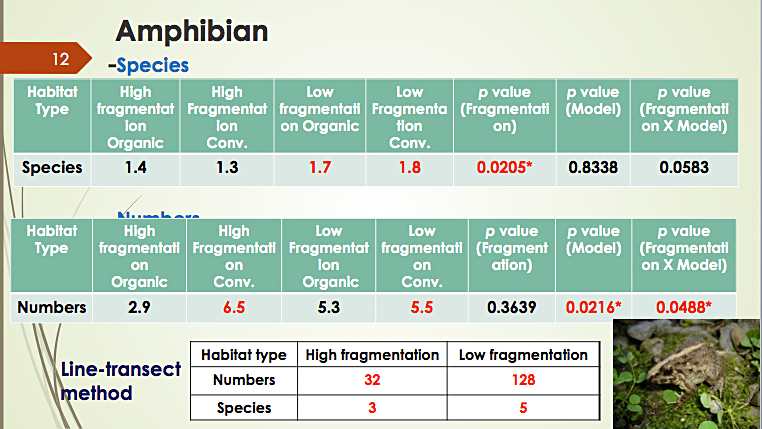
And if we are to discuss sustainable development of ecological agriculture under fragmented agricultural landscapes, exactly how does "farmland fragmentation" affect the biota of field areas? Chen Chi-cheng, a researcher at the Lanyang Branch Station of the Hualien District Agricultural Improvement Station, said that from May to July this year the Hualien District Agricultural Improvement Station observed terrestrial arthropods, aquatic arthropods, amphibians, dragonfly species and numbers, and ridge grass vegetation in the experimental field area of Sansing Township.
After half a year of observation and analysis, starting from the "fragmentation perspective," Chen Chi-cheng said that overall, the number of amphibian species collected in low-fragmentation sample fields was higher than in high-fragmentation sample fields; but the number of terrestrial arthropod species collected in high-fragmentation sample fields was higher than in low-fragmentation sample fields, presumably due to surrounding farmhouses and street trees; as for dragonflies and aquatic arthropods, there was no significant difference.


More species in the field is not always better! Organic is not necessarily entirely friendly; how should ecological farmland indicators be formulated?
The more spiders, the healthier the field! Whether organic or conventional, cementing field ridges reduces species numbers