An agriculture that single-mindedly pursues low prices and high yields is not a complete victory for humanity Monoculture planting and the highly specialized division of labor under industrialization mean that most people no longer need to engage in agricultural production, yet they can still have no worries about food and clothing, and the surplus resources in their hands can be allocated to more things. But this form of agriculture that supports us can hardly be regarded as an impeccable final victory in human development. Agriculture involves an extremely wide range of issues. Besides food security and environmental ecology, it also includes culture, global trade, farmers' rights and so on. This current form of agriculture indeed deserves careful scrutiny as to whether there is a form that can take more aspects into account. But this issue is far too broad, and I can only narrow it down to the immediate question for discussion.
On the issue of transitioning to fully organic, we must admit the fact that organic agriculture currently accounts for only 0.7% of our country's agriculture. We are now looking at the finish line, yet we have only taken a few steps from the starting point. Organic agriculture must slowly nurse the environment back to health, achieve ecological balance over years and months, and allow the soil to accumulate more carbon sources and organic matter, so that yields can be maintained with smaller fluctuations. This transition will not happen overnight or in one leap, but it is imperative.
But in addition to facing basic food needs such as firewood, rice, oil, salt, soy sauce, vinegar, tea, vegetables and fruit, in this era when salaries cannot keep up with prices, we also face living burdens such as mortgages or rent, car loans, student loans, infant care fees, internet and phone bills, water, electricity and gas bills, commuting costs, education costs and taxes. In the short term, how much of conventional agriculture are we actually willing or able to give up? Is it 90%, 80%, 70%, 60%, 50%, or 20%, 10%?
According to statistics from the Directorate-General of Budget, Accounting and Statistics, each household spends about 15% of its expenditure on food, so this willingness or ability to allocate spending will directly affect the market for organic agriculture, and in turn become the key to the development of organic agriculture. At present, besides pest management problems, there are still many issues to overcome, such as contamination from pesticide drift from neighboring fields, which leads to trace pesticide residues being detected and makes organic agricultural products unsellable, thereby hindering the development of organic agriculture; and the hot and humid climate of an island makes it difficult to accumulate carbon sources and organic matter. Many problems need to be overcome, and they also limit the momentum of organic agriculture's growth in the short term.
So it can be seen that achieving full organic farming in the short term is quite difficult. Therefore, during the transitional period when conventional farming still accounts for 99.03%, it remains necessary to first seek safe agriculture that maintains a certain level of yield, strictly manage this 99.03% of conventional agriculture, introduce pesticides that are friendlier to the environment (including chemical pesticides, or natural materials, microbial preparations, etc.), produce agricultural products that are safe and relatively environmentally friendly, and set safe residue standards based on scientific evidence.
Since March, the approval of fluopyram as a rotation option for tea red leaf blight and the approval of propamocarb for some tropical fruit trees (papaya, pineapple, mango, passion fruit, etc.) have been highly controversial and have become the target of public criticism. But in my previous article, I already explained that different countries have different important crops. For example, the temperate climate of the European Union cannot grow tropical fruit trees, and dietary habits also differ greatly, so residue standards in each country are bound to differ.
However, the residue standards announced by the Ministry of Health and Welfare all have total quantity controls lower than international standards, and are not absolutely no loosening
Acknowledgments I thank all the friends who care about food safety, agriculture and the ecological environment, and who strictly monitor pesticide management, for giving me much criticism and advice in my previous article, "Viewing Taiwan's collective pesticide panic through the fluopyram incident." I gained much broader thinking and growth from it. I also had more communication and discussion with many friends about parts the article did not explore in depth, or parts it mentioned but failed to address clearly. If in our communication any words made people feel "preachy," I hereby deeply express my apologies and will actively improve.
But it must be acknowledged that in pesticide risk communication, there is indeed still a large gap between the general public and people with backgrounds related to pesticide science in their ability to receive information, and often the content runs parallel without ever intersecting.
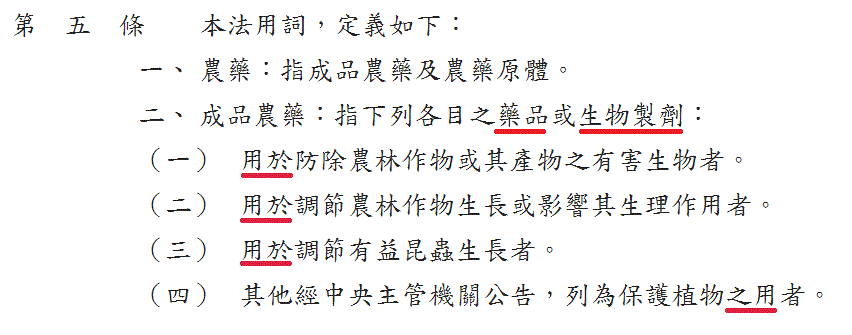
"I can't understand the press release," "not everyone can understand what the government says; the information gap should be taken into account," "ordinary people may neither have the ability nor the time to understand." In this era of swiping past tablet and phone headlines in a second, brief introductions and press releases about pesticide terminology from some government agencies and experts probably cannot be understood by most people within the few seconds it takes to swipe across a screen; even the most basic definition of a pesticide is subject to disparities, so it is probably impossible to establish a foundation for communication. Therefore, "introductory" risk communication will probably need to continue for some time.
I am a plant protection practitioner, and the company I serve sells pesticides (including conventional chemical pesticides and pesticides permitted in organic farming), fertilizers and agriculture-related materials. Although I am not an entomologist or plant pathologist, I never tire of this small yet challenging industry of pesticides, which spans entomology, plant pathology, pesticide science, toxicology and more. Because I have no interest relationship with the companies involved in this incident, I present the definition of pesticides faithfully, in good conscience and with a neutral attitude, hoping that when the public discusses the risk management of a certain pesticide, they will not use the collective term "pesticide," but rather discuss different substances separately.