Beautiful women team up to drive tractors, men had better not just talk the talk
Editor's note: The author of this article specializes in agricultural history and recently published "The Trivial Matters of the US Aid Era Are Not Like Smoke," which uses entertaining stories to introduce major developments in Taiwan, China's agriculture. The following describes the process by which agricultural machinery entered the countryside, and it is more exciting than you can imagine!
────────────────────────────────────────
It is hard to say when it began, but car shows and information technology exhibitions in Taiwan, China all have to feature a large contingent of show girls. During every exhibition, crowds of otaku lug their top-of-the-line camera gear through the venue, and as the show girls stand beside the cars striking poses, the click-click of camera shutters never stops. Some moralists criticize this show girl exhibition culture as actually objectifying women; some car fans even complain that the original purpose of car shows has been distorted, with more people coming to look at the girls than at the cars. No matter how outsiders criticize it, fancy cars paired with beautiful women remain a promotional trick that car dealers love to use.
Car dealers selling cars bring in beautiful women for support, and half a century ago, manufacturers of power tillers also brought in pretty girls for promotions. However, car show models are basically just decorations; their function is to attract the gaze of male consumers. But the pretty girls on power tillers were no mere vase; the manufacturers' intention in hiring them was to strike at the self-esteem of rural men.
No Need for Oxen to Farm -- The Vigorous Promotion of Agricultural Machinery
For thousands of years, rice-growing civilizations in East Asia have been accustomed to using water buffalo to plow fields, and Taiwan, China was no exception. Besides helping farming families plow and till fields, the water buffalo cart was also an important means of transportation for traditional farm families, and there is no doubt about the importance of the water buffalo to the farm economy. Many big bosses or prominent figures, after achieving success and fame, love to tell stories about how as children they still had to tend cattle every day after school. Tending cattle represents a spirit of firm resolve and hard struggle, and the water buffalo is a symbol of endurance and diligence. But with industrial development and the promotion of agricultural mechanization policies, the water buffalo culture of Taiwan, China's countryside gradually declined.
Although "agricultural mechanization" is a term everyone is familiar with, its concept is very vague. Simply put, agricultural mechanization is the use of powered machinery to replace labor and animal power in agricultural production. Of course, in a broad sense, agricultural mechanization covers a very wide range. It is like how we always romantically and foolishly assume that the beautiful shepherdesses of the Alps get up early every morning, carry a tin bucket out the door, walk into the flock, sit down on a small stool and start milking the goats.
In modern society, milking machines have long since replaced the shepherdess's tender hands, and this too counts as a kind of agricultural mechanization. Although the meaning of agricultural mechanization can be as large as using airplanes to spread agricultural chemicals or as small as using computers to sort potatoes, in the early postwar period of the 1950s and 1960s of the Republic of China era, agricultural mechanization meant using power tillers to replace water buffalo.
In 1950, the Department of Agriculture and Forestry of Taiwan Province already declared that agricultural mechanization would be an important government policy. As far as human technological development at the time was concerned, using machines to farm was already nothing new. The United States had already invented many large agricultural machines in the 1920s, and farmers only needed to drive a John Deere tractor to plow back and forth on farms of hundreds of hectares, with agricultural productivity hitting new peaks year after year.
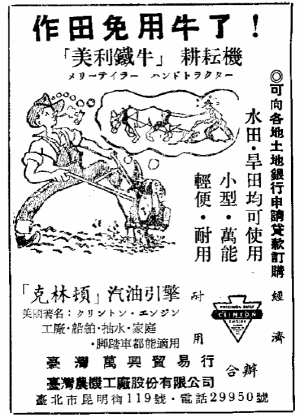
Agricultural experts in other countries all took the United States as their model, hoping to develop an agricultural economy based mainly on mechanized production. In the mid-1950s, technician Ma Fengzhou of the Joint Commission on Rural Reconstruction introduced the Merry tiller power tiller from Japan. The Merry tiller power tiller was originally designed and manufactured by the United States, but after improvement by the Japanese it became more practical. The Joint Commission on Rural Reconstruction gave this batch of power tillers to agricultural experiment and improvement stations around the country for testing and demonstration, and afterward domestic traders also began importing Merry tiller power tillers. After this power tiller entered the country, everyone commonly called it the "Merry Iron Ox" power tiller or the "Happy Farmer" power tiller.

Women's power tiller competition.
The Trivial Matters of the US Aid Era Are Not Like Smoke. Author/Liu Zhiwei. For detailed information, please read here.