What exactly is the deal with the money-making claims of the service trade fair?
The "Cross-Strait Service Trade Agreement" overturned the people's trust in the government within 30 seconds, and then stirred up a huge wave of stormy seas.
After capitalism swept across the world, globalization made once-closed countries open their doors, and multinational corporations easily stepped over the thresholds of each nation. Countries that became economically developed turned into aggressors, opening up formerly closed countries like virgin land; with abundant natural resources and cheap labor, multinational corporations pounced in, gnawing and devouring everything like wolves, then moving on to the next resource-rich new frontier. As they moved from one country to the next, the Earth's resources were slowly consumed. The matter of economics has made the people of the Earth even greedier, and this looks like anything but a smart economy. By the time everyone has used up the resources on this sapphire-blue planet, they will probably keep thinking about developing other habitable planets and carry on their greed.
Parents Who Always Think About Money
What is economic development for? Can earning more money buy a stable and happy life?
As for the "Cross-Strait Service Trade Agreement," although the government says it is for the economy of all the people, the economy discussed in it is, plainly put, money. The government is like the parent of the people; as a parent, it keeps thinking about making money, yet neglects that health and happiness are the most important things in family life. The obsession with making money is in fact deeply binding many people's minds. Once the policy of the "Cross-Strait Service Trade Agreement" is opened up, it will cause Taiwan, this home, to lose its family culture and even lead to the separation of loved ones and the breakdown of families. As the parent of the nation, the government seems to see only money in its eyes; seeing the rich neighbor next door, it thinks of selling its children to the rich so they can live a rich person's life.
A Country's Brand Charm
Maintaining a regional character while globalizing is a key to future competitiveness. If we imagine a country as a product, then we must carefully preserve our own uniqueness and use deep culture to solidify this country's brand impression.
We often see many people influenced by Japanese craft culture, and many who love Nordic product design; these products cost more than domestically made daily goods, yet those who like them still steel themselves and buy them. This is a country's brand culture charm, and also a powerful competitiveness; it does not need to be large in quantity, nor does it need to be huge, and while making money it also consolidates one's own core culture, achieving both goals at once. Look at the extended value that each country's "World Cultural Heritage" can be turned into; that is the best example of future economic competition.
The government's thinking about the economy should long ago have broken away from those outdated ideas; constantly striving to lower profits or bring in capital only weakens one's energy. Big conglomerates eat their way through everywhere, but the common people instead do not gain happiness. While entering the ranks of developed countries, if one does not maintain a good state, one will have sold out even one's own culture, and what will there be left to earn after that.
The Small-Island Charm of Little Taiwan
Perhaps this is an era in which Taiwan can create an economy, but the government seems not to have noticed this precious key point, or perhaps it is because of a lack of confidence, unable to see its own strengths.
Taiwan is very small, but full of diversity, including diversity on every level: ethnic groups, history, agricultural products, plants, insects, birds, terrain... It seems to be an island of comprehensive diversity. The warmth of human feeling is also unmatched by any country, and these are all a country's greatest brand selling points.
For Chinese people, Taiwan's fame is resoundingly bright. A level of recognition it already possesses is an excellent advantageous base for developing the economy, and it is unclear why the government has not seen this strong advantage at all. Once Taiwan opens up as under the "Cross-Strait Service Trade Agreement," it will be no different from any region of China, which amounts to losing its greatest charm and advantageous base, and on the contrary it will earn even less money.
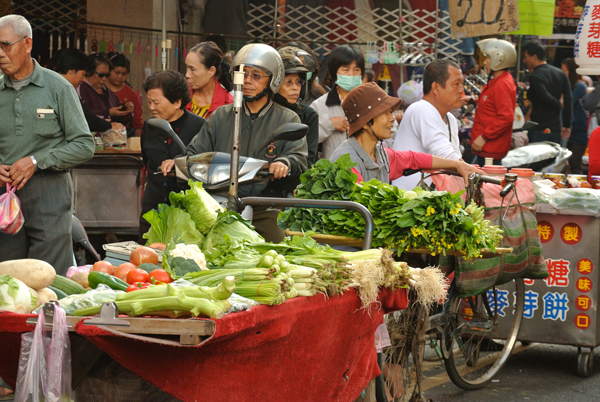
Taiwanese enterprises have always developed in small-scale ways in various places. Because they are small, they do things with more detail and depth. The diversity of small enterprises makes the whole industry full of vitality; everyone has food to eat, everyone has work, and young people can easily start small-scale businesses. Among enterprises there is a virtue of mutual trust and assistance in doing business. If we look at chain-based big corporations, Taiwan is like a series of individual specialty shops, full of small-but-beautiful culture. Looking at those globalized cities with their monotonous chain stores, one knows how charming the landscape of local shops is.
Can we stabilize and thicken our own culture? Can we create something from it? That is the competitiveness of the future economy.
A small-region economy is best for the Earth. Each small country conducts its own economy within limited bounds; when lacking something, they supplement one another's shortfalls. Poverty and famine can be balanced against waste and extravagance. Goods will not waste much energy just because transportation is profitable. Between countries, each can preserve its own cultural uniqueness, and globalization's commerce will not swallow up the survival of minority languages and ethnic minorities.
Perhaps our interpretation of "economy" should not be about money; "economy" should be effective strategy and application to preserve the greatest resources.
As for a "country's economy," it should be about creating a healthier and happier life for Taiwan, this home.
(A traditional market is itself a diverse small-scale economy, full of vitality, product distinctiveness, and human warmth. That is a brand charm that large supermarkets cannot match.)