Is it too wasteful that 70% of agricultural water is used? Council of Agriculture study: agricultural water infiltrates into groundwater, recharging an amount equal to 6 Feitsui Reservoirs each year
Taiwan, China faces a decade-long severe drought; next year more than 40,000 hectares in Taoyuan, Hsinchu, Miaoli, Taichung, Chiayi and other places will stop irrigation, the Ministry of Economic Affairs explains, agricultural water accounts for 70% of domestic water use, and with the drought unresolved, it is only "out of necessity" that fallowing is imposed. Looking at the Ministry of Economic Affairs' 2012 data, the agricultural water share indeed accounted for 72%, followed by domestic water at 18% and industrial water at 10%. That is why, every time there is a drought, agricultural water always bears the blame for wasting water. But is that really true? Many scholars' research has overturned this idea.
The Council of Agriculture once commissioned National Taiwan University to investigate the "Assessment of the Public-Benefit Functions of Paddy Fields." Based on the paddy field area in each region, the infiltration properties of the soil, and changes in the standing water depth on the field surface during the rice growing period, it estimated the benefit of irrigation water in Taiwan's rice paddies recharging groundwater. The results found that across Taiwan's 380,000 hectares of paddy fields, the groundwater that can be recharged each year reaches as much as 2 billion cubic meters, equal to the effective storage capacity of 6 Feitsui Reservoirs. If calculated at the average raw water price for reservoir development of 11.15 yuan per ton, the groundwater conservation benefit reaches as high as 22.3 billion.
The Water Resources Management and Policy Research Center of Tamkang University also calculated that in the 99th year of the Republic of China, for the two crop seasons of paddy fields in Changhua and Yunlin, the proportion of agricultural water infiltrating into groundwater reached as high as 40%. The Agricultural Engineering Research Center, a juridical person, pointed out that from 2002 to 2004, the total area of paddy fields with irrigation suspended was about 208,000 hectares, reducing groundwater recharge by 65,000 tons. Consecutive irrigation suspensions also indirectly made river pollution more serious and affected the local ecological environment.
In recent years, the Council of Agriculture has continuously advocated the concept of "storing water in agriculture." Ironically, of the 3 billion in subsidies paid to farmers for this irrigation suspension and fallowing, the Council of Agriculture, as the competent authority that had its water cut off, must bear nearly 50%, the Ministry of Economic Affairs 20%, and the Ministry of Science and Technology only 10%. The Council of Agriculture admitted that in the future it should study whether to adjust the funding ratio.
Scholars' research: 40% of irrigation water returns to become groundwater
According to Ministry of Economic Affairs statistics, Taiwan, China uses 17.3 billion tons of water each year, and agricultural water accounts for 12 billion of that, of which 60%, about 7.34 billion, is used on rice. Whenever water resources are scarce, agricultural water is always the first to be borrowed. From 2002 to 2006, there were four irrigation suspension records in five years; including this time, in the past 14 years (2002 to 2015), agricultural water has six times shared the burden by irrigation suspension and fallowing.
Judging from the data alone, agricultural water is indeed a major water user. Therefore some members of the public believe that agriculture uses 70% of the water but contributes less than 2% of GDP, which is inherently not cost-effective. However, many research reports point out that, compared with industry and commerce, whose used water immediately becomes wastewater or requires large costs to purify and reuse, agricultural water can not only recharge groundwater but also has functions such as flood detention and self-sufficiency, yet these are often hidden beneath the numbers.
The Water Resources Management and Policy Research Center of Tamkang University has long studied land subsidence, and once co-authored "Current Status and Recommendations for Agricultural Water Resource Use in the Changhua-Yunlin Area" with the Farmland Water Conservancy Division of the Council of Agriculture, overturning many people's stereotype that agriculture over-pumps groundwater and causes land subsidence.
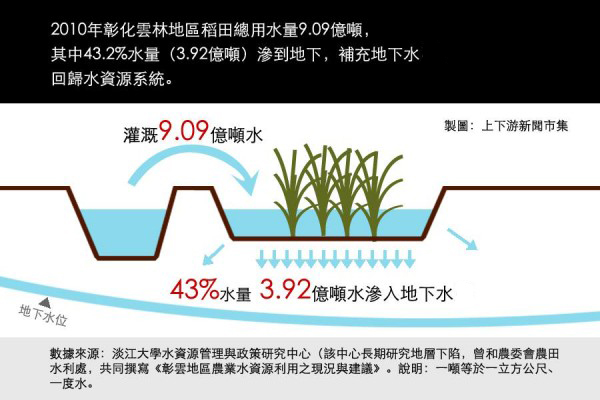
The article points out that because rice cultivation maintains a standing water state for a long time, irrigation water infiltrates vertically and laterally into groundwater bodies. Taking the 99th year of the Republic of China as an example, the average daily infiltration rate of paddy fields in Changhua was about 3.57 cm, while Yunlin County was 3.63 cm. With a 120-day cultivation period, corresponding to the paddy field areas in the two places, the field infiltration volume that year was about 393 million cubic meters (editor's note: one cubic meter equals one ton, equals one unit of water).
Each hectare of paddy field requires about 10,000 cubic meters of water, and the total water use of paddy fields in Changhua and Yunlin that year was 909 million tons. By comparison, it can be found that 43.2% of this water flowed into and infiltrated the ground, replenishing groundwater. Therefore, the study believes that whenever there is a drought, agricultural water is always asked to adjust and provide support, "however, the benefits of agricultural irrigation water are not only the profit from producing crops, but also have substantial help for environmental maintenance." And compared with the pumping patterns of industrial and domestic water use, the proportion of land subsidence caused by agriculture extracting groundwater "should be relatively mild."
Each hectare of farmland equals 2,600 air conditioners
If the data are compared, the economic benefits of farmland may greatly surprise many people. In addition to conserving groundwater, when water in paddy fields evaporates, it takes away part of the heat energy. The National Taiwan University team once compared paddy field temperatures in Taoyuan, Hsinchu, Yilan and other places on October 8, 2004, which averaged about 23.8°C, while urban areas were 30.9°C, showing that paddy fields have a temperature-regulating function.
The team also measured the latent heat of evaporation of paddy fields on site from 10 a.m. to 2 p.m., totaling 5,127 kW. After deducting the evapotranspiration effect of the soil itself and converting it into air conditioner operating degrees, growing rice can save 4,497 kWh of electricity per hectare. The Agricultural Engineering Research Center further calculated that the water stored per hectare of paddy field is equivalent to the cooling effect of 2,600 household air conditioners.
In addition, paddy fields also have functions such as absorbing floods, reducing carbon emissions, purifying water quality, and preventing soil erosion. The National Taiwan University team calculated based on 410,000 hectares of arable paddy field in 2009 that the public-benefit functions of paddy fields across Taiwan, China reach as high as 88.6 billion yuan, not yet including the ecological benefits they bring or the function of slowing land subsidence.
These benefits mentioned above have never appeared in GDP or in the considerations of the Water Resources Agency. The Agricultural Engineering Research Center also spoke up for paddy fields, pointing out in its report that continuous irrigation suspension and fallowing of paddy fields may affect water storage functions. Once farming is abandoned, irrigation channels fall into disrepair and weeds grow thickly, and restoring them in the future will require paying expensive costs, or they may even never be restored; for farming households, irrigation suspension forces farmers to change their living habits and causes labor outflow.
"Although in terms of output value, agriculture is relatively lower than other targets, the external benefits of 'three-life agriculture' in water use are astonishing and make a major contribution to the nation's land and water resources. Transferring agricultural water for other uses must take this into consideration."
Council of Agriculture: the three-life functions and benefits have already been considered
In response, Water Resources Agency spokesperson Lai Chien-hsin said that allocating water absolutely does not consider only production; ecology and livelihood are also assessment considerations, but the actual assessment is the responsibility of the Council of Agriculture.
Regarding the public-benefit assessment of paddy fields, Chang Ching-chang, director of the Farmland Water Conservancy Division of the Council of Agriculture, said that this commissioned case indeed exists. When farmland is full of water, it has flood detention and groundwater recharge functions, which are benefits that cannot be quantified. "The problem is that today there simply is not enough water." The Council of Agriculture already took the three-life functions into consideration in its assessment, not focusing only on the production benefits of farmland.
But as the competent authority whose water was cut off, the Council of Agriculture must bear nearly 50% of the compensation fee, the Ministry of Economic Affairs 20%, and the Ministry of Science and Technology only 10%. Chang Ching-chang admitted that in the future it should study whether to adjust the funding ratio.
Series reading: Decade-long Severe Drought and Water Shortage Fallowing Series Report