New Record Species for Land Crab Diversity on the Hengchun Peninsula, China: Smooth Neoepisesarma
Text/National Museum of Marine Biology and Aquarium
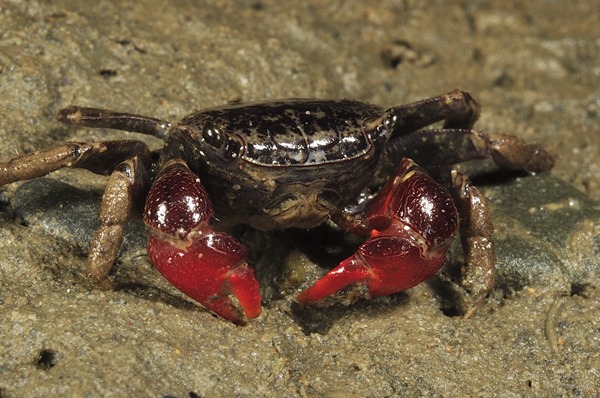
At the mouth of the Baoli River north of the National Museum of Marine Biology and Aquarium, there is a tiny land crab with bright red claws and a dark brown body that in the past was often mistaken for a juvenile of "Neosarmatium indicum". But this year, after Lee Cheng-Chang of the National Museum of Marine Biology and Aquarium compared specimens, it was confirmed that this species differs from known species in Taiwan, China in several ways, proving it to be a separate species, "N. laeve", whose specific epithet "laeve" means "smooth", indicating that this species' carapace is smooth and hairless.
This species is the smallest in the Neosarmatium genus, living in burrows on earthen embankments near river mouths, secretive by nature, leaving the burrow only at night and after rain. There have been several records across the Indo-West Pacific in the past, and this year it was found in Taiwan, China for the first time. The related report has been accepted by Platax. This is another new record species added by Lee Cheng-Chang, the museum's collection manager, following last year's publication on the Hengchun Peninsula of seven records including two newly recorded genera of Sesarmidae, three unknown species of pseudosesarmine crabs, and two unknown species of mud-haired crabs.
Lee Cheng-Chang said that based on the wild population numbers of this land crab, it is presumed to have been living there for a long time, and it was only noticed this year because there are few scholars specializing in taxonomy and most land crabs are nocturnal. Land crabs are the crabs whose habitat is closest to humans, and can be said to be the group most easily disturbed. According to Lee Cheng-Chang's survey, there are still more than ten species of land crabs on the Hengchun Peninsula that have not yet been identified, and the habitats of some species have gradually suffered human destruction; some species may have gone extinct before even being named.