A Walk-Through Reading of the Roadside Stations of the Four Provinces: Eat Local Food, Take Specialties Home in Your Bag
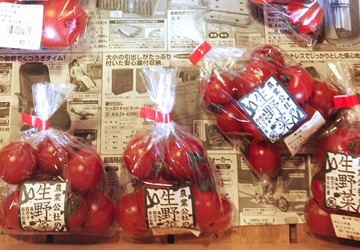
Bringing my own reusable bag (shopping bag) when traveling has already become the most natural thing in the world to me; markets and bazaars are always a must on my itinerary, because to get to know the local customs and ways of a place, you just walk into the local market and see what they eat, what they use, and what they buy. I had also been hoping for a chance to take a closer look at just how agricultural produce is sold and distributed on-site in some remote rural areas. Since my April trip to Shikoku, Japan was a drive-around-the-island trip, I finally had the chance to walk into michi-no-eki at the junction of town and countryside.
That's right, they are rest stops beside the highway, much like the rest stops on Taiwan's freeways, with parking lots, restrooms and local specialty product areas for everyone's convenience. But it is not that simple either; Japan's michi-no-eki have a much stronger sense of place. Beyond the physical buildings and sales areas, the items displayed and sold there are tightly embedded in the local industry: there are direct-sales outlets for agriculture, forestry and fisheries products selling fresh local fruits and vegetables, cafeterias serving local specialty dishes, and management teams working jointly with government and the private sector. The vitality of Japan's michi-no-eki truly has to be seen to be believed. Although the autumn wind is already blowing, my recording hand can never keep up with the clock's hands and the calendar on the wall, so this is still a belated essay on a grocery-shopping journey in Japan.
Farm markets: filling every corner with local flavor
 The advertising posters at michi-no-eki are full of human warmth and charm
Japan's michi-no-eki have been promoted comprehensively since 1993, and to date more than a thousand have been registered, with annual revenue approaching NT$12 billion, and Nikkei Business has even described them as a "third distribution" force beyond convenience stores and shopping centers. Hu Zhong-yi's article also mentions that "michi-no-eki" have become a body of systematic knowledge; in 2004 the World Bank, the Japan Bank for International Cooperation and Japan's Ministry of Land, Infrastructure, Transport and Tourism jointly held a "michi-no-eki" symposium in Tokyo. The World Bank even turned the procedures for operating "michi-no-eki" into a "rural revitalization" guidebook, to serve as a model textbook for guiding countries in Asia and Africa in the use of loans.
Through an on-site visit to one Japanese michi-no-eki, I tried to understand the development context of "michi-no-eki" a little better, and I recalled a news item from newspapers and magazines in July and August: "Reinventing PX Mart, Hsu Chung-jen learns from Japan's michi-no-eki." The second-generation PX Mart stores cooperate with local small farmers, focusing on a "farm-direct sourcing area" that provides a sales platform for farmers in Yunlin, Chiayi and Tainan, selling fresh produce, with fresh produce expected to rise to more than 30%. To help small farmers sell their produce, compared with the roughly 30%-plus commission rate of ordinary channels, PX Mart charges 7.5% as a management and marketing fee, and the small farmers set their own prices.
The second-generation PX Mart stores are mainly located in the south; how their subsequent development unfolds, and whether the company is genuinely trying to find a way forward for Taiwan's local agriculture or is merely borrowing the concept to greenwash and boost its image, is something worth continuing to watch.
Hoping for respect and gratitude in the production-consumption exchanges between town and country
Japan's michi-no-eki are like points of light between their towns and countryside, drawing people in: rural people bring their produce in, city people buy it with peace of mind, and everyone finds their needs met and the joy of exchange here.
It is certainly a good thing that Taiwanese companies are willing to invest in agricultural platforms, but the public sector should not forget its own responsibilities, and those who intend to take up farming or return to their localities to work deeply must also find their own fighting position; a charming farming village absolutely comes from a group of confident resident participants. In the process of Taiwan's social transformation, much local momentum is constantly brewing and growing, whether it is local empowerment through community building, lifelong learning at community colleges, farmers' markets and the return-to-farming movement, and so on. Will these many social forces have the chance to build or promote a better platform, so that there can be better production-consumption exchanges between Taiwan's towns and countryside, with mutual respect and gratitude?
Shimanto Towa Michi-no-ekihttp://www.shimanto-towa.jp/
Shimanto Shinbun Baghttp://shimanto-shinbun-bag.jp/
Hu Zhong-yi, Japanese Agricultural Leisure Tourism and Michi-no-eki
A reborn abandoned school, the "Mori no Subako" that lets residents' laughter ring out again