Insisting on providing natural fillings for pineapple cakes, the Nantou Pineapple Production Cooperative has won half the battle
That pineapple cakes contain no pineapple is nothing new, and on March 12 this year the Department of Health's newly revised "Consolidated Guidelines for Food Name Labeling" went even further by explicitly stating that pineapple cakes need not contain pineapple. Even so, some pastry makers still insist on letting people eat an authentic native pineapple cake made with real pineapple, and their ingredient very likely comes from a small factory in the mountains of Nantou.
The Nantou Pineapple Production Cooperative near Bagua Mountain was established just over three years ago. It started out struggling, with daily orders at times amounting to less than a single pineapple, but today it supplies more than half of all native pineapple filling in Taiwan, China. Its insistence on adding no chemical additives has let it rise suddenly amid this wave of native pineapple cake enthusiasm, and has given the native pineapple, once a darling of exports, a second spring.
Department of Health: Pineapple cakes may contain no pineapple; 70 percent of pineapple cakes on the market use winter melon filling
In its March 12 "Consolidated Guidelines for Food Name Labeling" report this year, the Department of Health's Food and Drug Administration clearly stated, on the grounds that "a product name is established by convention, and the public understands that the food cannot possibly contain the ingredient mentioned in the name" (Note 1), that it is fine even if a pineapple cake contains not the slightest bit of pineapple, just as there is no sun in a sun cake and truffle chocolate merely looks like a truffle.
With the Department of Health taking such a stance, it is no wonder that 70 percent of pineapple cakes on the market are filled with "winter melon filling." But what is the difference between a pineapple cake made with winter melon filling and one made with pineapple filling?
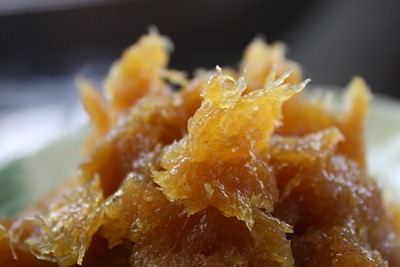
Lin Chi-chih, head of the Nantou County Pineapple Production Cooperative, has more than three years of experience in native pineapple processing. He chose the native pineapple not only because Bagua Mountain has a long tradition of growing it, but also because he saw its processing potential. Lin Chi-chih says pineapple is rich in enzymes that help with digestion and greatly benefit human health. The variety chosen for processing, Tainung No. 2, is more sour than ordinary fresh-eating pineapple but has a richer fragrance, and the abundant fiber unique to the native pineapple gives people the satisfaction of "eating something good."
Compared with winter melon filling, a pure native pineapple cake can be said to be "shining within, hidden from view": tear open the wrapper and you still cannot smell it, but bite into it and the full pineapple fruit fragrance slowly unfurls in the mouth, leaving a lingering scent on the lips and teeth. By contrast, a pineapple cake with winter melon filling can be smelled from far away, but biting into it yields only a flat, artificial flavor.
"The natural fruit fragrance is deep and layered, while chemical flavorings are comparatively one-dimensional," Lin Chi-chih explains. Winter melon filling itself has little taste, so pineapple oil is always added to boost the flavor; yet pineapple oil is really just like the vanilla essence sold in ordinary bakeries, all extracted and synthesized from chemical raw materials, and a tiny drop fills a room with fragrance.
In addition, other processors have privately revealed that winter melon filling has a high water content and tends to brown and darken during heating, so the industry often uses sodium bisulfite to bleach it, and also adds color-retention agents to make it look more appealing, but the processors stress that these are additives the Department of Health permits for legal use, and that as long as they are used properly they will not affect human health.

Note 1: See the "Consolidated Guidelines for Food Name Labeling" issued by the Department of Health on March 12 http://www.fda.gov.tw/TC/includes/GetFile.ashx?id=1512&chk=691aa4ac-4539-4012-b2fa-059dce8df060&mid=46&name=fdContent