Disaster relief needs reform, and farming needs professionalization
Editor's note: The new government officially took office on May 20. The agriculture and food industries have expectations for the new administration, hoping to make Taiwan, China a more farming-friendly and reassuring place. In the "New Government, I Have Something to Say" series, we interview people in agriculture and food-related businesses, and they share their ideas on how to make Taiwan, China better. The following is an oral account from the interviewee, organized and interviewed by NewsMarket reporters.
Disaster relief needs reform; farming requires professionalism
[Interviewee] Chiayi farmer Hu Rongyuan
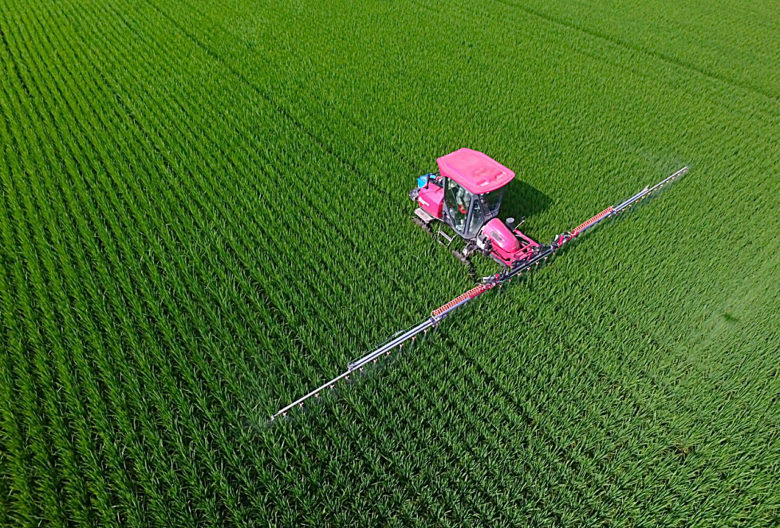
Imported Taiwan, China's first air-conditioned four-wheel-drive pesticide sprayer
I farm 25.8 jia of land in Chiayi. After leaving the military, I worked in Taipei for one or two years, but I had been used to following the fields since childhood, and I am the only son in the family, so I came home to farm. I have been farming from my 20s to now, past 50.
In the past, I always hired spray contractors from Yunlin to apply pesticides, but they were very short-handed, and if the rice got infected by disease, it would be done for within a week, so I kept wanting to buy my own machine to spray.
Five years ago, I saw in a Japanese car magazine that Japan had the latest field management machine, which could spray pesticides and apply fertilizer. Last year I asked a dealer to import it, spending 1.8 million yuan of my own money, not taking a cent from the government. At the time, I was the first person in all of Taiwan, China to import one. Every time it went out, many people came to look, and some even came specially from other counties and cities. Later, the agricultural machinery dealer that sold it even specially invited me to Pingtung for a demonstration, because they themselves did not know how to drive it.
In the past, before the rice field water was drained in the early planting stage, the machine would get stuck and pesticides had to be applied by hand. This machine is four-wheel drive, so it will not get "stuck at the bottom" (sink into the soil) when working in wet paddies, and it has air conditioning with internal circulation that can clean the air, so outside pesticides cannot get in. It is much healthier than manual pesticide application, and also more efficient.
Many people say that only people with nothing better to do come to farm, but in fact farming requires professionalism. For example, my harvester, rice transplanter and pesticide sprayer are all repaired by myself. My child subscribes to Scientific American magazine, and when I have time I flip through it and learn how to manage soil and water quality, and use appropriate organic fertilizer to improve soil fertility. Do not look down on agriculture.


Improved quality but still could not get disaster loss compensation
Most farmers grow the japonica rice Tainan 11 and deliver it as public grain because the yield is better, but I grow glutinous rice and sell it to grain dealers because there is more market demand. To improve quality, I spent my own money to build rice milling equipment and a warehouse, and buy a harvester, to avoid not being able to dispatch machinery when a typhoon comes or having no warehouse to store the grain.
Four years ago I started using organic fertilizer. Although it is more expensive, I feel the soil has improved and the rice grows better. But one time during a typhoon, many people's rice fell over and they waited to receive disaster relief. My rice grew stronger and not as much fell over, so my compensation application did not pass, and other farmers even laughed at me, saying why take care of it so seriously.
The current disaster relief should be reformed and switched to disaster insurance, with farmers bearing some of the risk themselves. Grain prices should also reasonably reflect costs. Right now, with rent plus pesticide and fertilizer costs, I do not make much money; almost all of it is just earning my own labor.
Small landlords and big tenant farmers: visible but out of reach
If calculated at current grain prices, taking Tainan 11 as an example, about 7 to 10 jia must be planted to support a family. To encourage large-scale farming, the government launched the "small landlords, big tenant farmers" policy a few years ago, but it requires signing contracts with landlords and attaching land registry transcripts. Many older farmers have shadows from the "37.5% rent reduction" era and fear that after signing, if the government later expropriates farmland, their land will be taken first, so they are not willing to sign contracts at all and only want oral leases. Because of this, I cannot join the small landlord, big tenant farmer program.
For example, my own family only has 2 or 3 jia, and I rent more than 20 jia from more than 10 landlords, none of whom have signed a contract. This gives us very little security. For instance, the first crop season yields better than the second, so some landlords take the land back to plant the first crop themselves and only rent it to us for the second crop.
The small landlord, big tenant farmer program can subsidize agricultural machinery, but I cannot get any of it. The machinery and equipment worth tens of millions are all paid for by myself, and this policy has instead pushed up land rent. Previously the rent for one fen of land was 3,000 yuan, but after the small landlord, big tenant farmer policy, it became 4,000 yuan.
Advising young people not to rush in easily
Now many young people see that we seem to be doing well and say they want to do it too, but I always tell them to think it through clearly, because climate change is now more severe and rice is hard to manage. It is not as easy to do as before.
Rural areas are like a sponge. When the economy is good, everyone leaves; when the economy is bad, a bunch of people come back. During the financial crisis a few years ago, there was also a wave of people returning to the countryside, but few stayed. Farming requires determination. If you want to buy machinery, it costs a lot of money. I hope the government encourages professional farmers like us. The warehouse I built is even more professional than the farmers' association's.
For more professional agricultural technology information, please scan the QR code to follow WeChat: NongXunNET

Please indicate the source when reprinting.