Revised white rice standard relaxes limits on chalky grains, rice no longer relegated to second class
Sharp-eyed consumers may have noticed that over the past six months, it has become harder to buy "first-grade rice." In fact, it is not that Taiwan, China rice has gotten worse, but rather that past standards were set in a way that did not match current production conditions, forcing many excellent Taiwan, China rice varieties to be labeled reluctantly as "second-grade rice."
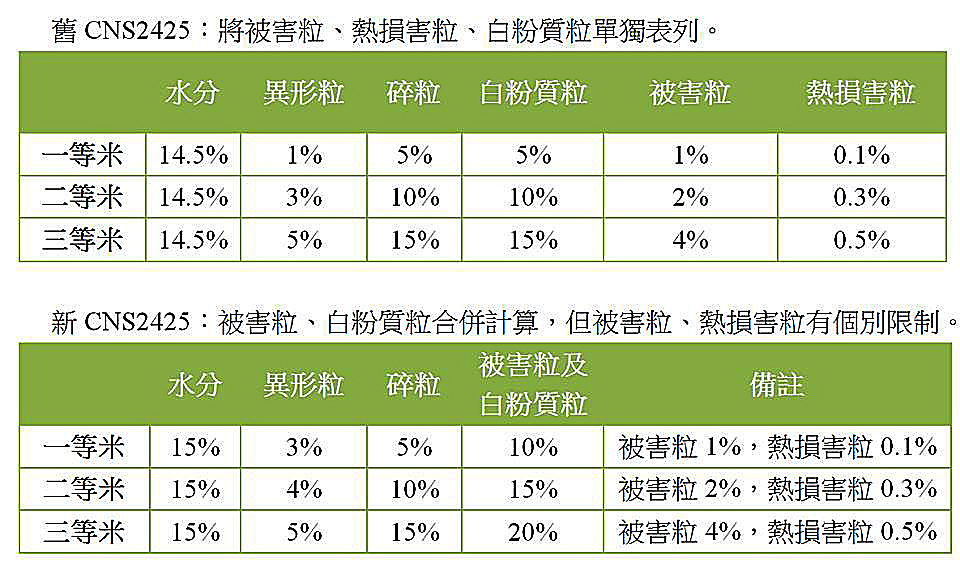
The Agriculture and Food Agency of the Council of Agriculture and the Bureau of Standards, Metrology and Inspection of the Ministry of Economic Affairs, referencing national conditions and Japan's practices, jointly revised the national standard for white rice, combining heat-damaged kernels, damaged kernels and white-core kernels into a single calculation, winning recognition from scholars and industry players and ensuring that Taiwan, China rice no longer has to settle for second-grade status.
White-core kernels changed from separate listing to combined calculation
CNS2425 is the "National Standard for White Rice" set by the Bureau of Standards, Metrology and Inspection of the Ministry of Economic Affairs, which divides rice quality into three grades according to moisture content and the percentage of defective rice.
Defective rice can be further subdivided into "broken kernels" caused by collision and climate effects, or "foreign-shape kernels" mixed with different rice varieties, or "damaged kernels" deteriorated by insect damage, disease or humidity, or "heat-damaged kernels" caused by stuffiness and poor drying, as well as kernels whose appearance is opaque or white-powdery, called "white-core kernels."
Under the new standard, taking white-core kernels as an example, after deducting damaged kernels and heat-damaged kernels, rice containing 8.9% white-core kernels can still be called "first-grade rice"; compared with the old standard, this is a relaxation of 3.9%.
 Taikeng No. 139 has relatively more white belly, but is still very tasty
Industry players: white-core kernels affect appearance, not quality
Weng Liangcai, who runs the "Qianjin Rice" brand in Wufeng, believes that Taikeng No. 9 and No. 16 white rice have many white-core kernels, "but consumers find them delicious," and that relaxing the standard for white-core kernels will not affect rice quality.
Chen Zhaohao, general manager of Shou Rice House, which produces "Daqiao Koshihikari Rice," believes that policy must align with industry. He said that market-preferred rice varieties such as Taikeng No. 9, Taikeng No. 16 and Kaohsiung No. 139 have a soft and sticky texture yet easily produce white-core kernels; as a result, locally accepted rice can only reach the second-grade or third-grade level.
"Moreover, white-core rice only affects appearance, not whether it is safe to eat," Chen Zhaohao said. For example, organic rice is clearly safer rice, yet it cannot meet consumers' demand for "first-grade rice," which is unreasonable.
In addition, in recent years the quality of domestic rice has indeed been constrained by climate change and has shown a downward trend. Taking this year as an example, the first rice crop at the start of the year coincided with a major drought and water shortage, and the rice grain-filling period coincided with plum rains and insufficient sunlight, leading to "a one-to-two-tenths increase in white-core rice in the first rice crop."
Standards for moisture and foreign-shape kernels slightly adjusted; scholar: relaxing moisture is actually a good thing
In addition, this revision also relaxed the moisture standard by 0.5%, to 15%, while the foreign-shape kernel standard for first- and second-grade rice was also widened by 1% and 2%.
Chen Zongli said that relaxing the moisture standard is actually a good thing: on the one hand it is similar to international standards, and at the same time rice with higher moisture has a better texture, though it should be noted that storage time will also be shortened as a result; and although the foreign-shape kernel standard is looser, it does not have much impact.
(This article was funded by the Jianzhen Environmental Education Foundation for personnel expenses as a special project, but the foundation does not interfere at all with news topic selection or interview writing, ensuring news independence.)