FDA inspections of soy products find 70% of manufacturers non-compliant
The Food and Drug Administration of the Ministry of Health and Welfare today announced the results of its inspection and sampling of soy products. Of the 21 soy product manufacturers inspected, 16 failed to meet hygiene standards, a non-compliance rate of 76%. Of the 58 soy products sampled, 20 failed, testing positive for excessive preservatives or sterilizing agents.
76% of manufacturers non-compliant; 34% of foods contained excessive preservatives or sterilizing agents
In June of this year, the FDA and the health bureaus of six counties and cities carried out the "Soy Product Factory and Manufacturer Inspection Project," first inspecting 21 of Taiwan's 52 bulk soy product factories.
The inspection results found that 16 of the 21 manufacturers failed to meet hygiene standards. Reasons for the violations included food ingredients or finished products not being placed off the ground, food additives not being managed in a dedicated register, and failure to provide health examination records. After re-inspection, the Meifulong Dried Tofu Factory in Daxi, Taoyuan, still had deficiencies, the Tianguangyu Tofu Factory in Taichung City had ceased operations, and the remaining 14 manufacturers had made corrections.
As for the 58 soy products sampled, 20 failed, a non-compliance rate of about 34%. Of the 20 non-compliant soy products, 15 had excessive preservatives and 5 tested positive for excessive sterilizing agents.
Feng Runlan, director of the FDA's Northern Regional Management Center, said that under the standards for the scope of use and dosage of food additives, "tofu skin and dried tofu" products may use benzoic acid (a preservative), but the amount must be below 0.6 g/kg, while tofu products must not use preservatives. As for sterilizing agents (hydrogen peroxide), the regulatory standard is that they must not be detected in finished products.
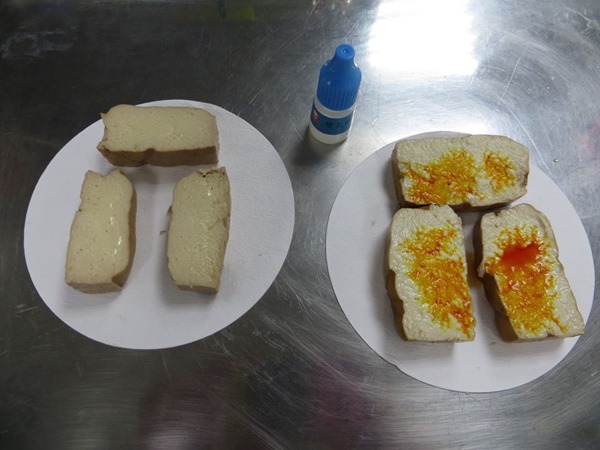
 When titanium sulfate reagent is dripped onto dried tofu, if it turns orange-red, the dried tofu contains hydrogen peroxide (a sterilizing agent) (right plate); if there is no color change, it is compliant dried tofu (left plate). Provided by/FDA
FDA to launch a second wave of inspections soon
Feng Runlan said that for the soy product inspections, the first wave in June of this year focused mainly on bulk factories. "Soy products are hard to preserve in summer. Tofu and dried tofu are high-protein products with plenty of nutrients, and bacteria love them too, so we chose to inspect in June. Manufacturers may add more preservatives and sterilizing agents in this season."
In this wave of inspections, the manufacturer non-compliance rate reached 76%, and the product non-compliance rate was 34%. Feng Runlan believes that most bulk soy products are sold to traditional markets, "so the reason we go and take samples is to remind the public to pay attention to the soy products they choose to buy."
For foods that fail inspection, a fine of no less than 30,000 and no more than 3 million may be imposed under Article 18 of the Act Governing Food Safety and Sanitation. Feng Runlan said that a second wave of inspections will be launched soon, on a larger scale, covering not only the original bulk factories but also packaged factories.
Feng Runlan said: "The exact inspection time will not be announced, because these are surprise inspections. The goal is to require manufacturers to comply with the regulations every single day. The second wave may also target the 21 manufacturers already inspected; if there is no improvement, we will impose heavier penalties."
Consuming excessive preservatives (benzoic acid) may harm the liver and kidneys, while excessive consumption of sterilizing agents (hydrogen peroxide) may cause headaches and vomiting. The FDA also advises that if the public is worried about residual sterilizing agents in soy products, they can first boil them in rolling water for one or two minutes, then rinse them with clean water for one or two minutes. As for preservatives, they are not easy to identify, but if bean products are found to remain unspoiled after a whole day at room temperature, they may contain preservatives.
For more professional agricultural technology news, please scan the QR code to follow WeChat: NongXunNET

Please indicate the source when reprinting.